The insurance industry is one of the few industries under constant pressure between customers’ expectations and strict regulatory demands for accuracy and compliance. And insurance companies are bearing the burden. As a result, many companies are turning to AI insurance agent development to build agents that not only assist or analyze but also act.
AI in insurance is making significant transformations for both insurance firms and customers. These insurance AI agents are capable of handling entire workflows on their own, but within the organization’s pre-set rules.
Agentic AI leverages advanced machine learning algorithms to analyze a vast amount of data accurately to make crucial decisions related to automated claim processing, optimizing the underwriting process and improving operational workflows. Here, we will explain the use cases, benefits, average cost and process of building AI insurance agents.
Understanding the Role of Agentic AI in Insurance
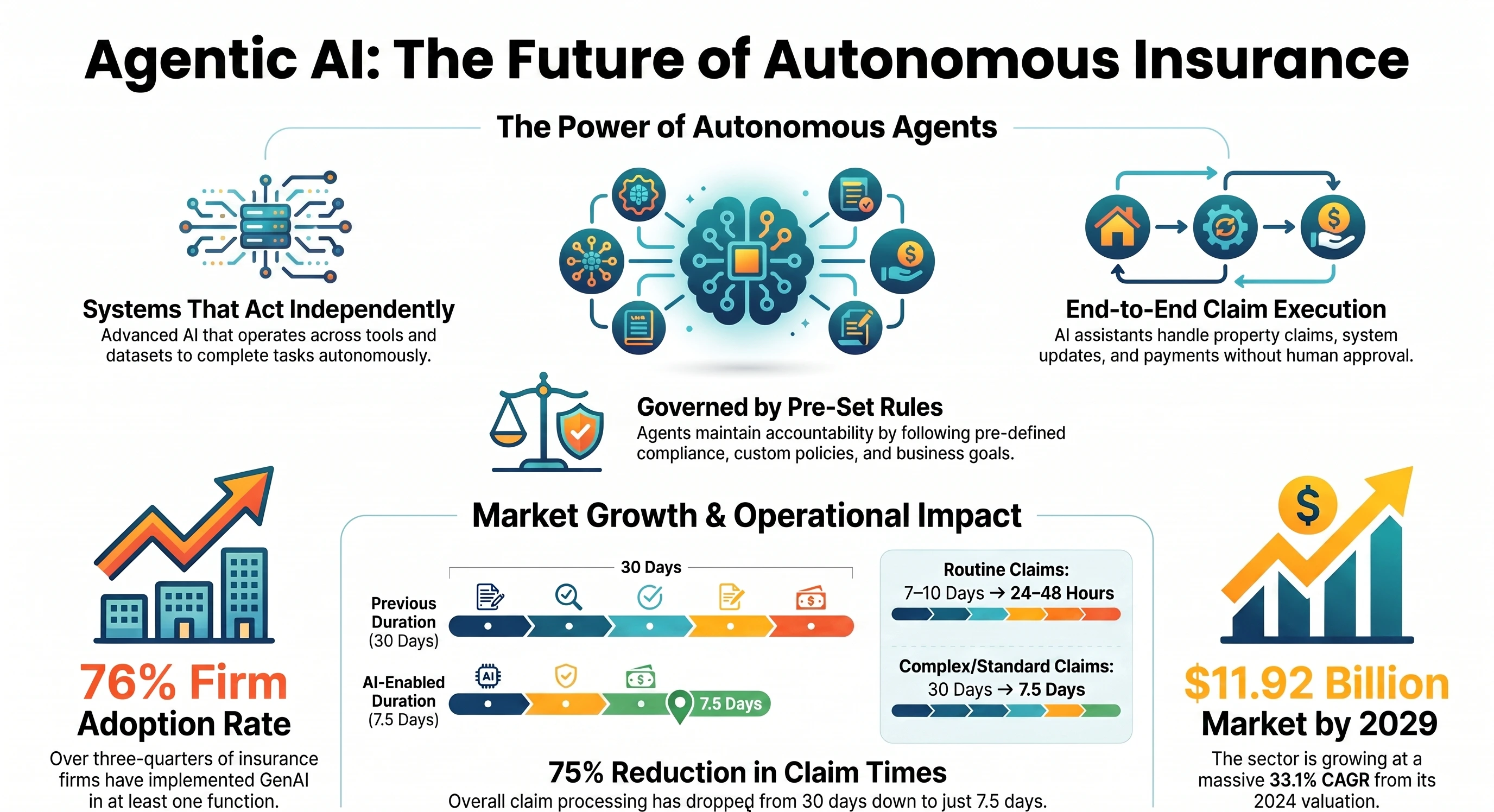
Agentic AI refers to advanced AI systems that have the capabilities of acting on their own. They can operate across tools and different datasets to complete tasks within the organization’s internal policies and pre-set rules that mainly include compliance rules, custom policies and business goals.
The role of these AI agents in insurance can be defined as advanced autonomous AI systems that can execute complex insurance processes. Tools like Conversational AI for Insurance are increasingly being used to power these policyholder-facing interactions, handling everything from claims updates to routine queries in real time.
As we all know, insurance is a highly regulated industry, so to maintain the balance between automation and accountability, these agents are pre-trained on existing data and follow pre-defined rules.
At the same time, the AI in the insurance sector has been witnessing significant adoption. The global AI in insurance market was valued at just $2.85 billion in 2024, which is expected to grow at a CAGR of 33.1% to reach a whopping $11.92 billion by 2029, according to Research and Markets.
Meanwhile, 76% of insurance firms have implemented GenAI capabilities in at least one business function. And because of these capabilities, the claim processing times have been reported to be drastically reduced by 75% from 30 days to 7.5 days, and routine claim processing has been reduced to 24-48 hours from 7-10 days.
Benefits of AI Agents for Insurance Companies
The most appreciated feature of agentic AI is making workflows fast and reliable. The advanced integration capable of handling complex workflows helps insurers drive measurable outcomes across the business.
Fairer Pricing Decisions
Agentic AIs are capable of assessing and analyzing vast and diverse datasets to get insights for more accurate risk assessment. These capabilities help underwriters move beyond broad demographic groups and set pricing based more on individual situations. For instance, two customers with the same vehicle models might have different premiums based on geographic weather risk or mileage patterns.
Faster Personalized Service
Insurance AI agents can offer faster turnaround times for issuing new policies or resolving claims. For example, if a customer files a travel insurance claim for lost baggage might receive real-time status updates and payout even in a single day with no human agent involved.
Significant Cost Savings
With AI agents, insurance companies can automate routine tasks like claim routing, data entry, or document verification to reduce operational costs, increase efficiency and prevent mistakes due to human errors. For example, a single AI agent can handle double the volume of tasks without hiring new staff.
Comprehensive Data Insights
With access to both unstructured and structured data, AI agents help companies identify patterns in real time. For example, Insurance AI agents may flag increasing claims from a specific region or location, cross-reference with the local situation and adjust policy thresholds before losses start to incur.
Top Use Cases of the AI Insurance Agent for Insurers
Agentic AI has found application in literally every industry, and insurance remains one of the few early adopters. Here’s how AI insurance agent development helps insurance companies:
Faster Claims Settlements
Agentic AI is capable of automating insurance claims from start to finish. This even includes crucial processes like approval, first notice of loss (FNOL), and payment processing. For example, the policyholder can submit the claim through the app with photos of the damage. Then, AI agents verify the policy coverage, check for damage estimates and issue payouts in no time. Faster resolution helps increase customer trust and satisfaction.
Risk Assessment
AI agents use real-time as well as past data to create precise risk profiles for customers. This data is generally extracted from wearable devices, home sensors and connected vehicles. In life insurance, this data can help with dynamic underwriting based on lifestyle changes. This means insurers can offer better coverage and more competitive premium rates.
Fraud Losses Prevention
Fraud is common and one of the biggest challenges for insurers. But agentic AI can flag suspicious fraud patterns by scanning documents, claims and customer behaviour across the systems. If any insurance claim mirrors past fraud attempts or may include tampered documents, the agents can escalate it immediately. Many insurance companies have reported a 20%-40% reduction in fraudulent activities with AI-driven analysis.
Customized Marketing Campaigns
Insurance AI agents can segment customers based on policy history, past behaviour and preferences to create highly effective marketing campaigns. With the help of AI agents, insurance companies can create personalized wellness plans to improve conversion and engagement.
24/7 Customer Support
Unlike basic AI chatbots, AI agents are more advanced in handling complex service requests and even act based on them. They can handle policy updates, claims follow-ups and coverage questions. For instance, if someone asks for plans, the AI can ask a few questions and create personalized plans for them, everything in one interaction.
The Complete Insurance AI Agent Development Process
LLM-based AI agents are particularly well-suited to high adoption rates among insurance companies. But building them from scratch and integrating them into existing systems requires a good understanding of the process. Here are the complete steps to develop Insurance AI agents:
Planning and Preparation
Before starting to build the AI agents, insurance companies must do the groundwork first with detailed research and planning.
- Define the scope and objectives: First of all, you need to figure out why your insurance business needs an AI agent. What do you want to achieve with that? Do you want to automate or improve existing systems?
- Select an appropriate LLM: Choose the best LLM model that aligns with your company’s objectives and needs, with features for data analysis, management and customer interaction.
- Collect and prepare your data: Gather the right set of data, such as claims records, customer details and previous interactions for more accuracy.
- Choose a platform: Choose the platform for building and deploying AI agents based on your preference and budget. At the same time, you can even build a custom stack from scratch.
Development and Design
After the planning stage is completed, it’s time to move forward with the insurance AI agent development. This stage is highly important and complex as well, and requires a deep experience and knowledge of AI systems and technical infrastructure. Make sure you hire the best agentic AI development partner so that the end product meets your expectations without much hassle.
- Train the LLM: Use the collected data to train your AI model and focus on industry-relevant use cases and languages.
- Develop the AI agent architecture: AI architecture works as the soul of AI models and enables it to connect to APIs, telematics and chatbot interfaces.
- Implement NLU: This stage ensures that the AI agent understands the context of the customers to be better conversational.
- Create knowledge integration systems: Integrate your AI agents with external data sources to enhance their insights.
- Develop reasoning and analytical capabilities: Beyond just NLU, make sure your AI agent can flag risks, suspicious behaviours, and achieve its objectives without compromising compliance or security.
Ensuring Ethics and Usability
No matter how great the technology is, it needs to be ethical and intuitive to interact with. Make sure your AI agent follows ethical considerations.
- Implement ethical and bias-mitigation measures: Make sure your AI agent is always fair and avoids negative or biased profiling.
- Create an intuitive user interface: Your AI agent should be intuitive and simple to interact with to make sure your employees and customers derive maximum value from AI.
Testing, Deployment and Improvement
Now that your insurance agent is ready, it should be implemented successfully in the real world. Here’s how you can do it easily:
- Testing and validation: Before you launch your AI agent, take time to test it. Can it handle high loads? Does it catch fraud? Does it answer effectively? If not, it’s better to improve it before launching.
- Deployment and scaling: After resolving all the issues, launch your AI agent to the world and scale it with growing demand.
- Continuous improvement and updating: Even after you launch your AI agent, there still remain some flaws that may be uncovered with new data, technological innovations and feedback. Make sure to work on those improvements and update the agent accordingly.
How Much Does Custom AI Agent Development Cost for Insurance Companies?
Every insurance company first needs a clear view of cost. However, calculating the exact cost is not possible without clear requirements and integration depth.
The cost typically depends on workflow automations, integration with core systems and the level of governance.
The average cost of Insurance AI agent development:
Project StageIncluded ServicesApproximate Investment (USD)Initial prototype or pilot phaseFocused workflow automation, limited integrations, and controlled deployment environment$40K – $60KTeam or function-based rolloutDeployment for a specific insurance function with stronger integrations and compliance setup$70K – $160KCross-functional automation setupMultiple connected workflows, orchestration support, audit tracking, and process automation$160K – $280KLarge-scale enterprise implementationEnterprise-wide deployment with advanced security, monitoring, scalability, and optimization layers$290K – $400K
These cost averages cover build and integration work only. The ongoing expenses for model monitoring and cloud usage are not included in this estimate.
Conclusion
Insurance companies that have invested in AI agents are already seeing practical improvements across claims operations. As adoption continues to grow, insurance AI agents are expected to play a much bigger role in streamlining insurance workflows, improving customer experience, and supporting faster decision-making across the industry.
Meanwhile, AI software development partners, such as Mtoag Technologies, make it easier for insurance companies to build, integrate and execute AI agents into their workflows. This helps organizations operate more effectively through automated solutions that maintain the highest standards of accuracy and compliance.
FAQs
What is the Role of AI in Insurance?
AI is helping insurance companies handle work faster and more accurately. It is used for checking risks, spotting fraud, processing claims, answering customer questions, and even suggesting suitable policies. This reduces delays and helps both insurers and customers save time during the process.
What is the Best AI for Insurance?
There is no fixed answer because every insurance company uses AI differently. Some tools are better for claims and fraud checks, while others help with customer support or underwriting. The right AI usually depends on what problem the company is trying to solve.
How can an Insurance Agent Use AI?
An insurance agent can use AI to organize leads, send reminders, compare policies, and quickly respond to customer queries. It also helps in understanding customer preferences better, which makes conversations more relevant instead of spending hours on manual follow-ups and paperwork.
Will AI Replace Insurance Claims Jobs?
AI can handle repetitive parts of claims work like document checks or basic assessments, but complete replacement is unlikely. Insurance claims often involve discussions, investigations, and customer handling where human judgment still matters a lot, especially in complicated or sensitive cases.