Artificial Intelligence (AI) has emerged as a global revolutionary technology that has already started reshaping the major industries and domains. The most impacted ones include healthcare, finance, logistics, retail, manufacturing, and agriculture. And the most interesting thing is that it's just the start, the Artificial Intelligence (AI) statistics and forecasts for 2026 point towards larger adoption and wider real-world use.
The rapidly evolving AI technologies, such as GenAI, Machine Learning (ML), and Natural Language Processing (NLP), are all collaboratively contributing to the exponential growth of the AI market.
To get the most out of this technology shift, startups and businesses should deeply analyze and understand the key market AI statistics. It will help them discover the underlying opportunities & risks and equip them with better tech decision-making abilities.
So, let’s reveal the latest AI statistics and forecasts for the future to help you reap the rewards of this fastest-growing industry.
Global AI Market Size
The global AI market has moved far beyond early-stage growth. The scale of expansion over the next decade shows how deeply AI is becoming integrated into economic systems.
- 2025: $371.71 billion (Markets and Markets)
- 2032: $1,771.62 billion (Fortune Business Insights)
- 2033: $3,497.26 billion (Grand View Research)
- 2035: $5,267 billion (Roots Analysis)
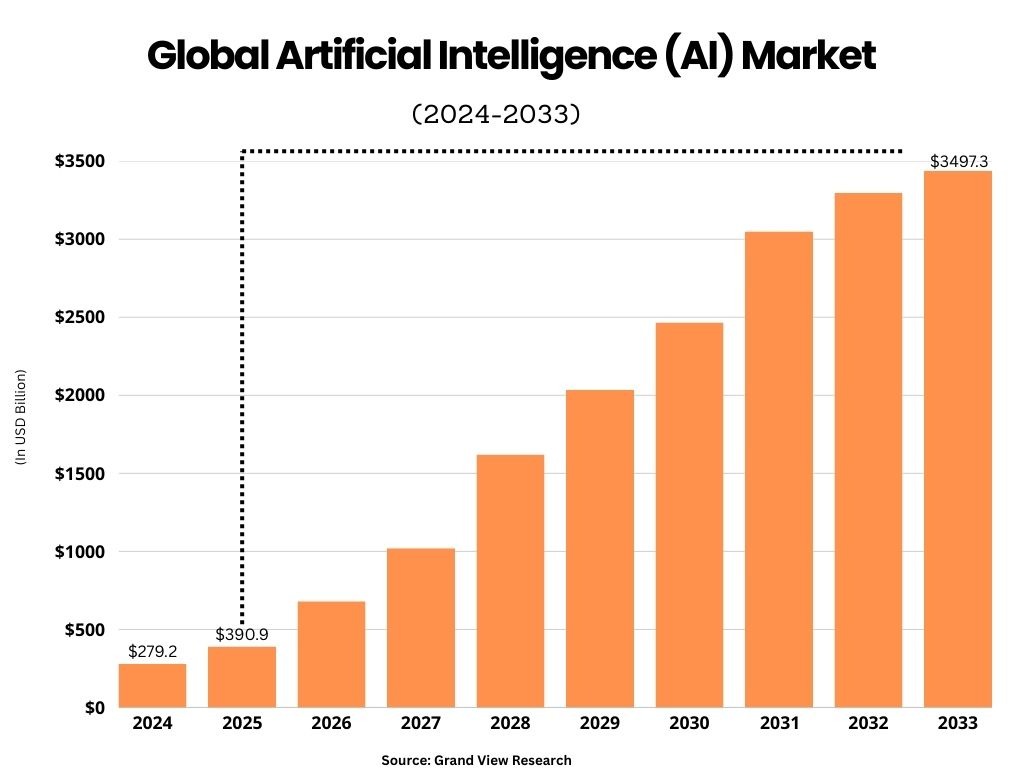
These figures show more than revenue growth. They reflect how AI is spreading across industries such as healthcare, finance, logistics, retail, manufacturing, and agriculture. AI is not confined to mobile app development anymore. It is influencing supply chains, pricing models, diagnostics, forecasting, and automation across sectors.
AI Market CAGR (Compound Annual Growth Rate)
- 2025–2032: 29.2%
- 2025–2033: 31.5%
- 2025–2034: 38.50%
- For businesses, this pace of growth signals urgency. Markets expanding at this rate reward early, structured adoption and penalize hesitation.
AI Adoption Statistics
AI adoption is no longer limited to large technology firms. Small and mid-sized businesses are moving quickly, often driven by competitive pressure rather than experimentation.
- Around 83 percent of organizations are already using AI in some form. (Salesforce)
- Nearly 75 percent of SMBs are actively testing AI tools. (Salesforce)
- 85 percent of Fortune 500 companies are using AI across operations.
- 88 percent of large enterprises globally have implemented AI in at least one business function. (McKinsey)
- 78 percent of SMBs plan to increase AI investment in the coming years.
The pattern is clear. AI adoption has crossed the threshold where it is considered a standard capability. Businesses not building internal familiarity now may struggle to catch up later, even with budget availability.
AI Investment and Funding Statistics
Corporate R&D Spending
Organizations are reallocating digital budgets toward AI-driven initiatives. In India, high-performing companies are investing 20 percent or more of their digital budgets into AI-related development. This includes automation, analytics, predictive systems, and generative tools.
Venture Capital and Startup Funding
AI startups accounted for over 50 percent of global venture funding by Q3 2025, with total funding reaching $310 billion. This marks a major inflection point where investors are prioritizing AI-first business models.
Growth of Generative AI Startups
Generative AI startups have seen a 3.7 times increase in formation, signaling strong confidence in AI-driven applications across content, software, healthcare, finance, and enterprise tools.
For founders, this also means higher competition and higher expectations around differentiation, data quality, and real-world outcomes.
AI Technology Segment Statistics
Generative AI
Between 2025 and 2027, 92 percent of businesses plan to increase investment in generative AI. By 2025, 25 percent of companies using generative AI are expected to deploy intelligent agents. This figure is projected to reach 50 percent by 2027.
Generative AI is moving from content assistance into workflow execution, internal tools, and customer-facing automation.
Machine Learning
Machine learning accounts for around 40 percent of the AI market share in 2025. It is expected to grow at a 32.60 percent CAGR, driven by its role in accuracy, prediction, and decision systems.
Machine learning remains foundational, supporting personalization, fraud detection, forecasting, and optimization across industries.
Natural Language Processing (NLP)
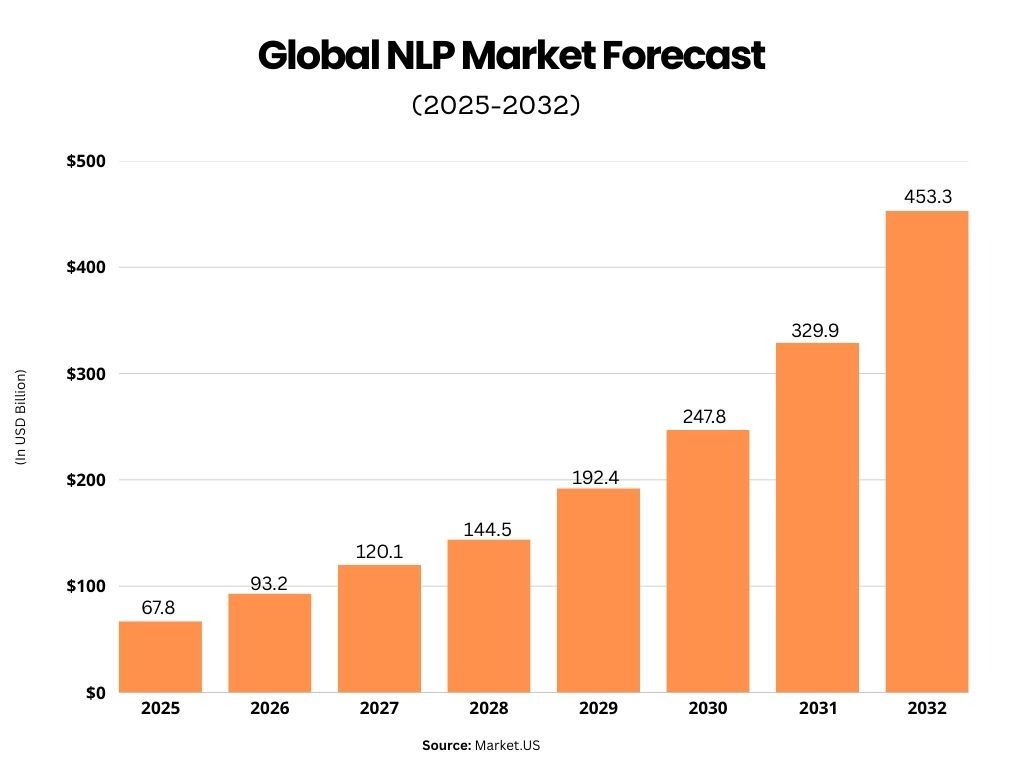
The NLP market is projected to reach $453.3 billion by 2032. NLP is powering chat interfaces, document analysis, voice systems, and enterprise search, making human-machine interaction more natural and scalable.
Computer Vision
Computer vision is critical for manufacturing quality control, healthcare imaging, security systems, and retail analytics.
- 2024 market size: $17.84 billion (Fortune Business Insights)
- 2032 projection: $58.33 billion
- CAGR: 15.9 percent
Robotics
The global robotics market is expected to reach $185.37 billion by 2030, growing at a 20.28 percent CAGR. Robotics adoption is expanding beyond factories into warehouses, healthcare, agriculture, and service environments.
AI Workforce Statistics
Job Growth and Role Evolution
AI demand is creating more jobs than it is displacing in the long term.
- By 2030, around 170 million new roles are expected to be created. (World Economic Forum)
- About 92 million roles may be replaced.
- Net job growth is estimated at 78 million roles.
This shift highlights role transformation rather than elimination.
Talent Shortage Reality
Critical talent shortages exist in MLOps, AI ethics, and large language model development. Around 76 percent of large enterprises report serious AI talent shortages, with an average hiring cycle of 4.7 months. Meanwhile, the AI talent market remains constrained.
- Talent demand-to-supply ratio stands at 3.2:1. (Second Talent)
- Over 1.6 million open AI positions.
- Only 518,000 qualified candidates are available.
Salary Trends
AI professionals command premium compensation.
- Average salary premium: 20 to 30 percent.
- Certain roles see premiums exceeding 56 percent.
- Average AI salary in the US: $160,000 annually.
- Senior roles exceed $200,000.
- Top positions reach $250,000 to $500,000+ annually.
For businesses, this emphasizes the need for internal upskilling, partnerships, and long-term workforce planning.
Consumer AI Usage Statistics
Over two-thirds of global consumers have interacted with AI-powered tools in the past year. Usage is no longer novelty-driven. It is utility-driven.
Chatbots
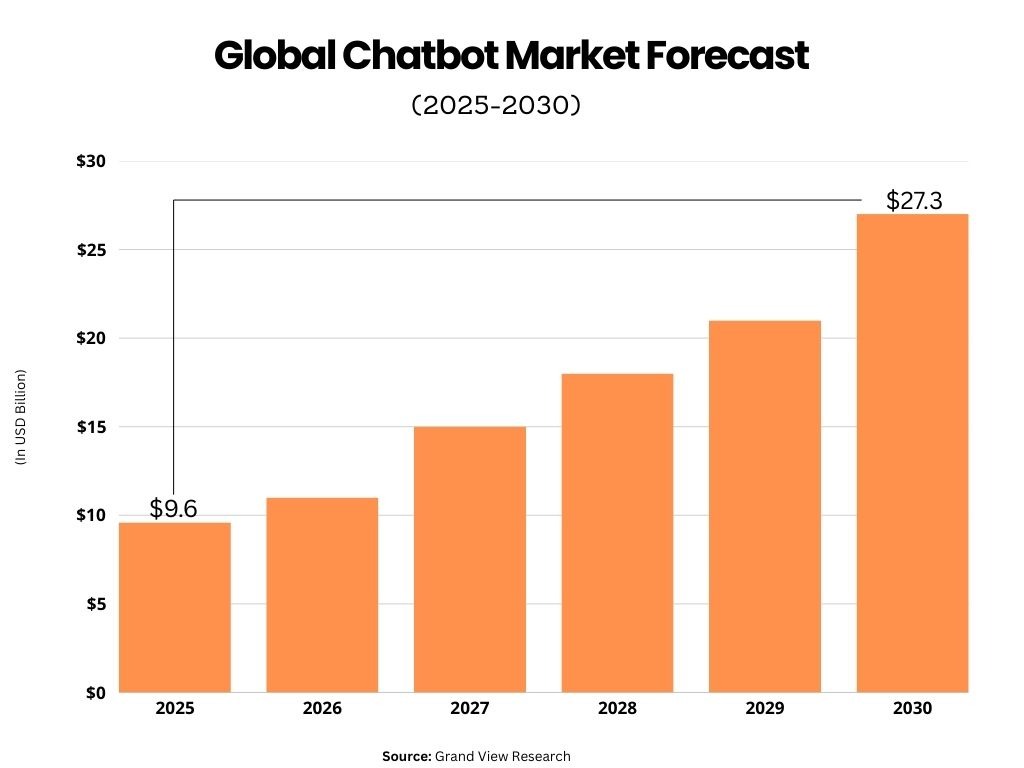
- Global chatbot market projected to reach $27.29 billion by 2030
- CAGR: 23.3 percent
Customer service remains the primary application, with rapid growth in e-commerce, retail, HR, and healthcare.
Virtual Assistants
- Market size expected to reach $14.10 billion by 2030
- Up from $2.48 billion in 2022
- CAGR: 24.3 percent
Consumer trust in voice assistants is increasing, with 50 percent of users already using them for purchases and 25 percent planning future use.
AI Automation Tools
- About 50 percent of developers use AI tools for productivity
- US adults use AI for email writing (19 percent), task management (18 percent), and meal planning (16 percent)
- 16 percent use AI for personal finance management
These behaviors indicate growing comfort with AI handling routine decisions.
Generative AI Statistics
The global generative AI market is projected to reach $109.37 billion by 2030, growing at a 37.6 percent CAGR.
Generative AI has the potential to increase employee productivity by 0.1 to 0.6 percent annually by 2040, depending on adoption depth.
Key enterprise use cases include:
- Content generation
- Customer service automation
- Software development
- Healthcare documentation
- Financial analysis
The BFSI sector is experiencing particularly strong adoption for fraud detection, risk modeling, and customer engagement.
Around 75 percent of knowledge workers already use AI tools at work, with 46 percent having used them for over six months.
Major players driving this space include Microsoft, Google, Amazon Web Services, IBM, Adobe, Meta, and Nvidia.
Future Forecast: What the Next Decade Looks Like for AI?
Market Contribution
AI is projected to contribute $15.7 trillion to global GDP by 2030. Revenue expansion will span infrastructure, enterprise software, consumer applications, and AI-native services.
Business Impact Areas
- New Revenue Models: AI-powered subscriptions, intelligent features, and data-driven services will form new income streams.
- Productivity Gains: Automation and generative tools will accelerate decision-making and reduce operational friction.
Operational Transformation: Integrated AI systems combining automation, agents, and edge intelligence will shorten cycles and improve resilience.
AI’s Role Between 2025 and 2035
- AI as Infrastructure: Investment will grow in data centers, specialized chips, and edge systems.
- Agents and Augmentation: AI agents will support human work rather than replace it, reshaping job design.
- Competitive Separation: Organizations with strong data governance and AI-native models will outperform those relying on legacy systems.
Conclusion
The AI statistics and forecasts for 2026 make one thing evident for businesses. Artificial Intelligence is no longer evolving at the edges of operations but is shaping how products are built, how customers are served, and how internal decisions are made at scale.
For startups and enterprises alike, the challenge now lies in moving from interest to execution. AI success depends on clean data, clear use cases, realistic timelines, and systems that integrate with existing workflows. As Artificial Intelligence continues to mature over the next decade, companies that focus on execution quality, data readiness, and long-term scalability will be better positioned to compete.
Many organizations are already taking this step by working with established AI development companies such as Mtoag Technologies, which focuses on building practical AI solutions across machine learning, generative AI, and intelligent automation aligned with real business requirements.
As Artificial Intelligence continues to mature over the next decade, companies that prioritize execution discipline, data readiness, and scalable AI architectures will be better positioned to compete and grow in an AI-driven market.
FAQs
How Big is AI Currently?
The global AI market is valued $371.71 billion in 2025, according to Markets and Markets. The adoption is expanding across healthcare, finance, manufacturing, retail, and enterprise software worldwide.
Why do 85% of AI Projects Fail?
Most AI projects fail due to poor data quality, unclear business objectives, weak integration with existing systems, lack of internal expertise, and unrealistic expectations about timelines and outcomes.
What is the 30% Rule in AI?
The 30% rule suggests AI-driven automation can reduce operational effort or costs by roughly thirty percent when applied to stable, repeatable processes with sufficient data and governance.
How Smart will AI be in 2050?
By 2050, AI is expected to match or exceed human performance in many specialized tasks, supporting decision-making, automation, and research, while still requiring human oversight and control.