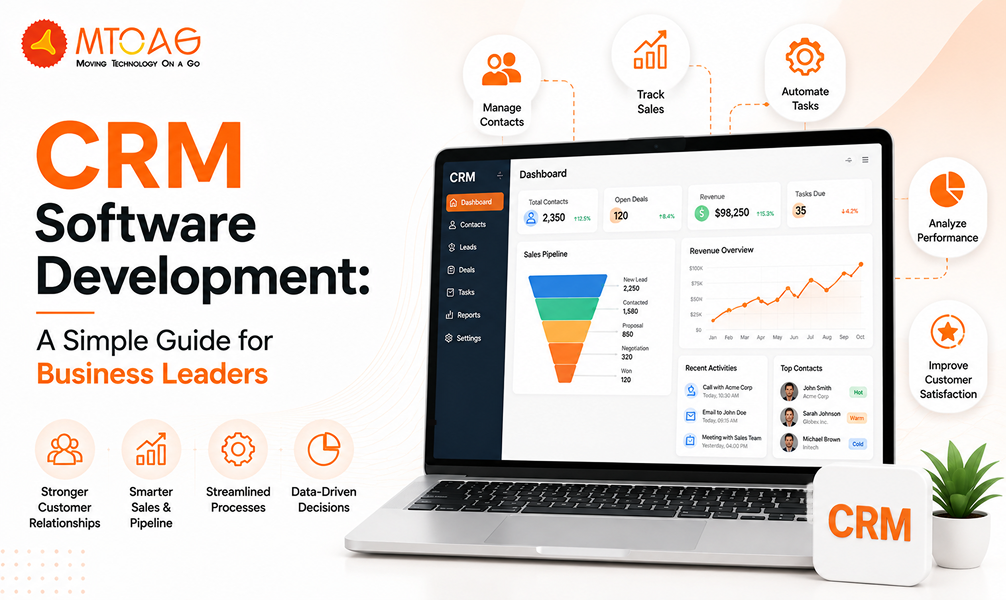
Offering customer-centric experiences is what makes your business unique in this crowded digital landscape, where everyone is mindlessly following the crowd or peer pressure. So, how can you create those one-of-a-kind user-centric experiences? In such a situation, custom Customer Relationship Management (CRM) software development seems a viable option to manage existing and potential customers while streamlining workflows.
Businesses these days are increasingly relying on off-the-shelf CRM solutions. However, businesses with unique requirements aren’t always able to find what they want, as most enterprise CRM suites are often designed to meet the common needs of the masses. After months of usage, they finally realize that they are paying for a huge system that has many components of no use and only a few features they really need.
Although enterprise CRM systems are best for startups and small-scale companies, they may still fall short in serving large-scale businesses with unique demands and complex project requirements. But what does it take to develop a CRM system? This comprehensive guide to custom CRM software development will explain the basics, process and cost of developing such software systems.
Key Takeaways
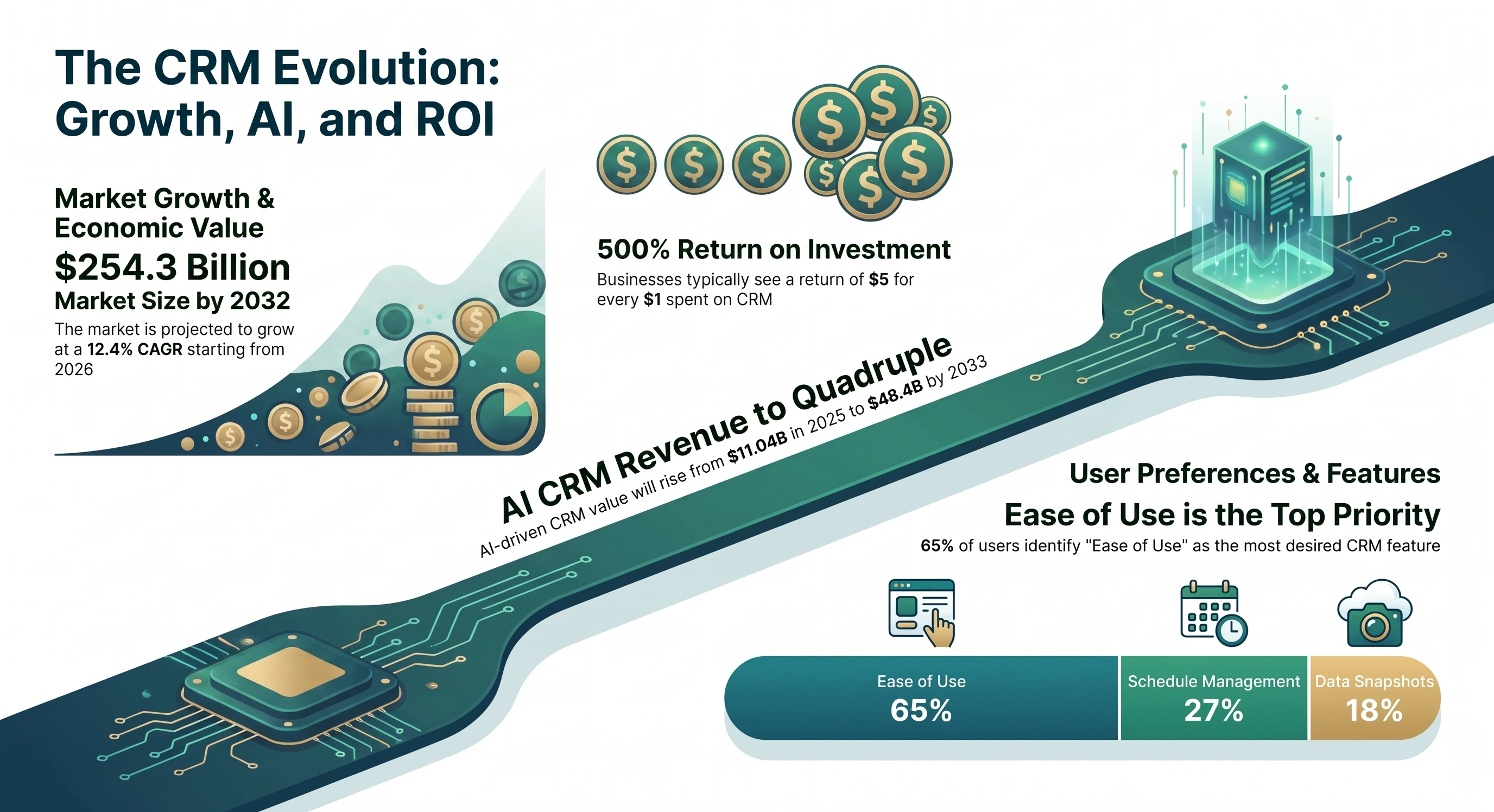
- The global market size of CRM software is valued at $126.2 billion in 2026 and is expected to grow at a CAGR of 12.4% to reach $254.3 billion by 2032. (Source: SellersCommerce)
- The prevalence of AI in CRM was worth $11.04 billion in 2025, which is expected to grow to $48.4 billion by 2033. (Source: SellersCommerce)
- “Ease of Use” remains the top and most desired CRM feature with 65%, followed by “Schedule Management” at 27% and “Data Snapshots” at 18%. (Source: InsideCRM)
- The ROI in the CRM market equates to $5 for every $1 spent. (Source: ReadyCloud)
What is CRM Software?
CRM is a specialized software system for businesses that helps them manage relationships with both existing and potential customers through a single centralized platform. The system stores customers’ information, helps create personalized marketing campaigns, offers advanced AI/ML-powered recommendations and guides towards a better customer service experience.
When a company invests in CRM solutions, it is technically spending money to offer a smoother customer experience and allow customers to purchase with more personalized service. Under a single dashboard, they can manage the entire customer journey across commerce, marketing, sales, IT and customer support.
Types of CRM Software Solutions
Before we move forward to understand the process of CRM software development, let’s first understand the different types of CRM systems available.
Operational CRM Systems
These CRM systems are directly intended for sales automation, better customer handling and improving overall marketing and customer retention efforts. These systems include advanced features, such as managing contacts, potential customers, tracking the sales process and a help desk for a better customer experience.
Analytical CRM Systems
These types of CRM software systems help businesses collect a massive amount of data from different sources. They then convert the information to create reports, insights and useful data to plan and strategize next steps. Popular examples of Analytical CRM systems include Salesforce Einstein, Zendesk and Zoho Analytics.
Collaborative CRM Systems
As the name itself suggests, collaborative CRM systems take together the capabilities of both operational and analytical CRM systems. It helps businesses manage workflows with clear information and data. It has advanced features, such as shared boards, live chats and group discussions.
Custom CRM Development vs Off-the-Shelf CRM Solutions
Businesses with increasing pressure to effectively manage customers often invest in off-the-shelf CRM solutions only to regret it later. As said earlier, while these enterprise-ready solutions are a perfect start for small-sized businesses, they can’t fulfill the requirements of companies with unique and complex needs.
Here’s a detailed comparison between custom vs off-the-shelf CRM software to help you understand what really suits your business requirements.
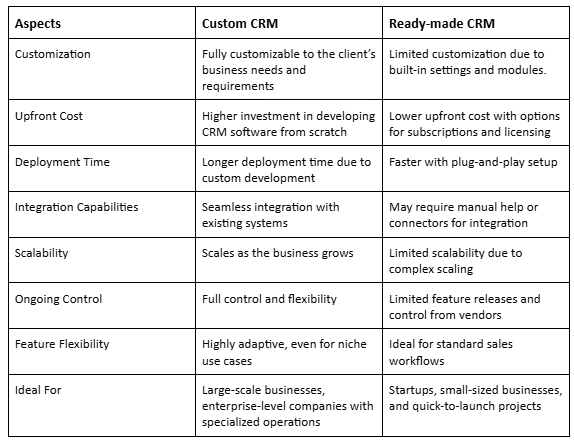
1. Alignment and Control
As custom CRM software development involves developing a new system from scratch, they adapt exactly to the business’s long-term strategies, which makes it perfect for highly specific process automation. You have complete control over your data on CRM customized platforms.
Meanwhile, off-the-shelf CRM solutions don’t offer this level of control and flexibility. Businesses often need to adjust their operations to align with the software’s structural limitations.
2. Cost Dynamics
Custom CRM development involves a significant upfront capital investment. While the investment may look costlier in the beginning, the long-term ownership makes it more cost-effective, as there will be no per-user, per-month subscription or licensing fees.
At the same time, ready-made CRM software solutions are relatively cost-effective with a predictable monthly cost. The low upfront cost allows businesses to enter with a fixed budget. However, the cost can scale sharply with increasing employee count and the need for advanced feature upgrades.
3. Integrations
Custom CRM software is developed from scratch and can seamlessly integrate with specialized ERP software, HRMS platforms and existing accounting tools and platforms.
Meanwhile, off-the-shelf CRM solutions lack this level of integration capabilities. These solutions often rely on pre-built API connectors. They may face challenges or sometimes may require middleware to integrate with highly proprietary legacy systems.
4. Support and Maintenance
After-sales support and maintenance remain the most significant difference between custom and ready-made software solutions. If you opt for custom solutions, your software development partner will be taking care of long-term maintenance, bug fixes, and security patches.
However, if you go for off-the-shelf CRM solutions, you get support from a dedicated customer service team, documentation, and continuous updates shipped by the vendor.
Here’s a quick comparison between custom CRM software development vs ready-made CRM solutions:
How to Build Custom CRM Software?
Going for a ready-made CRM software forces businesses to spend their valuable budget on an additional suite of tools that are not even tailored for their unique workflows. In such a situation, custom solutions remain the best option.
Here are the detailed steps of the custom CRM software development process:
Identify Key Stakeholders in Your Organization
The first and foremost step in developing CRM software is identifying the key stakeholders within the company who will use the system. If you don’t know who will be using the system, there is no sense in creating it. These stakeholders can be representatives from the company’s departments, including marketing, sales and customer service. Each of the stakeholders will benefit the company in their own way.
Conduct Market Research
Customer Relationship Management systems make the customer service experience easy and quick by letting customers help themselves through the customer portal and documentation. You can add FAQs and informative pages to help users find and fix issues by themselves, which lowers the burden on your customer support team.
Choosing the Right Software Development Company
Well! That’s a tricky step. Every other software development agency out there claims to offer the best and promises to integrate advanced features and functionalities. But in reality, most of them fail when it is time for actual delivery. Make sure you choose a development partner with good experience in relevant CRM projects. A professional company guides, plans, and suggests useful features for your CRM software system.
Prioritizing CRM App Features
Overloading the CRM software with many features and advanced functionalities not only takes a long time to develop but also adds to the overall cost. Therefore, it is always better to customize the software and prioritize the features that are actually needed for your organization. However, this flexibility isn’t possible with ready-made CRM solutions, but is something that makes custom-made CRM software solutions stand out.
Designing and Planning
A complex interface may confuse users and even frustrate them from using the CRM. Make sure the system is simple enough so that employees can understand it better in one go. Organize features and functionalities logically and minimize unnecessary clutter. It is better to ask yourself: what tasks will the CRM perform for its users, and how can it streamline them? Consider the end-user’s experience interacting with the system.
QA and Testing
After the development phase is successfully completed, the QA team takes charge next. The team rigorously test the system to find and fix the issues before deploying. They check whether the system works well, all of its parts function effectively and if it is robust enough to be used by several stakeholders.
How Much Does a Custom CRM System Cost?
The cost of developing a custom CRM system can range between $10,000 to $500,000 and significantly depends on the features you choose, the complexity of the project and the experience of your chosen development team.
Here we have calculated the averages of custom CRM software development costs, based on complexity level:
- A basic CRM system with core features such as task tracking and contact management typically costs between $10,000 to $50,000. It may take at least 2-4 months to build such a system.
- At the same time, a mid-level CRM system with seamless integrations, custom workflows and reporting often ranges between $50,000 to $150,000, with an estimated development time of 4-6 months.
- Highly advanced and enterprise-level CRMs with advanced security features, automation and full integrations can cost $150,000 to $500,000 or sometimes even more, with at least 6-12 months in production.
Conclusion
CRM development is a boon for organizations, handling the pressure of balancing customer management and focusing on core business activities. While many lean towards off-the-shelf solutions, thinking of them as a cost-effective option, custom CRM solutions are actually saving costs when long-term ownership is considered, as there is no need to pay for licensing fees or pay for every custom feature your team needs.
So, now that you know what’s better between custom and ready-made CRM solutions, the process and cost of developing such advanced systems, it's time to choose a reliable software development partner to get started. Mtoag Technologies is one of the leading options for CRM software development, with over 17+ years of engineering excellence and a proven history of developing CRM solutions across industries, including retail & e-commerce, healthcare, real estate, financial services, and manufacturing.
FAQs
What are the 4 Types of CRM?
The four common types of CRM are Operational CRM, Analytical CRM, Collaborative CRM, and Strategic CRM. Operational CRM manages sales and customer service, Analytical CRM studies customer data, Collaborative CRM improves team coordination, and Strategic CRM focuses on building long-term customer relationships and retention.
Can I Build My Own CRM with AI?
Yes, it is possible to build a custom CRM with AI. Businesses often add features like lead scoring, automated follow-ups, chat support, reporting, and sales predictions. However, development cost, integrations, maintenance, and scalability should be planned before starting.
Is AI Replacing CRM?
No, AI is not replacing CRM. Instead, AI is making CRM smarter by automating repetitive work, improving customer insights, and helping teams respond faster. CRM still remains the central system that stores customer data and manages relationships.
What are the 5 Steps of the CRM Process?
The CRM process usually follows five steps: collecting customer data, organizing information, engaging with customers, converting opportunities into sales, and maintaining long-term relationships through support, communication, and follow-ups to improve retention and repeat business.
What are the Top 3 CRM Tools?
Three widely used CRM tools are Salesforce, HubSpot CRM, and Zoho CRM. Salesforce is known for enterprise-scale capabilities, HubSpot for ease of use, and Zoho for balancing features with affordability.