Information Technology (IT) is one of the few sectors with exponential growth. It is no longer the same as it used to be, like 10 or 20 years ago. Earlier, businesses had limited options and worked around whatever software was available. But today, when a business needs a digital solution, they have multiple options to choose from. And one of the most common ones remains the choice between custom software vs SaaS platforms.
Both options have their advantages and disadvantages, but the right one for your business should be the one that aligns perfectly with your business objectives, operational flexibility, growth plans and long-term scalability capabilities. Still confused? This detailed comparison guide between custom software vs SaaS will answer all your doubts and help narrow down the options to just one that you can go for.
Understanding the Basics of Custom Software vs SaaS
What is Custom Software?
Custom software refers to advanced software systems that are built keeping in mind the specificity of the company’s needs and objectives. These software solutions are not generic ones with similar functionalities, as in the case of SaaS software.
Instead, they are designed around the unique business logic and workflows to support complex operations, modernize the current architecture and manage customers more efficiently. Although every software development project is different, custom solutions provide better flexibility than the SaaS tools that have been used by millions already.
When comparing custom software vs SaaS, the former gives better control and adaptability over integrations, features and data governance. However, it requires a significant upfront investment and ongoing maintenance after deployment. For mid-to-large-sized organizations with a regulated environment, unique workflows and compliance-mandatory requirements, custom software development is nothing short of a boon.
What is a Software-as-a-Service (SaaS) Product?
SaaS software refers to cloud-based applications that businesses can access through the internet. Instead of developing software from scratch, businesses can use a SaaS platform by paying a recurring subscription fee. Popular examples of SaaS include Slack, Zoom and Google Workspace.
Although some SaaS solutions can be customized, many of them still offer standardized functions and functionalities. Unlike custom software development, most SaaS vendors take care of hosting, security updates, bug fixes and ongoing maintenance.
In terms of comparing SaaS vs custom software, the former stands out because of its low initial cost and faster deployment. This means there is no need to develop anything or build architecture. Businesses can use the new system immediately after paying recurring subscription fees. Additionally, the upfront cost is relatively lower than that of custom software development.
However, SaaS software products provide limited customization and often have hidden costs & vendor lock-in, is something that hurts the business's ROI.
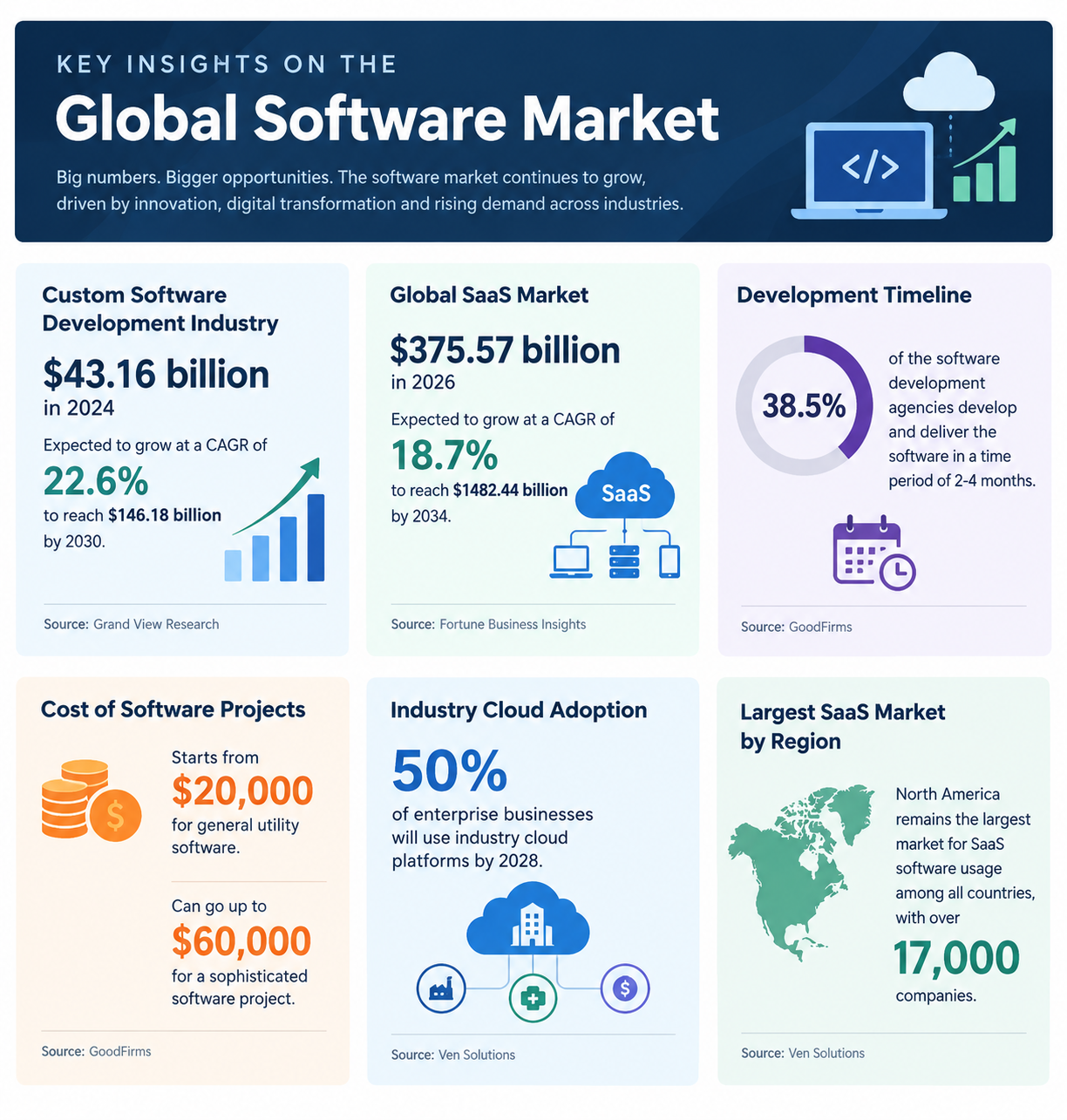
Key Insights on the Global Software Market
- The custom software development industry was valued at $43.16 billion in 2024, which is expected to grow at a CAGR of 22.6% to reach $146.18 billion by 2030. (Source: Grand View Research)
- Meanwhile, the global Software-as-a-Service (SaaS) market is worth $375.57 billion in 2026 and is expected to grow at a CAGR of 18.7% to reach $1482.44 billion by 2034. (Source: Fortune Business Insights)
- Around 38.5% of the software development agencies develop and deliver the software in a time period of 2-4 months. (Source: GoodFirms)
- The average cost of software projects starts at $20,000 for general utility software, while it can go up to $60,000 for a sophisticated software project. (Source: GoodFirms)
- Experts predict that 50% of enterprise businesses will use industry cloud platforms by 2028. (Source: Ven Solutions)
- North America remains the largest market for SaaS software usage among all countries, with over 17,000 companies. (Source: Ven Solutions)
Custom Software vs SaaS Software: Detailed Comparison
Comparing custom vs SaaS software doesn’t mean positioning one as superior and the other as outdated. Here’s an unbiased and fact-based comparison between the two:
Customization
SaaS is a standardized software solution that is built for multiple users. They offer features, functionalities and workflows according to the subscription plan chosen by the organization. Although there is some customization available, deep customization remains the downside here. Organizations may need to adjust business processes to align with the software.
Custom software solutions work differently from SaaS. They are built from scratch around the business’s exact needs. Custom software is scalable and supports unique business logic and industry requirements. This helps businesses have the upper hand in terms of flexibility that generic SaaS platforms can’t offer.
Cost
The best thing about SaaS software is its low initial cost. You don’t have to spend thousands of dollars on building a system. However, the expenses continue as long as you continue the service. Gartner has predicted that enterprise SaaS renewals will see about a 10-20% increase in the near future.
At the same time, custom software eliminates these recurring subscription or licensing fees. Although the initial investment may cost between $20,000-$60,000, there is no need to pay the vendor forever. However, there is a maintenance cost, but custom development remains the upper hand over SaaS in terms of long-term RoI.
Return On Investment
Return on Investment (RoI) greatly depends on the business’s goal and long-term scalability plans. SaaS software offers faster value as the team can easily and quickly deploy it. As the global SaaS market is near $400 billion, the demand for flexible software solutions will increase in the future.
Meanwhile, custom software development delivers better RoI for companies by creating a competitive differentiation and becomes an asset for the organization that supports business growth over the years.
User Growth
Using SaaS software is really easy, and adding or removing employees is really quick. It helps support remote teams and seasonal demands. Around 75% of business applications are based on SaaS, demonstrating how businesses are adopting scalability. However, the cost increases with each new user as these software solutions are usually tier-based.
In custom software development, there are no per-user fees. Once you have developed the system, you can easily scale it without major licensing costs. Custom software systems are in high demand these days, as scalability remains critical for long-term growth.
Data Control
SaaS software solutions usually store their data on third-party servers. They are usually managed by SaaS providers. This setup can help reduce the cost and infrastructure work. However, there may be some concerns over data governance and customer data.
Meanwhile, custom software provides complete ownership of systems and data to the organization. They can decide where to store the data and who can access it. This level of data control is critical for strictly regulated industries that require adherence to data compliance and sovereignty rules.
Compliance Standards
Most of the SaaS providers adhere to strict standards, such as SOC 2, GDPR and ISO 27001, to build trustworthiness among customers. SOC 2 is the most recognized standard for data protection and cloud security.
Custom software systems are highly compliance-flexible. The system can be built for industries with specific regulations, including finance, healthcare and government sectors. This helps enterprises adhere to standardized industry compliance that many SaaS solutions may not support fully.
Custom Security
Most of the SaaS vendors offer predefined security settings for broad applications. Although it works well for standard operations, customization still remains the biggest red flag here. Businesses need to adjust within the vendor’s feature set and roadmap.
Custom software helps organizations to build security policies around their business logic. Organizations can develop encryption methods, advanced controls, and access to workflows. This gives a competitive advantage in strictly regulated environments.
Custom software allows organizations to create security policies around their exact business logic. Companies can build advanced controls, encryption methods, and access systems that fit unique workflows. This flexibility can become a competitive advantage in highly regulated environments.
Quick Comparison Between Custom Software vs SaaS
Comparison PointSaaS SoftwareCustom SoftwareHow It Works in RealityBusinesses start with an existing platform and adapt internal processes around itSoftware is created around the business’s existing operations, goals, and workflowsTime to Start UsingUsually quicker because the product already exists and requires setup rather than developmentRequires planning, development, testing, and phased implementation before launchInitial Financial CommitmentLower entry cost with predictable monthly or annual paymentsHigher investment at the beginning due to design and development effortCost After Several YearsCosts continue as subscriptions grow with users, storage, or premium featuresOngoing support exists, but there are no recurring platform licensing chargesFlexibility During GrowthWorks well until business requirements move beyond available featuresFeatures, modules, and integrations can evolve as business priorities changeProcess AlignmentTeams may adjust workflows to fit platform limitationsSoftware follows existing business processes instead of changing themIntegration PossibilitiesDepends on APIs, vendor support, and available connectorsCan be designed to connect directly with existing systems and future toolsData & Platform ControlInfrastructure and major platform decisions remain with the providerGreater ownership over data structure, access policies, and platform directionChange RequestsBusinesses depend on vendor release cycles and product roadmapsNew functionality can be planned and implemented when neededOperational ResponsibilityVendor handles hosting, updates, performance, and maintenanceInternal teams or technology partners manage updates and system healthRisk Over TimeFaster start, but dependency on pricing, policies, and feature availabilityMore control, but requires long-term ownership and maintenance planningIdeal Business ScenarioCompanies that want speed, standardization, and lower initial commitmentCompanies with unique workflows, long-term scaling plans, or competitive differentiationConclusion
The selection between custom software vs SaaS is something that takes great effort and a few brainstorming sessions. However, there are signs every business shows, and you need to catch them fr sustainable growth. For instance, when your current technology starts limiting your potential rather than expanding it, it's time to go for custom software development.
At Mtaog Technologies, we have been developing custom software solutions since 2007 and are now integrating them with the power of artificial intelligence and machine learning. Our agile-centric approach makes sure that each software solution we build is delivered on time, on budget and, most importantly, meets the client’s expectations.
FAQs
What is the Difference Between Custom Software and SaaS?
Custom software is built around a company’s exact workflows, goals, and operational needs, while SaaS (Software as a Service) is a ready-made product designed to serve many businesses with the same core features. SaaS is faster to start with, but custom software offers more flexibility, ownership, and long-term adaptability.
What are the Disadvantages of Custom Software?
Custom software usually requires a higher upfront investment, more planning, and a longer development timeline compared to off-the-shelf tools. It also needs ongoing maintenance, updates, and technical support. If requirements are unclear in the beginning, costs and timelines can expand during development.
Is AI Replacing SaaS?
AI is not replacing SaaS; it is changing how SaaS works. Most modern SaaS platforms are adding AI to automate tasks, improve decisions, and personalize experiences. Businesses still need software systems, but those systems are becoming more intelligent and less dependent on manual processes.
What are Examples of Custom Software?
Popular examples of custom software include ERP systems built for manufacturing operations, hospital management platforms, logistics tracking systems, customer portals, inventory management tools, internal workflow automation platforms, learning management systems, and enterprise applications developed for unique business processes.
How to Create Custom Software?
Creating custom software usually starts with requirement discovery, where business goals and workflows are documented. After that come planning, UI/UX design, development, testing, deployment, and ongoing improvements. The strongest projects focus first on solving business problems rather than selecting technologies.
How Much Does It Cost to Build Custom Software?
There is no fixed price because custom software is usually priced based on complexity, user roles, integrations, security requirements, and future scalability. For context, a basic business application may start around $15,000–$40,000, mid-level platforms often range between $40,000–$150,000, and enterprise-grade systems can go well beyond that. In most cases, the biggest cost driver is not coding, but how many business processes the software is expected to replace or automate.
What is the Use of Custom Software?
Custom software is used when standard tools force teams to change the way they work. It helps businesses automate internal operations, connect disconnected systems, improve reporting, manage data better, reduce repetitive tasks, and create processes that match how the business actually runs.