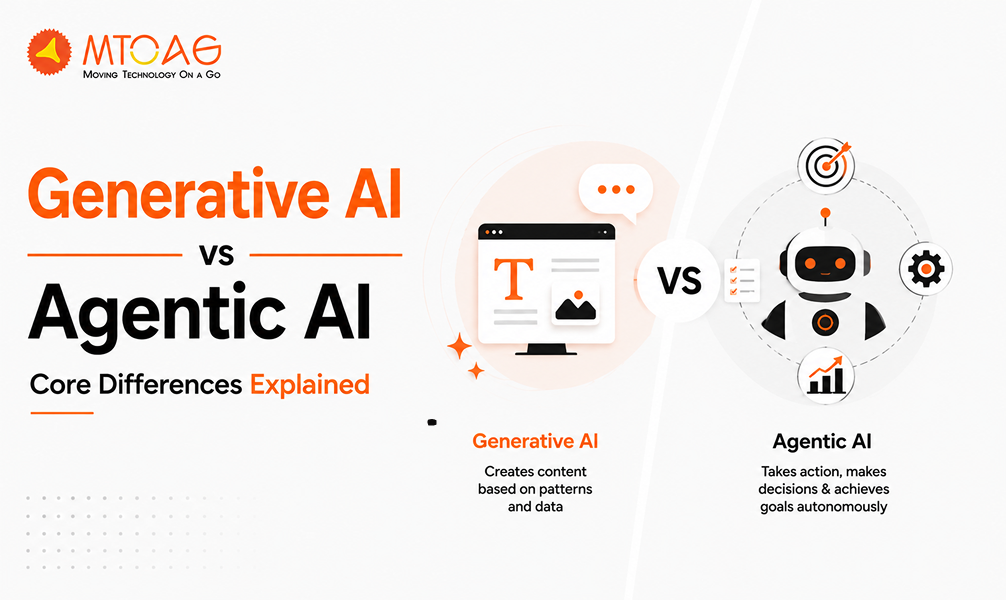
The debate of Generative AI vs Agentic AI starts with their capabilities and ends with their purpose. Both GenAI and Agentic AI offer benefits in terms of productivity by assisting, augmenting and optimizing the tasks and workflows. Both represent the broader AI ecosystem and are powered by Large Language Models (LLMs).
However, the easiest way to differentiate between Agentic AI vs Generative AI is to understand the former as proactive and the latter as reactive. In practical terms, Gen AI responds to “what needs to be created,” whereas Agentic AI focuses on “what needs to be done.”
Through this comparison guide, we will spot out the key differences between Generative vs Agentic AI and, more importantly, show how organizations can use them together.
Generative AI vs Agentic AI: Understanding the Basics
Agentic AI Definition
Agentic AI is an advanced and autonomous form of Artificial Intelligence (AI). It is a complete system that independently takes on multi-step, defined tasks while still having human oversight. It can independently plan, make decisions and take actions, but may need a human to escalate when needed. It is a proactive technology, meaning it can break down goals, plan a viable action and execute steps to achieve that goal.
The core components of Agnetic AI include a planned module that allows agents to break complex tasks into manageable steps, a short-term and long-term memory to remember past actions and learn from mistakes and capabilities to interact with external systems, APIs, and databases to collect information and perform actions on its own, such as sending emails, updating CRM or even scheduling a meeting.
The most common use cases of Agentic AI are
- Customer Service Automation
- Sales Process Automation
- Workflow Automation
Generative AI
Generative AI, shortly known as GenAI, is a subset of AI that can generate new and unique content based on vast training data. Unlike other AI models that analyze existing data, GenAI is better known for its creativity. The process starts with a human prompt, GenAI analyzes the request and then generates a comprehensive output.
GenAI is entirely powered by Large Language Models (LLMs) that work by predicting the next logical element in the sequence. For instance, predicting the next words to create a sentence, paragraph or even a full article. In image generation, the technology predicts pixels to create new visual pieces.
The common GenAI use cases include
- Writing and editing of marketing copy, blog posts and emails.
- Creating unique images, audio, and video based on prompts.
- Condensing long documents or articles into key bullet points.
- Generating codes for software development
Key Differences Between Generative AI vs Agentic AI
Here we have listed down a few core differences between agentic AI and Generative AI:
Market Size
According to Fortune Business Insights, the agentic AI market was valued at $7.29 billion in the year 2025, and it is expected to grow by a CAGR of 40.50% to reach $139.19 billion by 2034. In terms of adoption, North America dominated the largest market share with 33.60% in 2026. Meanwhile, the technology is rapidly transitioning from experimental pilots to production-level systems, with nearly 79% enterprises reporting implementation of Agentic AI in at least one business function.
Their dominance in the market is attributed to its key capabilities that include advanced AI research, solid cloud infrastructure and development of highly adaptable platforms. Industry giants like IBM, Microsoft, Anthropic and NVIDIA are fueling this widespread adoption.
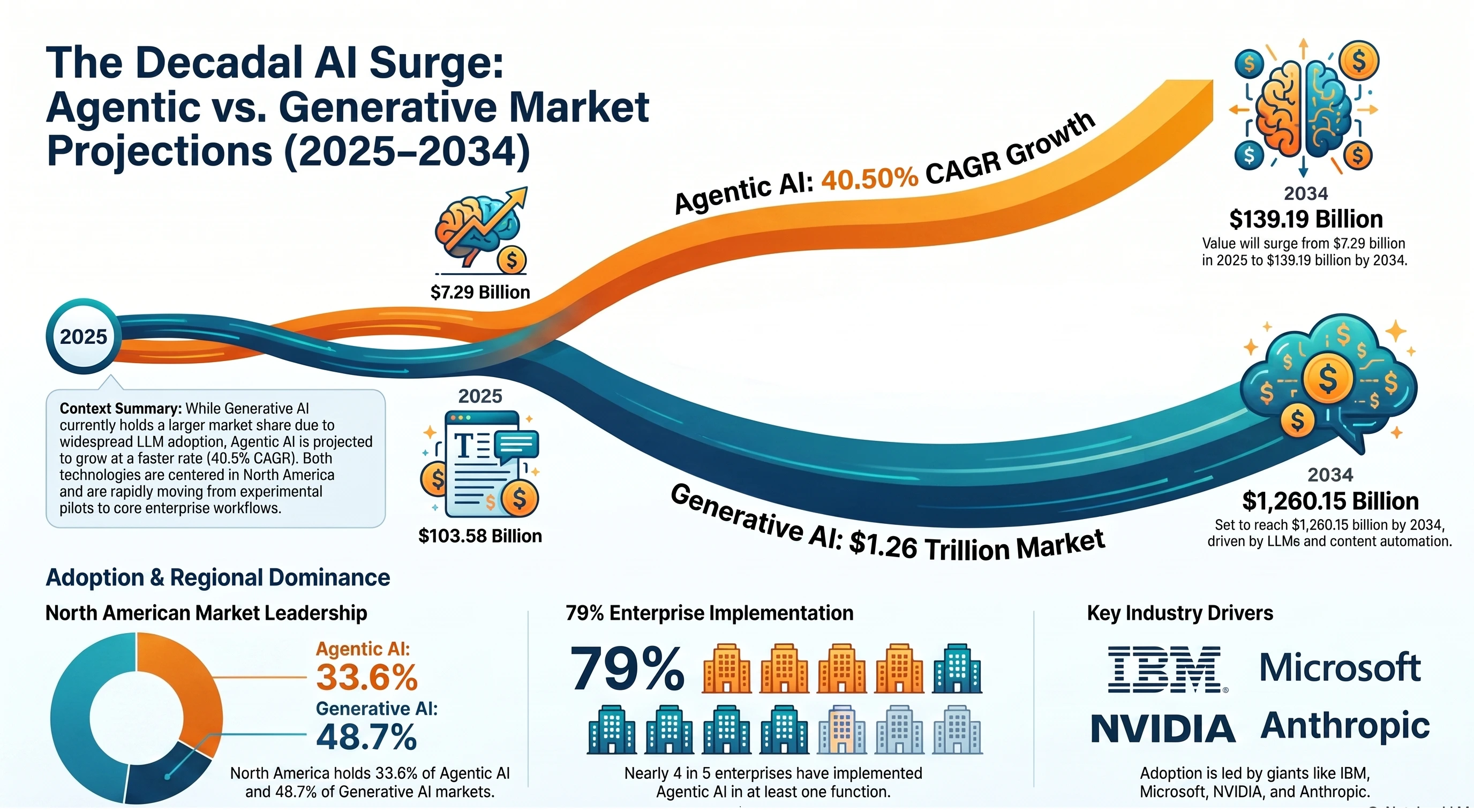
Meanwhile, the global market size of Generative AI in 2025 was valued at $103.58 billion and is projected to grow with an annual CAGR of 29.30% to reach $1,260.15 billion by 2034. In Generative AI as well, North America takes the largest market share with 48.70%. The growth is driven by the increased demand for LLM models like ChatGPT, automated content generation and its seamless integration into industrial and commercial workflows.
Businesses across marketing, IT, manufacturing, healthcare, energy and transportation are adopting Generative AI to reduce operational inefficiencies while improving performance. Transformer-based large language models (LLMs), Generative Adversarial Networks (GANs) and diffusion models have been instrumental in generating content, code and process stimulation and scenario modelling.
Core Function
The core function of Generative AI is to generate content in outputs, such as text, images, or code. It identifies the patterns from pre-trained datasets. GenAI is best for single-step tasks, where users input a specific request and expect faster responses and relevant output. The example of GenAI includes blog generation, writing emails, summarizing reports and generating images.
Meanwhile, agentic AI manages and executes multistep tasks. It performs processes with chaining action, meaning it goes chain-wise to reach a desired outcome. Unlike Generative AI, agentic AI can reason, plan and act across logic layers. For instance, it can research, find sources, extract relevant data, draft a report and tweak the strategy based on findings.
Autonomy
Generative AI has comparatively low autonomy and depends entirely on the users for interactions. Every action GenAI takes is based on the prompt and doesn’t retain context between two different tasks unless designed to do so within a session. Without training, it can’t initiate tasks or modify behaviours.
On the other hand, agentic AI has high autonomy. Once it is provided with an overarching goal, it can independently plan, analyze, execute and give outcomes using the feedback from its environment. It uses its own decision-making abilities to stay on track and complete the tasks with human intervention.
Workflow Automation
Generative AI has been supportive in automating workflows. It can assist with writing, editing, or even translating, but it can’t manage the entire process from start to finish. There must be a user guiding at every stage, which limits its ability to automate full workflows without human intervention.
Agnetic AI supports full workflow automation. It is designed to carry out sequences of actions that require decision-making, coordination and adjustment. For instance, it can plan, schedule meetings, send communications, handle unexpected changes and update timelines. This makes it useful for industries that require compliance, software development and research.
Decision Making
Generative AI can make decisions, but mostly at a basic level. It can choose the next word, sentence, image component or even code segment based on the trained data. It can’t evaluate alternatives or reason. Its choices are often powered by pattern recognition rather than strategic thinking.
On the other hand, agentic AI can make complex decisions. It can consider expected outcomes, weigh multiple options and choose the best action based on the overall goals and current conditions. Agentic AI can interact with APIs, use tools and learn from its past actions through feedback. This can help adapt with time, improve future performance and handle situations that require judgment or reasoning.
Conclusion
The difference between Agentic AI vs Generative AI lies in their fundamental approaches to how AI can help businesses and how they can be used in conjunction with other tools and initiatives to benefit businesses. While businesses have started realizing the potential for AI, there is a significant gap in acknowledging its potential and implementing strategic AI strategies with clean training data. Today, many businesses understand the AI potential but still struggle to operationalize it.
Mtoag Technologies addresses these challenges with its Agentic AI and Generative AI development services that don’t merely respond to prompts but also operate within professional workflows. Unlike generic AI solutions, we offer domain-specific agents that are refined according to different industries.
FAQs
Is ChatGPT Generative AI or Agentic AI?
ChatGPT is primarily Generative AI. It creates text, answers queries, and assists with content based on prompts. It does not independently plan or execute multi-step actions unless integrated into a larger agentic system with tools and workflows.
What are the 4 Types of AI?
The four types are Reactive Machines, Limited Memory AI, Theory of Mind AI, and Self-aware AI. Most real-world systems today, including ChatGPT, fall under Limited Memory AI, using past data to improve responses without true understanding or consciousness.
What is the Difference Between Agentic AI and Generative AI?
Generative AI focuses on creating outputs like text or images from prompts. Agentic AI focuses on completing tasks by planning, deciding, and executing multiple steps. One supports creation; the other drives execution across workflows with higher autonomy and decision-making capability.
Is ChatGPT an LLM or Generative AI?
ChatGPT is both. It is a Generative AI application powered by a Large Language Model (LLM). The LLM enables it to understand prompts and generate human-like responses, making it effective for writing, coding, and conversational tasks.
What are the Top 3 Generative AI?
Top Generative AI tools include ChatGPT for text, Google Gemini for multimodal tasks, and DALL·E for images. Each excels in generating content but still depends on prompts rather than independent execution.