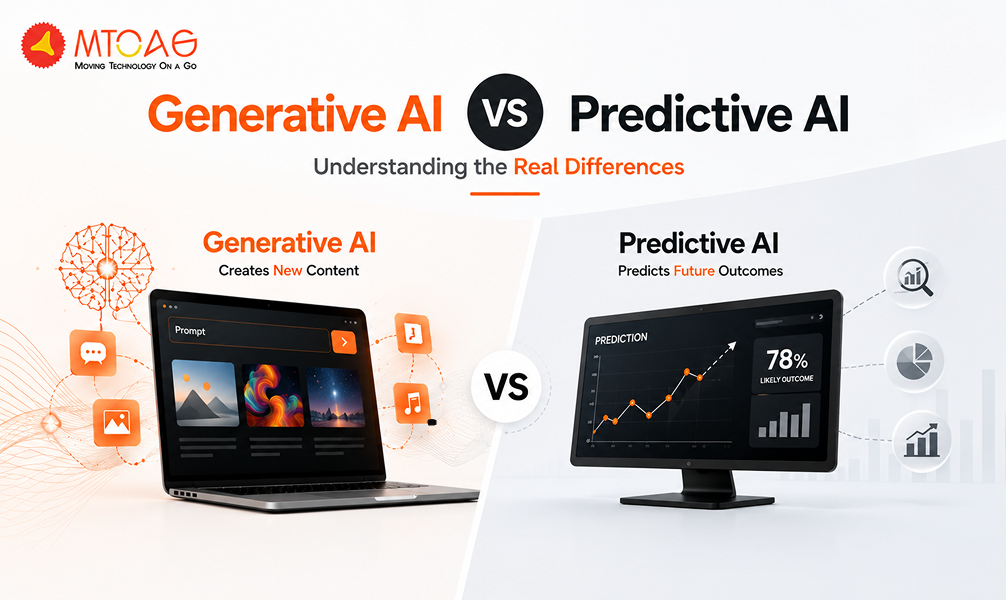
It's now the AI era that’s taking over literally everything. In particular, generative AI tools are making what seemed impossible a decade ago possible. AI tools like ChatGPT are continuing a conversation, Midjourney can turn text prompts into visuals, and Copilot suggests the next lines of code. The surprising fact is that they aren’t even predictive AI tools. And that’s where comparing generative AI vs predictive AI becomes a must if you think both are the same.
At a glance, these GenAI tools may look predictive, but they are fundamentally different from predictive AI. While Generative AI generates new content, predictive AI forecasts the results based on historical data. Both are powerful in their own way and serve different purposes across industries.
Through this detailed comparison guide, we will point out the key differences between Generative AI vs Predictive AI, breaking down everything you should know about these technologies.
Understanding Generative AI
Generative AI, you better know it by the term GenAI, is a subset of artificial intelligence (AI) that generates new content, such as text, video, image, audio and even software code. It is powered by large language models (LLMs) and diffusion models and is trained on learning patterns from the vast existing data.
Unlike traditional AI tools, generative AI creates original outputs that imitate human creativity. The most common examples of generative AI include ChatGPT, GitHub Copilot and DALL · E. The technology has been transforming how we work and solve complex issues. Generative AI has found its application across a wide range of industries, such as healthcare, education, retail, manufacturing, logistics and marketing.
Understanding Predictive AI
Predictive AI leverages statistical analysis, machine learning and historical data to identify patterns and forecast future behaviour, events and trends. Unlike Generative AI that generates content based on prompts, predictive AI helps businesses act proactively by anticipating risks, personalizing experiences and optimizing operations.
People often confuse predictive AI with prescriptive and descriptive analysis. However, all three are different in a way that descriptive analysis helps businesses understand the past patterns. Meanwhile, prescriptive analysis recommends actions businesses need to take to achieve desired future outcomes.
Detailed Comparison Between Generative AI vs Predictive AI
Primary Function
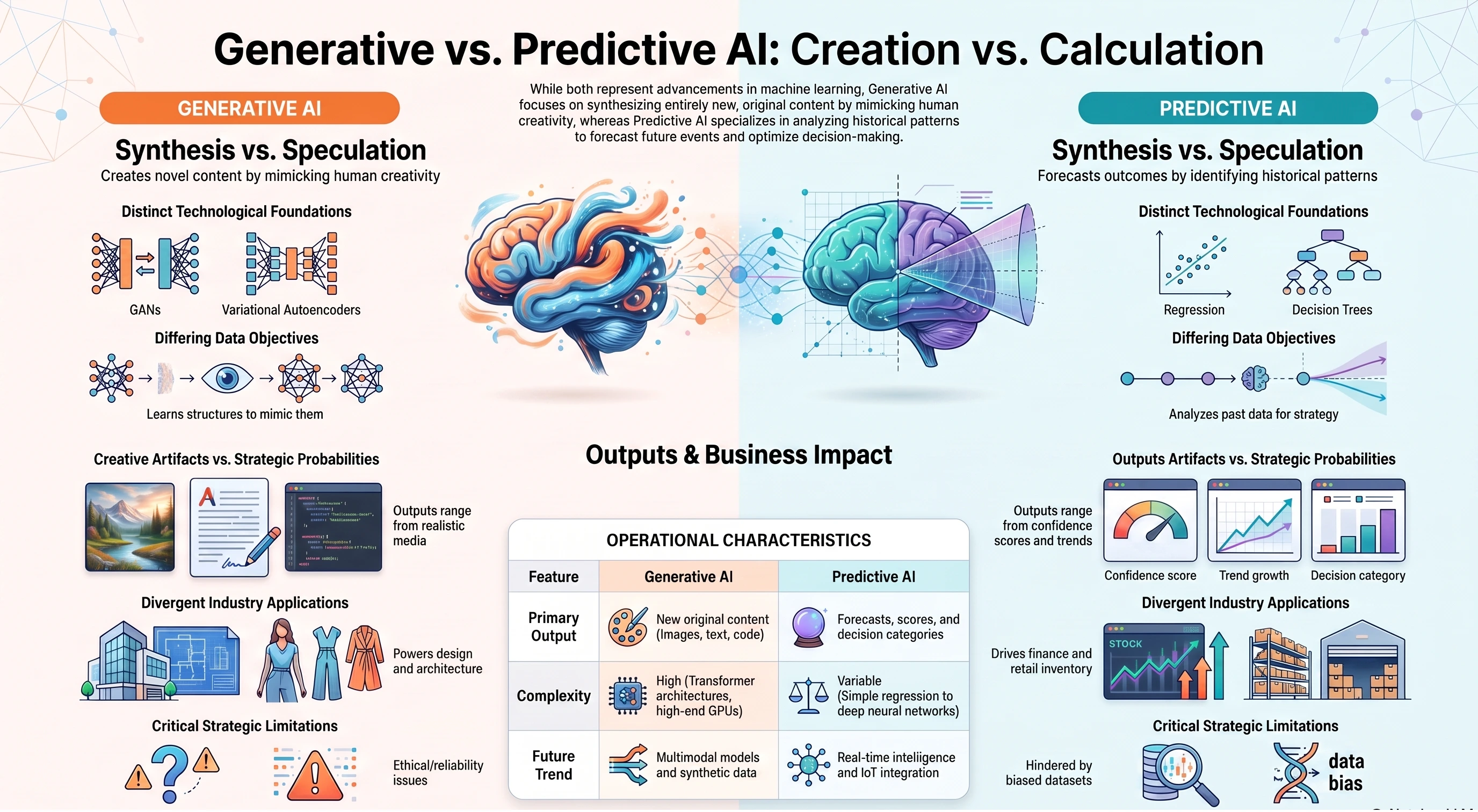
The main function of Generative AI is to generate entirely new and original content by learning from existing data and training. Gen AI apply its understanding to generate unique outputs. The technology is integral to industries where innovation is key, as it provides novel solutions and creations.
Predictive AI analyzes the existinga nd past data to forecast future trends. It helps identify the patterns within historical information to predict what might happen next. It enhances the decision-making abilities by anticipating the future goals, behaviours and risks.
Technologies Used
Generative AI uses advanced technologies, such as Variational Autoencoders and Generative Adversarial Networks. GAN has two neural networks that keep contesting with each other to generate new data, while Variational Autoencoders encode data, tweak it and then decode it to create a new variation. These technologies power GenAI to generate highly innovative and diverse content.
Predictive AI leverages a number of technologies, including classification algorithms, regression analysis, neural networks and decision trees. Classification data sorts data into categories, while regression analysis predicts outcomes. At the same tie neural networks stimulate human creativity to identify patterns, and decision trees break down data into decision paths.
Data Handling
Generative AI learns from the input data to produce new content reflecting known patterns. This helps GenAI to create realistic and diverse outputs by mimicking the underlying structure of its training data.
Meanwhile, predictive AI analyzes the past patterns within historical data to forecast future events and trends. These historical patterns help businesses forecast valuable insights and prepare a data-driven strategy across various fields.
Applications
Generative AI powers industries that depend on originality, variation, and rapid content production. Design teams use it to create advertising visuals, concept art, packaging drafts, and UI mockups without starting every project from a blank screen. Meanwhile, content platforms rely on these systems to produce blog drafts, personalized recommendations, subtitles, and multilingual communication at scale.
Predictive AI focuses on identifying patterns hidden inside historical and real-time data so organizations can anticipate future outcomes before they occur. For instance, financial institutions use predictive systems to evaluate investment risks, identify fraudulent transactions, and estimate market fluctuations. Retail brands analyze purchasing behaviour to forecast demand and optimize inventory distribution across locations.
Output
Generative AI produces entirely new outputs that resemble human-created material while remaining machine-generated. These outputs include realistic images, conversational text, music compositions, animation sequences, software code, product concepts, and video content. A well-trained model can generate visuals that resemble professional photography or create long-form articles that maintain contextual flow and natural readability. The value of these systems comes from their ability to produce original variations instead of repeating stored information.
Predictive AI delivers probabilities, classifications, forecasts, and behavioural estimations based on existing data patterns. Instead of generating something new, these systems calculate what will most likely happen next. A predictive model may estimate customer churn rates, identify credit risks, forecast sales demand, or detect equipment failure before breakdowns occur. Most outputs appear in the form of percentages, confidence scores, trends, or decision categories that help organizations respond proactively.
Complexity
Generative AI demands significant computational power because the system must understand patterns deeply enough to create convincing new content. The technologies, such as transformer architectures, Generative Adversarial Networks, and Variational Autoencoders, rely on enormous datasets and multi-layered neural structures during training. Developers often spend weeks or months refining these models to improve realism, contextual understanding, and response quality. High-end GPUs, distributed computing environments, and extensive parameter optimization usually support large-scale generative systems.
Predictive AI varies in complexity depending on the business objective and the nature of the dataset. Simpler models, such as linear regression or decision trees, handle straightforward forecasting tasks with limited variables. More advanced use cases require deep neural networks, ensemble learning systems, and real-time analytics pipelines capable of processing massive data volumes simultaneously. Predicting stock volatility, consumer intent, or healthcare outcomes often involves thousands of interacting variables and continuous model retraining.
Real-World Examples
Generative AI continues to reshape creative and technical industries through large-scale automation and intelligent content production. Fashion companies use it to generate clothing concepts, fabric combinations, and virtual try-on experiences before physical manufacturing begins. Gaming studios create adaptive environments and realistic non-player characters that respond dynamically to user interactions. Architects experiment with AI-generated layouts to explore multiple structural possibilities within minutes instead of days.
Predictive AI influences daily operations in sectors where forecasting accuracy directly impacts efficiency and profitability. Telecom companies predict customer churn and launch retention campaigns before users switch providers. Banks monitor spending behaviour to identify fraud patterns in real time and minimize financial losses. Agricultural platforms estimate crop yield performance by combining weather conditions, soil data, and satellite imagery. Smart city initiatives depend on predictive analytics to improve traffic flow, energy distribution, and public resource management.
Advantages
Generative AI expands creative possibilities by producing large volumes of original content within significantly shorter timelines. Businesses use it to reduce manual design workloads, automate repetitive production tasks, and accelerate innovation cycles. Synthetic data generation also helps industries train AI systems when real-world data remains limited, expensive, or highly sensitive. Healthcare organizations benefit from privacy-safe datasets, while cybersecurity teams simulate attack scenarios to strengthen defence mechanisms.
Predictive AI strengthens decision-making through data-driven forecasting and behavioural analysis. Organizations gain the ability to identify risks early, allocate resources more efficiently, and optimize operational strategies before problems escalate. Retailers improve inventory management, healthcare providers support preventive treatment planning, and financial firms enhance risk assessment accuracy. Predictive systems also improve customer experiences by enabling personalized recommendations, targeted marketing, and adaptive service delivery.
Limitations
Generative AI still struggles with consistency, factual reliability, and ethical responsibility. Models occasionally generate misleading information, distorted visuals, or outputs that fail to align with the intended context. Deepfake technology and manipulated media continue to raise concerns surrounding misinformation, digital trust, and identity misuse. Copyright conflicts also create legal uncertainty because generated outputs may resemble copyrighted material from training datasets.
Predictive AI depends heavily on the quality, relevance, and diversity of its training data. Biased datasets often produce biased predictions, which can reinforce existing inequalities in hiring, lending, policing, or healthcare systems. Inaccurate historical records also reduce forecasting reliability and create flawed decision pathways. Many predictive systems struggle when external conditions change rapidly because older patterns no longer represent current realities.
Future Trends
Generative AI will continue expanding beyond content creation into software engineering, digital simulation, personalized education, and enterprise automation. Businesses increasingly integrate multimodal models capable of understanding text, images, audio, and video simultaneously. Industries will likely adopt synthetic data generation more aggressively as privacy regulations become stricter worldwide. AI-assisted product development, virtual collaboration environments, and autonomous creative systems will also reshape how organizations innovate and communicate.
Predictive AI is moving toward real-time intelligence powered by connected devices, streaming analytics, and edge computing environments. IoT ecosystems already generate enormous data volumes from sensors, vehicles, medical devices, and industrial equipment, creating stronger foundations for predictive decision-making. Energy providers optimize consumption patterns dynamically, transportation systems reduce congestion proactively, and healthcare platforms monitor patient conditions continuously instead of periodically. Future predictive systems will likely combine automation with live analytics to support immediate operational responses across industries.
Conclusion
The debate between Generative AI vs Predictive AI doesn’t end with which technology is better than the other. Both technologies have different advantages and applications, as well as challenges to address. We created this comparison guide to help readers understand the key differences between the two and why they can’t be used interchangeably.
However, a skilled AI development partner knows how to use both these technologies holistically to benefit the business. If you are impressed with the capabilities of predictive AI and Generative AI, and are planning to leverage them to your advantage, we, at Mtoag Technologies, can help you. We have been in the AI development for over a decade and have so far helped 2500+ clients with their digital transformation.
FAQs
Is ChatGPT Generative AI or Predictive AI?
ChatGPT is mainly a form of Generative AI because it creates new content such as text, answers, code, summaries, and conversations. At the same time, it also works using predictive behaviour in the background, since it predicts the next most likely word in a sentence based on the context given. So technically, it uses prediction to generate responses.
What are the Top 3 Generative AIs?
Some of the most widely used Generative AI platforms today are OpenAI’s ChatGPT, Google Gemini, and Anthropic Claude. These tools are commonly used for content writing, coding, research, automation, image generation, and business productivity tasks. The “best” option usually depends on the type of work, accuracy needs, and workflow requirements.
Is Predictive AI the Same as Generative AI?
No, both are different. Predictive AI focuses on forecasting outcomes using existing data, such as predicting customer behaviour, sales trends, fraud risks, or demand patterns. Generative AI, on the other hand, creates new content like text, images, videos, or code. One predicts what is likely to happen, while the other generates something new based on learned patterns.