Public transportation is no longer what it was a decade ago. Digitalization has deeply influenced the space, and many market players have even started to dominate. And one such is the Moovit App. We know a lot of you already know about this transportation app, and only a few know that it has 1.5 billion active users and generates around $75 million in revenue while being free. These figures are enough for businesses to consider investing in transportation app development like Moovit.
Moovit is a transit app that doubles as a journey planner app. It allows users to track public transportation, such as buses and trains. Users can access real-time information related to the timings, maps and routes. It operates in over 3400 cities across 100+ countries and is available in 45 regional languages.
Ever since the launch of Moovit in 2012, many competitors have entered the space and are taking advantage of underlying opportunities. The transportation and logistics market is vast, and demand for such applications remains high. If you are planning to develop a Moovit-like app, this is the only guide you will need to understand the features, business model, process and the overall development cost.
Key Takeaways
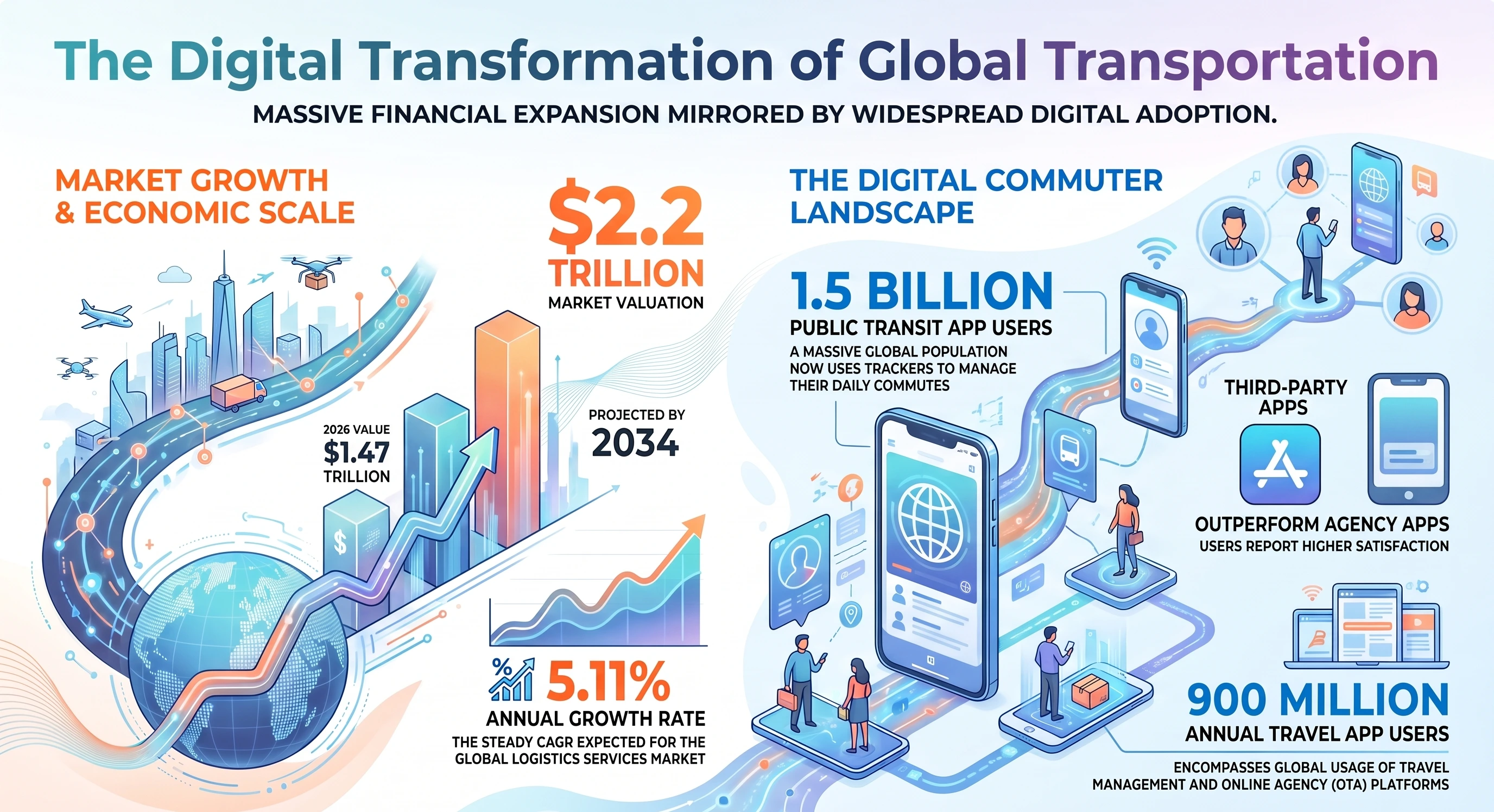
- The market for global transportation and logistics services was valued at $1478.23 billion in 2026, which is projected to grow at an annual CAGR of 5.11% to reach $2202.39 billion by 2034. (Source: Fortune Business Insights)
- Round 1.5 billion people globally use public transportation trackers to commute. (Source: Moovit)
- A shared Third-party transportation app has higher user satisfaction than an official agency-branded app. (Source: Science Direct)
- Over 900 million users globally use travel management apps or online travel agency (OTA) apps annually. (Source: Business Of Apps)
Understanding the Business Model of a Transportation App Like Moovit
Most of the transit apps, including Moovit, are usually free for users. People download it, search for routes, track transportation and navigate without even paying anything. But that doesn’t mean Moovit doesn’t make any money. The app still makes a profit, and its $70 million annual revenue is clear evidence of that.
Moovit don’t directly charge users, but instead it earns through multiple monetization channels that are built around its transportation network and user base.
Free for Users, Valuable for Businesses
Apps like Moovit attract a large number of users every day by offering route planning and real-time transit information for free. While users use the app thinking it's free, companies see them as data. More users mean more travel data, enabling new opportunities to partner with transport-related businesses.
Advertising and Sponsored Visibility
Advertising remains one of the best mobile app monetization channels for logistics and transportation platforms. Since users frequently use these apps, businesses have opportunities to promote local services and events within the platform. Some tourist attractions and recommendations may also include sponsored placements.
Partnerships with Transit and Mobility Providers
The transportation apps like Moovit often partner with ride-hailing services, public transport agencies an dmobility operators. In return, they are paid commission, licensing fees or integration revenue when users access these services through the app.
B2B Software and Analytics Services
Many transportation platforms operate as technology partners by offering route optimization, passenger insights, operational dashboards, and mobility analytics to transit authorities and transport companies through paid agreements.
Data Creates Long-Term Value
As said earlier, more users mean more data, and aggregated and anonymous data help organizations understand travel behaviour and improve transportation planning accordingly.
So, while users use the app thinking of it as free, the platform earns through a technology layer that supports the broader transportation ecosystem.
Core Features & Functionalities of a Transportation App
Transportation apps are built to provide the simplest and fastest way to commute without being lost and confused. They can help with route planning, navigation and important travel updates in one unified platform. However, you need to pay attention to each feature that supports these functionalities.
Here’s a list of features needed for a transportation app like Moovit:
Route Planning and Smart Journey Suggestions
Route planning remains the most important feature for a transportation app. Users should be able to enter their starting point and destination to get multiple travel options based on travel time, distance, transfers and available transportation options. Meanwhile, smart recommendations help users to choose the best and most convenient option.
Real-Time Transit Tracking
Apps like Moovit offer live updates on transportation, such as metros, buses, trains and other available services. Instead of relying on a fixed schedule, the app stands out for offering real-time updates, estimated arrival times, delays and service changes during the journey.
Multi-Modal Transportation Integration
Modern transit apps offer multiple travel options within a single journey. Users can see available public transport, walking directions, ride-sharing services, bicycles, or other mobility solutions to create flexible travel plans.
Live Navigation and Trip Assistance
After selecting the route, the app should have a feature that guides users throughout their journey with step-by-step navigation. It should have notifications for when to board, where to switch transportation modes and when to get off at the correct destination.
Location-Based Search and Nearby Discovery
Most transit apps use GPS capabilities to identify the user’s location and show them the nearby stops, transit routes, stations and available transport options. This makes it easy to travel without even searching.
Notifications and Travel Alerts
Transportation apps send real-time alerts related to route disruptions, delays, traffic conditions and schedule changes. These updates can help travellers adjust their plans and reduce unexpected interruptions during commuting.
User Feedback and Travel Insights
Many transportation and logistics platforms allow users to share travel updates, report issues and contribute real-time information, helping improve route accuracy and service quality over time.
Steps for Building an App like the Moovit App
Building a transportation app is definitely not like creating a map screen and connecting it to GPS. Transportation apps operate on real-time data, multiple service integrations, and continuous updates happening in the background. The real challenge is making all of those moving parts feel simple for the user.
1. Define the Transportation Model and Scope
First off, you need to decide what kind of transportation experience you want your app to offer. Some platforms are all about public transit, while others focus on buses, trains, ride-sharing, walking routes and micro mobility options. Figuring this out early on will affect a whole lot of your architecture, APIs, the development effort and how scalable your app will be.
2. Research Transit Data Sources and Integrations
Before you start building, you need to figure out where you are going to get your transportation data from. Most apps rely on transit APIs, mapping providers, GPS feeds, schedule databases and real-time location services. The quality of your data is way more important than how your app looks because if your data's off, your users' trust will be gone in a heartbeat.
3. Design the User Journey and App Experience
Transportation apps are used in time-sensitive situations, so navigation must feel effortless. Make sure to focus on route search, trip planning, nearby stops, live tracking, and minimal user actions. The interface should reduce decision-making rather than create additional steps.
4. Build the Backend Infrastructure
The backend handles user requests, route calculations, transit updates, notifications, and data synchronization. Since transportation information changes continuously, the system must support real-time processing, scalable APIs, caching mechanisms, and stable cloud infrastructure.
5. Develop Core Transportation Features
Build the features that turn the actual commute into an experience. This usually includes route planning, live transit tracking, location services, journey recommendations, alerts, saved routes, and trip history. Start with essential functionality before expanding.
6. Add Real-Time Tracking and Analytics
Real-time updates make the app way more usable. Get GPS tracking, event processing, monitoring dashboards and analytics up and running, so you can see how your routes are performing, what your users are doing and where the operational issues are.
7. Test It, Launch It, And Keep Improving
Transportation apps are rarely done and dusted at launch. Keep an eye on user feedback, track your performance metrics, sort out any routing issues, and get the data more accurate over time. Continuous optimization is what separates a decent transportation app from one that people wholly rely on.
How Much Does It Cost to Develop a Transportation App?
The cost of developing a transport app like Moovit starts from as low as $25,000 and may go up to $3,00,000. However, it greatly depends on the functionality, complexity and the planned features, which makes the backend architecture a major cost factor.
Let’s break down the cost based on complexity level:
A basic transportation app with core features like route search, user registration, simple navigation, and GPS tracking typically falls in the range of $25,000–$50,000.
Meanwhile, a mid-complexity app with all the above features and add-ons like real-time transit updates, route optimization, push notifications, admin controls, and third-party API integrations may cost between $50,000 and $120,000.
At the same time, an advanced platform similar to Moovit can cost around $150,000–$300,000+. These include features such as multi-modal trip planning, live vehicle tracking, analytics dashboards, cloud scaling, predictive routing, and high-volume data processing.
However, these cost estimations are only the initial investment; the transportation platforms need cloud infrastructure, mapping services, API usage, monitoring tools, maintenance, and feature upgrades, which further add to the cost.
The best piece of advice we can give here is to launch an MVP first, validate the user behaviour and expand the platform based on that instead of integrating every advanced feature from day one.
Conclusion
Building an app like Moovit definitely needs a significant investment, but more than that, it needs a strategic execution plan to be competitive enough to survive and make profits. Above, we have tried our best to break down everything section-wise to help businesses understand better.
If you have an idea for a transportation app and think it might be the next big thing in the industry, Mtoag Technologies can help you plan, execute, build, and launch it with the right technical foundation and guidance. With over 17 years of experience in software development and more than 2500 successful project deliveries, we understand what it takes to move an idea from concept to a scalable digital product.
FAQs
How Does the Moovit App Work?
Moovit works by collecting transportation information from different sources and turning it into a simple travel experience for users. When someone enters a destination, the app compares available routes using buses, metro systems, trains, walking paths, and sometimes other mobility services. It also uses live updates, location data, and schedule information to suggest routes, estimate arrival times, and guide users during the journey.
Is Moovit Better than Google Maps?
It depends on how the app is being used. If the goal is daily public transportation and detailed transit guidance, many people prefer Moovit because it focuses heavily on buses, trains, and commuting updates. On the other hand, Google Maps is broader and supports navigation across driving, walking, local discovery, and many other use cases. For regular commuters, transit-focused features may feel more useful, while general users may prefer an all-in-one mapping experience.
Does Moovit Cost Money?
Moovit is generally free for users to download and use for route planning and transportation guidance. However, like many free apps, it can generate revenue through advertising, business partnerships, premium offerings in some regions, and transportation-related integrations. Users typically access core features without paying directly.
How Long Does It Take to Develop an App Like Moovit?
The development time depends on the complexity of the product. A basic transportation app with route search and GPS features may take around 3–5 months. A more advanced platform with real-time tracking, transit integrations, live updates, notifications, and scalable infrastructure can take 8–12 months or longer. Most successful transportation apps are developed in stages and improved continuously after launch.