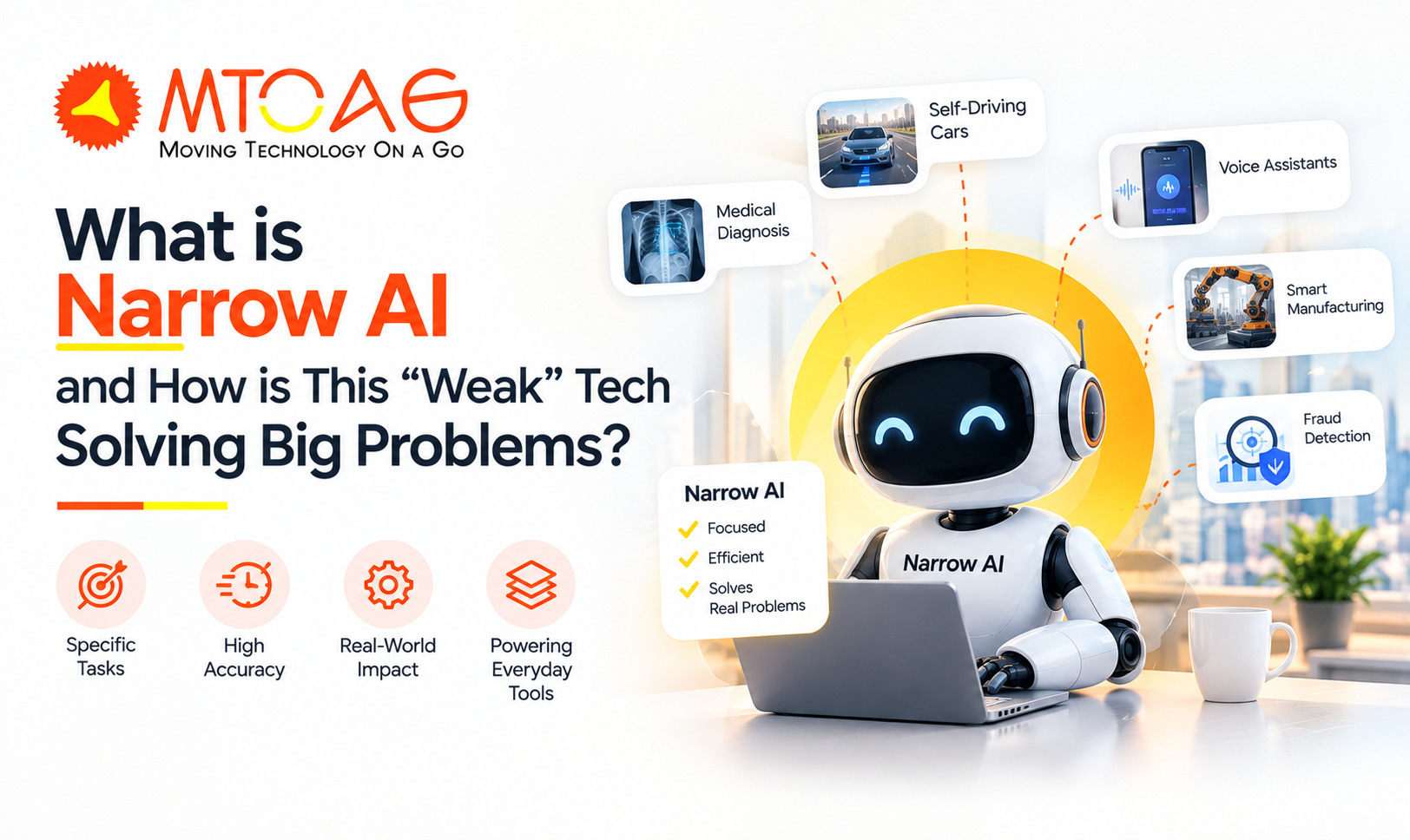
It’s almost 2027, and Artificial Intelligence has literally taken over everything you could have imagined. And the surprising part is that you even interact with AI several times a day without even realizing it. When your bank flags a suspicious transaction, when Google Maps presents you with the fastest routes, or when Netflix recommends the next Binge-watch based on your past viewing history, that’s all because of Narrow AI.
Originally termed Artificial Narrow Intelligence (ANI), the technology is also referred to as “weak” AI but why? If it’s the one powering everything in the AI ecosystem? Then why is it called Weak? Well! ANIs are basically specialized systems that are trained to perform a single task, or a group of tasks, sometimes within a specified domain.
Let’s learn more about artificial narrow intelligence, its impact, how it differs from other AI types and what it is used for. This guide will help you understand the concept in the easiest way possible.
What is Narrow AI?
Narrow AI, officially goes by the term “Artificial Narrow Intelligence (ANI)” and unofficially as “Weak AI,” is actually incredibly powerful, like other types of AI. The ANIs are defined as advanced AI systems that are explicitly designed for a specific task or a group of closely related tasks.
Unlike General AI, narrow AI doesn’t replicate human intelligence or perform intellectual tasks like human beings, as it operates under a predefined set of rules. As they are specifically designed to perform specific tasks with superhuman speed and precision, it can’t adapt to out-of-the-programming tasks.
Narrow AI is one of the most common AI types we use today. This can be facial recognition technology, AI assistants, recommendation engines, or autonomous vehicles. However, it falls short when it is about human consciousness, genuine understanding and the capability to apply knowledge to different contexts
Narrow AI is the most common form of AI that we encounter today. It is programmed to perform singular tasks such as facial recognition, language translation, or playing chess, and it does so with proficiency often surpassing human capability. However, it lacks consciousness, genuine understanding, and the capacity to implement knowledge across different scenarios beyond its specific programming.
Statistical Overview of Artificial Narrow Intelligence (ANI)
- The commercial AI technology in use today is all based on Narrow AI. (Source: Vier.ai)
- According to the guiding standard in AI deployment, narrow AI should handle 70% of repetitive work, while 30% is left for human judgment and creativity. (Source: Vier.ai)
- Financial narrow AI systems can detect anomalies and fraud in milliseconds, reducing false positives in comparison with old rule-based systems. (Source: ShipShapeData)
Artificial Narrow Intelligence (ANI) vs Artificial General Intelligence (AGI)
Point of ComparisonArtificial Narrow Intelligence (ANI)Artificial General Intelligence (AGI)What it isAI is designed to perform one specific task really well.AI that can think, learn, and solve different kinds of problems like a human.What it can doCan only do the specific task it was built for.Can handle many different tasks without needing a separate system for each one.Learning abilityLearns within its assigned task and cannot easily apply that knowledge elsewhere.Can use what it learns in one area to solve problems in another, just like humans do.FlexibilityLimited and task-specific. It cannot adapt to completely new situations on its own.Highly flexible and can adapt to new challenges without being specially programmed.ExamplesChatbots, recommendation systems, voice assistants, spam filters, and facial recognition.A virtual assistant that could learn any new skill, understand emotions, reason, and perform almost any intellectual task like a human. (This does not exist yet.)Availability todayWidely used in everyday life across many industries.Still under research and has not been achieved yet.What is Artificial Narrow Intelligence (ANI) Used For?
As the name suggests, artificial narrow intelligence is designed to perform specific narrow tasks within the same domain. The system accesses data from a specific resource and uses it to do the task or series of related tasks. As these systems lack human consciousness and intelligence, their operations are limited to their programming only.
Narrow AI systems are really helpful for businesses and even for personal use. For example, AI-powered manufacturing machines can manufacture products faster than humans. At the same time, digital virtual assistants can play or turn off music or videos when asked. These systems get better over time through deep learning and machine learning.
What are the Types of Narrow AI?
Narrow AI is classified into two main types, including
Reactive AI
It is the basic version of Narrow AI, with zero data storage capabilities and literally no memory. It can emulate human behaviour and respond accordingly to different interpretations without any previous experience.
Limited Memory AI
This is the more advanced version of narrow AI with memory and data storage abilities. This allows machines to interpret accurately using statistical data. Most of the narrow AI in action today is limited memory AI that allows machines to use massive amounts of data to give accurate results using deep learning.
Popular Examples of Narrow AI
Here’s a list of some of the most popular real-world examples of Artificial Narrow Intelligence:
- Virtual assistants, such as Amazon’s Alexa, Apple’s Siri, Microsoft’s Cortana, and Samsung’s Bixby.
- AI-powered systems used as a prediction tool to diagnose cancer and other health-related issues accurately using human behaviour replication, cognition and reasoning.
- Self-driving autonomous vehicles, such as Waymo, Tesla and Cruise.
- IBM’s Watson is capable of responding to queries in natural language.
- Google’s RankBrain is an algorithm used to sort search results.
- Drone-based robots.
- Image/facial recognition and interpretation software.
- Tools for the best recommendations based on past purchases, search results and history in the marketing and entertainment domains.
What are the Pros of Narrow AI?
While narrow AI has limited broad thinking capabilities, it offers real benefits within these limitations. Businesses rely on these AI systems to save time and effort and reduce the costs associated with handling tasks that are overwhelming for humans to manage at scale.
Let’s look at some of its main benefits:
- Automation of Repetitive Tasks: Narrow AI systems are capable of excelling at repetitive and routine tasks, such as appointment scheduling, data entry, or information sorting, helping businesses to focus on more complex tasks.
- Continuous Availability: Unlike Humans, AI systems remain available 24/7 and don’t even need rest or frequent coffee breaks. They can provide support and process requests whenever asked for.
- Accuracy and Consistency: Narrow AI is specialized in reducing errors and delivering results wth accuracy, no matter whether it is about detecting defects in manufacturing units or scanning medical images.
- Scalability and Cost Efficiency: Narrow AI needs prior training, and once it is done, it can handle a massive workload. This eliminates the need for hiring extra staff or resources, which lowers the operational costs.
- Faster Decision-making: Narrow AI has the ability to process massive datasets within seconds. This offers businesses the crucial insights to quickly react, make changes and lead to better decisions.
- Personalized Experiences: Narrow AI can create personalized experiences for each user. For instance, Netflix recommends the next binge-watch to users based on past viewing behaviours.
- Stronger Security: Banking, Financial Services, and Insurance (BFSI) use narrow AI to spot anomalies and unusual transactions to flag potential fraud threats even before they happen.
What are the Cons of Narrow AI?
Despite the benefits, Narrow AI is criticized for its limitations. Systems built around weak AI are powerful, but within their scope only. They even raise concerns over cost, data and security.
Here are some of the downsides of narrow AI:
- Limited Scope: Narrow artificial intelligence systems are designed to perform a specific task within a limited scope. A system trained to recognize faces can’t be used to analyze medical scans without being retrained.
- No True Understanding: AI systems can process massive data resources and spot patterns, but they are unable to understand the context or meaning as humans do. This limitation leads to issues like AI hallucinations, where these systems generate output that looks convincing but is completely inaccurate.
- Dependence on Data Quality: The performance of narrow AI depends greatly on the training data. If the training data has some flaws, the results will have those weaknesses.
- Prone to Bias: If the data these systems use are culturally, socially, or demographically biased, AI models may replicate or even show those biases in their recommendations.
- High Development and Maintenance Costs: Building, training and updating such an advanced system requires a specialized team and significant resources, which adds further to the overall cost.
Conclusion
Artificial Narrow Intelligence may be called “weak” AI, but its impact is highly powerful. It has become a practical tool for many businesses, helping them perform tasks with ease, such as improving customer experience, detecting fraud, optimizing operations, and automating repetitive work.
While it limits thinking and reasoning like humans, it can still deliver exceptional outcomes within the task scope it is designed for. As AI continues to evolve and witness higher adoption, choosing the right AI solutions has become a competitive advantage.
If you are planning to integrate AI into your business, Mtoag Technologies can help you do so with ease. We offer advanced AI development solutions that are secure, scalable and industry-specific to solve real business challenges.
FAQs
What is Narrow AI with Examples?
Narrow AI, also known as Artificial Narrow Intelligence (ANI), is an AI system built to perform one specific task or a set of related tasks. It cannot think beyond its programming. The popular real-world examples include ChatGPT, Siri, Google Maps, Netflix recommendations, spam filters, and facial recognition systems.
Is ChatGPT a Narrow AI?
Yes, ChatGPT is a form of Narrow AI. It is designed to understand and generate human-like text based on user prompts. While it can answer questions, write content, and assist with many language-related tasks, it cannot think, reason, or perform tasks outside its training and design.
What is Narrow AI vs Generative AI?
Narrow AI is a broad category of AI designed for specific tasks, such as fraud detection or voice recognition. Generative AI is a type of Narrow AI that creates new content like text, images, music, or code. In simple words, all Generative AI is Narrow AI, but not all Narrow AI is Generative AI.
Which Companies Use Narrow AI?
Many of the world's leading companies use Narrow AI in their daily operations. Google uses it for search and navigation, Amazon for product recommendations, Alexa, Netflix for content suggestions, Tesla for driver assistance, and banks use it to detect fraudulent transactions.
Which Three Applications Use Narrow AI?
Three common applications of Narrow AI are virtual assistants like Siri and Alexa, recommendation systems used by Netflix and Amazon, and fraud detection systems used by banks. These AI systems are trained for specific tasks and cannot perform beyond their intended purpose.