Serverless computing is the latest addition to the IT infrastructure. Gone are the days when businesses were required to pay hefty amounts for physical servers, maintenance, and complex infrastructure management just to keep their websites running. However, the introduction of cloud computing solved this problem to a great extent, and then serverless computing has taken it a step further. It took no time to become enterprises’ first choice.
Serverless computing is basically a cloud model where the cloud service providers manage the infrastructure tasks, so developers can focus on creating and deploying applications. This model helps businesses lower costs, accelerate development, and focus on business logic.
Let’s further understand what serverless computing is all about, how it works, what its potential uses are, some popular examples nd how it benefits both businesses and the development team.
What is Serverless Computing?
Serverless computing is a cloud infrastructure management model where the development team build the application without having to manage or allocate servers. The cloud services provider automatically manages and allocates the servers. The ‘Serverless’ here doesn’t mean there are “no servers” involved. Instead, they are managed by a cloud service provider (CSP).
This way, developers can solely focus on core business logic and coding the best front-end for the application. All they are left to do is build the best web application and deploy it to CSP-managed containers.
After that, the cloud providers handle the rest of the process, which may include allocating the cloud infrastructure required to run the code and managing the routine infrastructure maintenance, such as capacity planning, operating system updates, system monitoring, and security management.
The best part of leveraging serverless computing services remains the cost-effectiveness that comes along. You don’t have to pay for idle capacity. The provider allocates the required resources when the code executes and stops when it stops. The billing follows the same suit, and the pricing is calculated based on required resources and execution time.
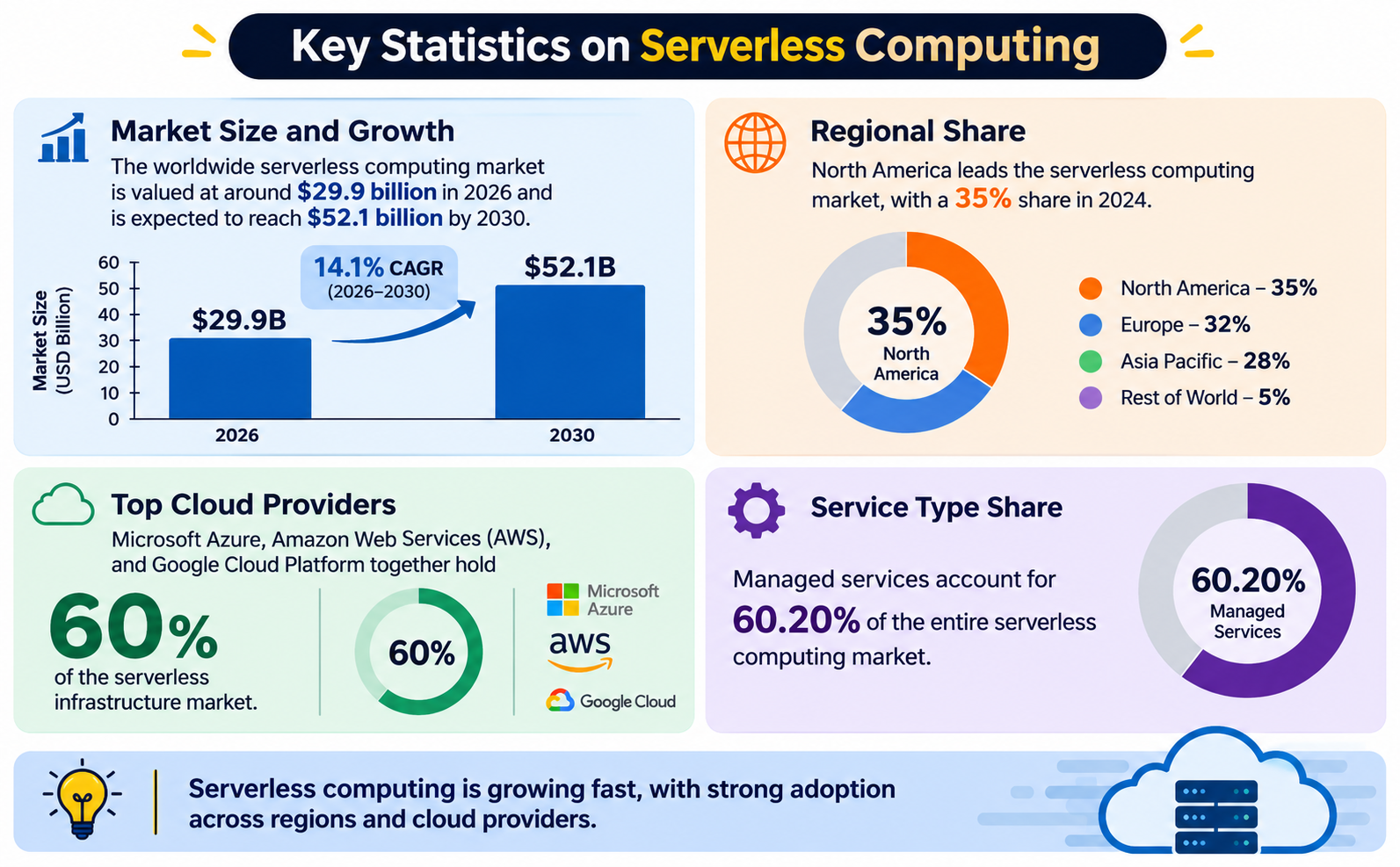
Key Statistics on Serverless Computing
- The worldwide serverless computing market is valued at around $29.9 billion in 2026, which is expected to grow at a CAGR of 14.1% to reach 52.1 billion by 2030. (Source: GrandViewResearch)
- North America dominates as a major stakeholder, with a market share of 35% in 2024. (Source: GrandViewResearch)
- Microsoft Azure, Amazon Web Services (AWS), and Google Cloud Platform collectively share 60% of the serverless infrastructure market. (Source: Mordor Intelligence)
- Managed services account for 60.20% of the entire serverless computing market. (Source: Mordor Intelligence)
Traditional Computing vs Serverless Computing
AspectTraditional ComputingServerless ComputingInfrastructure ManagementTeams are responsible for provisioning, configuring, and maintaining servers.The cloud provider manages all server infrastructure automatically.Resource AllocationCompute resources are allocated in advance, even during periods of low demand.Resources are allocated dynamically only when code is executed.Cost StructureYou pay for server uptime, regardless of whether applications are actively used.You pay only for the actual execution time and resources consumed.ScalabilityScaling requires manual intervention or pre-configured auto-scaling rules.Applications scale automatically based on incoming requests without manual configuration.Deployment SpeedInfrastructure setup can delay application deployment.Developers can deploy functions quickly without managing infrastructure.Maintenance ResponsibilityOperating system updates, patches, and server health monitoring are handled internally.Infrastructure updates, security patches, and maintenance are managed by the cloud provider.Application DesignUsually built as large, tightly connected applications (monolithic or layered architecture).Typically designed as small, event-driven functions that perform specific tasks.Performance During Idle TimeServers continue running even when there is little or no traffic.No compute resources run when there are no requests, reducing unnecessary costs.Fault IsolationA server or application failure can impact multiple services running on the same infrastructure.Individual functions execute independently, reducing the impact of isolated failures.Operational ComplexityRequires dedicated teams for infrastructure monitoring, backups, and capacity planning.Operational overhead is significantly reduced, allowing teams to focus on development.Ideal Use CasesLong-running applications, enterprise systems, databases, and legacy workloads.APIs, microservices, event-driven applications, real-time processing, and automation workflows.Real-World Use Cases of Serverless Computing
Although serverless computing has emerged as a versatile cloud architecture, this doesn’t imply that it fits every workload. But there are some specific scenarios where it performs exceptionally well.
On-Demand API Backends
The most common applications of serverless technology remain building the backend of websites, mobile, and desktop applications. Each different API endpoint maps directly to a single serverless function. For instance, the traffic on an e-commerce application remains steady during normal hours. But during a flash or Black Friday Sale, the traffic can abruptly skyrocket. Meanwhile, the serverless API immediately scales to accommodate the sudden requests without any manual intervention and scales back to normal when the sale ends.
Real-Time, Event-Driven Data Processing
Serverless computing is specifically built around triggers and is highly optimized for asynchronous data processing workflows. They ideally work best for scrubbing application logs, processing multimedia assets, or handling IoT telemetry data stream packets.
Scheduled Operational Tasks and Automation
Many modern applications greatly depend on periodic data cleanups, maintenance routines, or daily report generation. Maintaining dedicated cron-job servers for a single task results in massive resource waste.
Serverless computing can schedule these recurring tasks precisely using cloud timers. The system triggers specialized functions to generate business intelligence reports, aggregate transactional data and email them to all stakeholders every day. This way, businesses pay only five minutes of compute time that is required to compile data, which eliminates the always-on cost for periodic tasks.
Advantages of Serverless Computing Over Traditional Computing
Here are some of the pros of leveraging serverless computing over cloud and traditional computing:
1. Reduced Infrastructure Costs
Cost efficiency is the X-factor behind the popularity of serverless computing among enterprises. In traditional server settings, businesses need to pay for servers that remain active 24x7 even when there is no traffic. However, serverless follows a pay-as-you-go model, where you pay only when the code is executed. There will be no cost for idle servers, which makes it an economical option for many startups, growing businesses, and applications with unpredictable workloads. The cost helps businesses optimize their cloud spending without sacrificing performance.
2. Automatic Scalability
The best thing about serverless computing is its automated adjustment of resources based on application demand. In traditional servers, scaling always requires manual configurations, auto-scaling policies, capacity planning, and, obviously, extra cost. However, with serverless computing, the cloud platforms immediately allocate additional resources when traffic surges and scale back when the demand decreases. This makes sure that performance remains consistent even during peak usage without unnecessary resource consumption during quieter periods.
3. Faster Development and Deployment
Developers using serverless computing can focus on coding quality rather than thinking more about server management, operating systems, or infrastructure. This can lead to reduced development complexity and faster development cycles. Since the cloud service provider handles all the server-related updates, allocation, and runtime management, you can launch new features much faster. However, the deployment of individual functions simplifies testing, which allows businesses to respond quickly to customer needs and dynamic market demands.
4. Lower Maintenance and Operational Effort
Traditional computing requires continuous maintenance of servers, including operating system patches, software updates, security management, and hardware monitoring. These tasks take a lot of time and effort and require dedicated IT resources. Serverless computing eliminates most of these responsibilities, as cloud providers manage the underlying infrastructure. Therefore, the development teams spend less time on operational tasks and more time on improving the application, solving business problems, and creating new features. This reduces the operational burden and increases productivity while minimizing infrastructure-related tasks.
5. High Availability and Improved Reliability
Serverless platforms are built on highly resilient cloud infrastructure that is designed to deliver reliable performance. Cloud providers automatically distribute workloads across multiple servers and availability zones, reducing the risk of downtime caused by hardware failures. Unlike traditional environments, where businesses must configure redundancy and failover mechanisms themselves, serverless services include these capabilities by default. This built-in reliability helps ensure applications remain available to users, improves the overall user experience, and reduces the complexity of disaster recovery planning.
Popular Examples of Serverless Computing
Some of the popular real-world examples of serverless computing include:
- AWS Lambda: This service by Amazon allows developers to run code without server management. It automatically scales up with demand and integrates with AWS services. It is ideal for APIs, data processing, automations and event-driven applications.
- Azure Functions: It is a specialized platform by Microsoft that is for building event-driven applications. The service automatically executes the code in response to triggers and integrates with Azure services, simplifying the application development process.
- Google Cloud Functions: This cloud service from Google executes code only when it is triggered by a specific event. It automatically scales, manages infrastructure, and integrates well with Google Cloud services for backend development.
- Cloudflare Workers: Workers run serverless applications at the network edge and process requests closer to users by reducing latency. It is ideal for authentication, APIs, website performance optimization, and content personalization.
- Firebase Cloud Functions: Firebase Functions help developers build backend logic for mobile and web applications without the hassle of managing servers. They respond to Firebase events automatically, which makes the development process faster and more scalable.
Conclusion
Serverless computing has positively impacted the software development industry by reducing infrastructure complexity and allowing development teams to focus on better digital experiences. As businesses are increasingly showing interest in cloud-native technologies, choosing the right architecture is as important as the right technology partner.
Every development project has different requirements, and understanding them helps businesses make informed decisions. And, yes, a well-planned serverless strategy can deliver lasting value. If you are planning to build cloud-based applications or modernize your existing systems, Mtoag Technologies can help you identify the right approach and develop scalable, high-performing solutions that support your business growth.
FAQs
What is True about Serverless Computing?
A common misconception is that serverless computing does not use servers. In reality, servers are still used, but the cloud provider manages them instead of the business. This allows developers to focus on building applications while the provider takes care of infrastructure, scaling, maintenance, and updates.
What is the Difference between Cloud and Serverless?
Cloud computing provides virtual servers, storage, and other resources that businesses still need to configure and manage. Serverless computing is a cloud service where the provider also manages the servers. Developers simply deploy their code, and the platform automatically handles the infrastructure and scaling.
Is Serverless Computing SaaS or PaaS?
Serverless computing is generally considered part of Platform as a Service (PaaS) because it provides a platform where developers can build and run applications without managing servers. However, it is often viewed as a specialized cloud model known as Function as a Service (FaaS), which is closely related to PaaS.
Is Serverless Better than Kubernetes?
Serverless and Kubernetes solve different problems, so one is not always better than the other. Serverless is ideal for event-driven applications, APIs, and workloads that change frequently. Kubernetes is better for managing complex, long-running applications that require greater control over the infrastructure and deployment environment.
What is the Use of Serverless?
Serverless computing is used to build and run applications without managing servers. It is commonly used for web and mobile application backends, APIs, file processing, real-time notifications, chat applications, data processing, automation tasks, and event-driven workflows that need to scale automatically.