Although the COVID-19 pandemic wreaked havoc worldwide, it also gave an unforgettable lesson that health is the real wealth, which we usually take for granted. However, the pandemic is over now, and people have started being more cautious with their fitness, probably the reason why businesses are increasingly investing in fitness app development.
On the Google Play Store alone, health and fitness apps saw 3.6 billion downloads worldwide. These mainly included running, tracking, dieting, yoga, meditation, calorie tracker and home workout categories. The popularity of health and fitness apps shows no signs of stopping, with users preferring digital solutions to staying fit and accessing personalized guidance from anywhere.
Today, fitness apps are not limited to simple workout timers or step counters. They are now being integrated with AI, real-time analytics, wearable compatibility, video streaming and personalized recommendations. But before you blindly board the ship, there are basics that you need to understand, mainly the ROI potential, cost, revenue models and the process itself. So, let us explain to you everything step by step so you know what to expect next and take more informed decisions.
Key Statistics on Fitness App Development Services
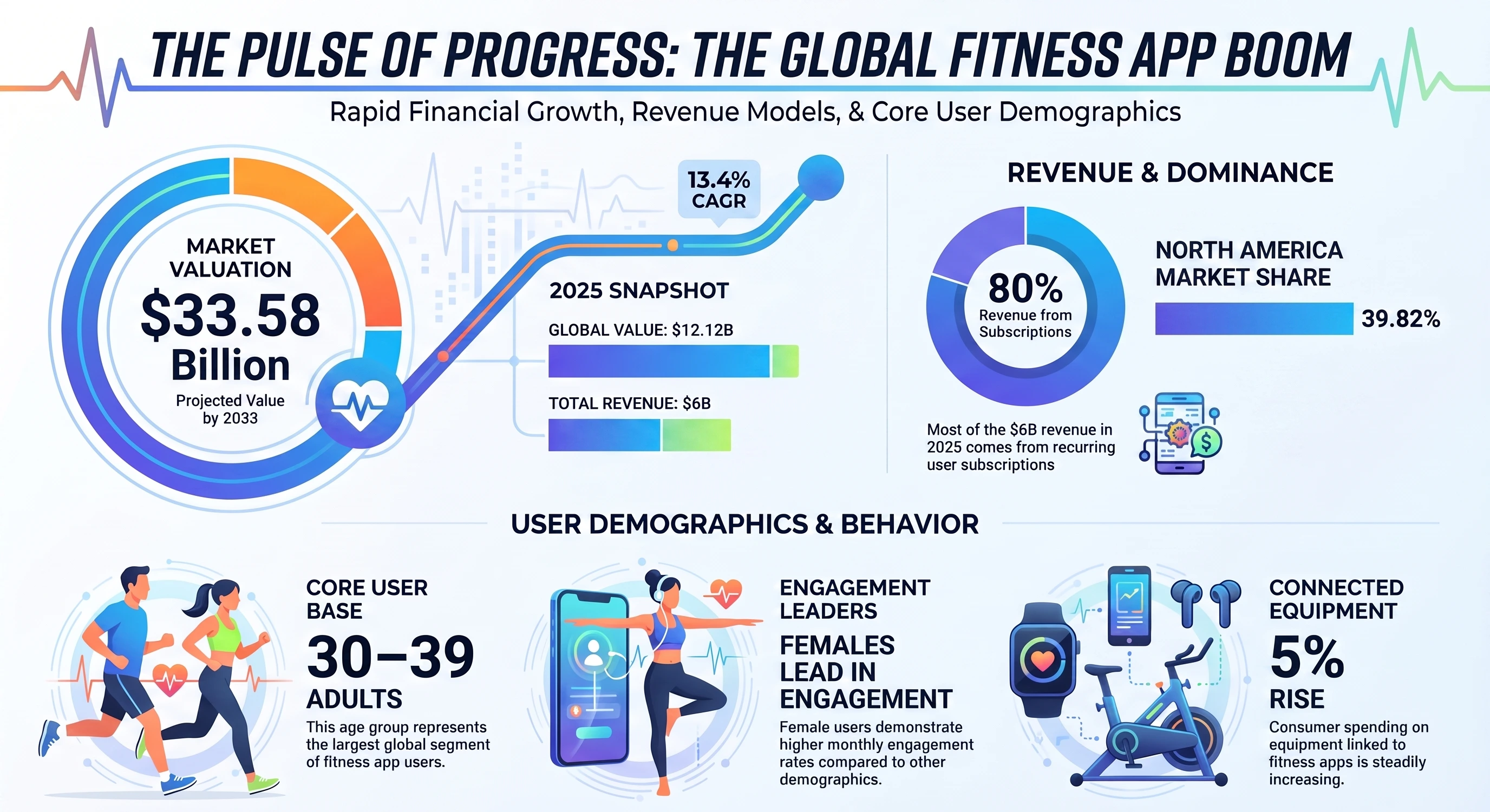
- The global fitness app market is valued at $12.12 billion in 2025 and is projected to grow at a CAGR of 13.40% to reach $33.58 billion by the end of 2033. (Source: Grand View Research)
- North America contributes to the highest market share of the fitness app market with 39.82%. (Source: Grand View Research)
- Health and fitness apps generated approximately $6 billion in revenue in 2025, with about 80% of revenue coming from subscriptions and the rest from ads. (Source: Business Of Apps)
- Adults (aged 30–39 years) are the largest user base globally, with female shows higher monthly engagement. (Source: Run Repeat)
- Consumers' spending on connected fitness equipment through an app has increased 5%, and paid apps have seen a 10% growth overall. (Source: Run Repeat)
The above-featured stats are enough to prove the worth of health and fitness app development and present the best opportunities for healthcare and fitness businesses to invest. With such a massive market value that continues to rise, increasing user demand for virtual fitness and higher ROI potential, fitness applications are making their own niche.
Core Features of Fitness Apps That Can’t be Ignored
Have you ever wondered why top fitness apps are increasingly gaining more users? The reasons are many, and behind every reason there is a feature that powers up the application to be as smart as users need. With the integration of AI, ML and other emerging technologies, these apps continue to evolve and introduce new features to keep users engaged.
Here, we have listed a list of key features that you should never ignore while developing a fitness app:
1. Robust Tracking & Analytics
- Activity & Sleep: This feature continuously logs the distance, altitude, daily steps and sleep cycles to evaluate recovery.
- Advanced Progression: There should be a feature that automatically tracks sets, reps and personal records.
- Wearable Sync: The apps should seamlessly integrate with wearables, such as Apple Watch, Samsung Watch, Fitbit and Garmin to scrape biometric data and heart rate zones in real time.
2. Personalization & AI Coaching
- Smart Routines: These features help users with AI-generated exercise regimens that automatically adjust based on past performance.
- Tailored Profiles: Allow users to adjust the age, height, weight and specific fitness records for the profile.
3. Nutrition & Wellness Planning
- Diet Simulation: There should be a feature for tracking calorie counts, water intake, and macronutrient breakdown.
- Dietary Adjustments: The app should have custom diet plans based on allergies, ingredient preferences, or even on budget.
4. Gamification & Community
- Reward Systems: To make the app more engaging, an integrated reward system that includes points, badges and milestones to boost motivation.
- Social Support: Allow users to share their milestones, accomplishments, and join challenges to keep them engaged.
5. Content & Instructional Resources
- Instructional Libraries: Make sure your app works for both beginners and fitness freaks. There should be video or animated guides to ensure they follow proper techniques.
- Live & On-Demand Classes: There should be an option for live or on-demand personalized virtual classes, such as guided yoga, HIIT or strength classes.
6. Usability & Notifications
- Push Reminders: Make sure your fitness application sends personalized push notifications for workouts, meal prep, and hydration to maintain daily discipline.
- Data Privacy: Modern users appreciate clear communication and control over personal health and location data, so that is a priority too.
Understanding the Revenue and Monetization Models of Fitness App Development
Most of the fitness apps generate revenue through a combination of app monetization models that mainly include subscriptions, freemium, brand partnerships, and in-app purchases.
1. Subscription Models (The Industry Standard)
Subscriptions are the most common and predictable revenue model for fitness apps, where users are charged monthly or annually based on their preference. They can be based on tiers, from basic to most advanced. It provides steady, recurring revenue for the app while keeping consistent user engagement.
2. Freemium Model
This model attracts a large user base by offering the core app for free. However, users need to pay for the advanced features and functionalities. The free features may include basic step counting and simple activity logs, while advanced features include exclusive video tutorials and customized diet charts.
3. In-App Purchases & Pay-Per-Use
This is one of the best app monetization models for fitness app development. Instead of recurring subscriptions, it allows users to make purchases of specific content or features as needed. For instance, users can pay for a 12-week workout plan for weight loss or individual diet plans.
4. Enterprise & Corporate Wellness (B2B)
This is one of the newest yet the most effective monetization models. It allows fitness platforms to collaborate with companies to offer employee wellness perks. This model provides steady revenue, massive volume and long-term contracts.
5. Affiliate Marketing and Brand Partnerships
Modern fitness apps have a large user base, which makes them prime platforms for brand promotions. Apps can earn a commission by promoting specific supplements, gear, or even partnering with sports apparel brands. They can make additional money without directly charging the users.
Key Steps of Fitness App Development Process
Understanding the basics of the fitness app development process can help businesses stay relevant at all stages, know what to expect and make more informed decisions.
1. Idea Validation
Not just fitness, but every other mobile application should solve a problem to be successful. At this stage, you need to define your niche and validate whether this app idea will work or not. This stage usually:
- Identify the targeted audience and their needs.
- Validate the problem statement of the users
- Understand the workouts, habit tracking, and wellness industry.
- Deciding whether you need an MVP (minimum viable product) or a full-fledged app.
2. Business Model and Strategy
Once you are satisfied with your app idea validation, you now need to decide its revenue streams. The key decisions during this stage include:
- Choosing the best monetization model (refer above for app monetization models).
- Defining the value proposition of the app.
- Understanding what users want and what they are willing to pay.
- Align pricing with competitor apps.
These choices directly influence the scope and long-term sustainability of fitness app development.
3. Feature Planning
Once you are done validating your app idea and deciding on the monetization models for your app, it's time to move on to planning the core feature for the first release. It is advisable to
- List down all the essential features for the app.
- Prioritize the features based on impact.
- Separate essential features from future enhancements.
- Aligning features with chosen monetization models and user behaviour.
4. App Design and Development
Design and app development typically go hand in hand. Make sure the UI/UX designs are clear, visually engaging, and cleanly structured. From a technical point of view, the team during this stage:
- Build the backend infrastructure.
- Implement analytics and personalization logic.
- Integrate wearable data.
- Integrate with health APIs.
5. Testing
Fitness apps should not just be visually appealing, but also something that works optimally and performs reliably every day without crashes or performance compromise.
The mobile app testing stage includes
- Functional testing.
- Wearable data consistency.
- Performance and battery.
- Edge cases like missing data.
- Permission and security handling.
6. Deployment
Once the testing phase passes and quality analysts give the thumbs up for the app, it is ready to be released on the App Store and Google Play Store. That’s not the ending! This stage involves
- Making sure the app complies with App Store guidelines.
- Configuring monitoring and analytics tools.
- Preparing for first-time user flows and onboarding.
7. Marketing and Launch
After publishing, make sure to market the launch to let people know about your app. Make sure you focus on:
- Create a clear launch strategy.
- Target early adopters.
- Use influence marketing, content marketing and partnerships.
- Collect early feedback.
8. Continuous Improvement
Even after your fitness app is launched, the work doesn’t stop here. It needs to be improved and updated regularly to make sure it runs optimally. Post-launch typically involves:
- Gathering user feedback and reviews.
- Analyzing engagement and retention.
- Refining onboarding based on feedback.
- Adding features based on demand.
- Maintaining stability and performance.
How Much Does It Cost to Develop a Fitness App?
The very first question that comes into the founder’s mind remains the cost of fitness app development, and answering it in a single number is often the hardest. The more advanced features and functionalities with AI capabilities integrated, the higher the cost of the app will be.
If we talk about the industry averages, the estimated cost of developing a fitness app in the US ranges between $30,000 - $50,000 for a basic app with essential features only, while the price subsequently increases to $50,000 - $100,000 for mid-range apps and $100,000 - $150,000+ for advanced apps with AI integrations.
Conclusion
Fitness apps have evolved a lot in recent years, transforming from simple workout trackers to advanced AI-enhanced wellness platforms that support nutrition, sleep monitoring, mental wellness, and real-time health tracking.
As we have discussed in this guide, fitness app development is less about packing the app with features and more about meaningful functionalities. Every succeeding stage of the process builds on the previous one.
If you are planning to develop a fitness app, having the right development partner by your side can make the process less complicated and far more efficient.
At Mtoag Technologies, we bring 17+ years of software development experience to help businesses build fitness apps that have the potential to disrupt the industry. Get in touch with our business consultant to talk about your app idea, scope and next steps toward success.
FAQs
Is the Fitness App Profitable?
Yes, fitness apps can be highly profitable when they solve a real user need and keep people engaged regularly. Most successful apps earn through subscriptions, coaching plans, ads, wearable integrations, premium workouts, or nutrition tracking features that encourage long-term usage.
Can I Build My Own Fitness App?
Yes, a fitness app can be built with the help of an experienced app development company or an in-house team. The process usually involves planning features, designing the interface, developing the app, testing performance, and regularly updating it based on user feedback.
Is There a 100% Free Fitness App?
Yes, many fitness apps offer completely free workout plans, step tracking, meditation sessions, or basic health monitoring features. However, most popular apps eventually introduce premium subscriptions for advanced analytics, personalized coaching, meal plans, or exclusive fitness programs.
What are the Top 10 Fitness Apps?
Some of the most popular fitness apps include Nike Training Club, MyFitnessPal, Fitbit, Strava, Centr, and Freeletics. The best option usually depends on personal fitness goals, workout preferences, and tracking requirements.