Artificial Intelligence has expanded its footprint in literally every industry we could imagine. Gone are the days when experts were only making predictions about AI and ML capabilities for sectors. Today, businesses are already leveraging AI-native applications for real-world benefits.
AI isn’t limited to integrating chatbots or recommendation engines. The new age businesses are now using an AI-native approach to effectively use AI at every layer. With that being said, they have started witnessing a high growth ratio and return on investment (ROI).
So, it’s high time to invest in AI-native apps and use them to your advantage. This blog will deeply analyze and explain the concept of AI-native applications, their use cases, and benefits for businesses.
What are AI Native Applications?
AI-native applications can be understood as systems where AI is used to build the product from the ground up, not added later as a layer or feature. The core logic itself depends on model behaviour.
Instead of relying on predefined rules, these systems operate through inference. Every interaction passes through a model layer that interprets context, understands patterns, and produces responses dynamically. That’s why responses can feel more flexible, sometimes even slightly different each time.
From a market standpoint, the push toward these systems is aggressive. Projections place the AI market somewhere near $1.68 trillion by 2031, with growth rates that most software categories don’t sustain for long. Early-stage SaaS products are already leaning heavily into this, with around 80% integrating AI in some form, with over half reporting profitability.
10 AI-Native Apps Use Cases You Should Know
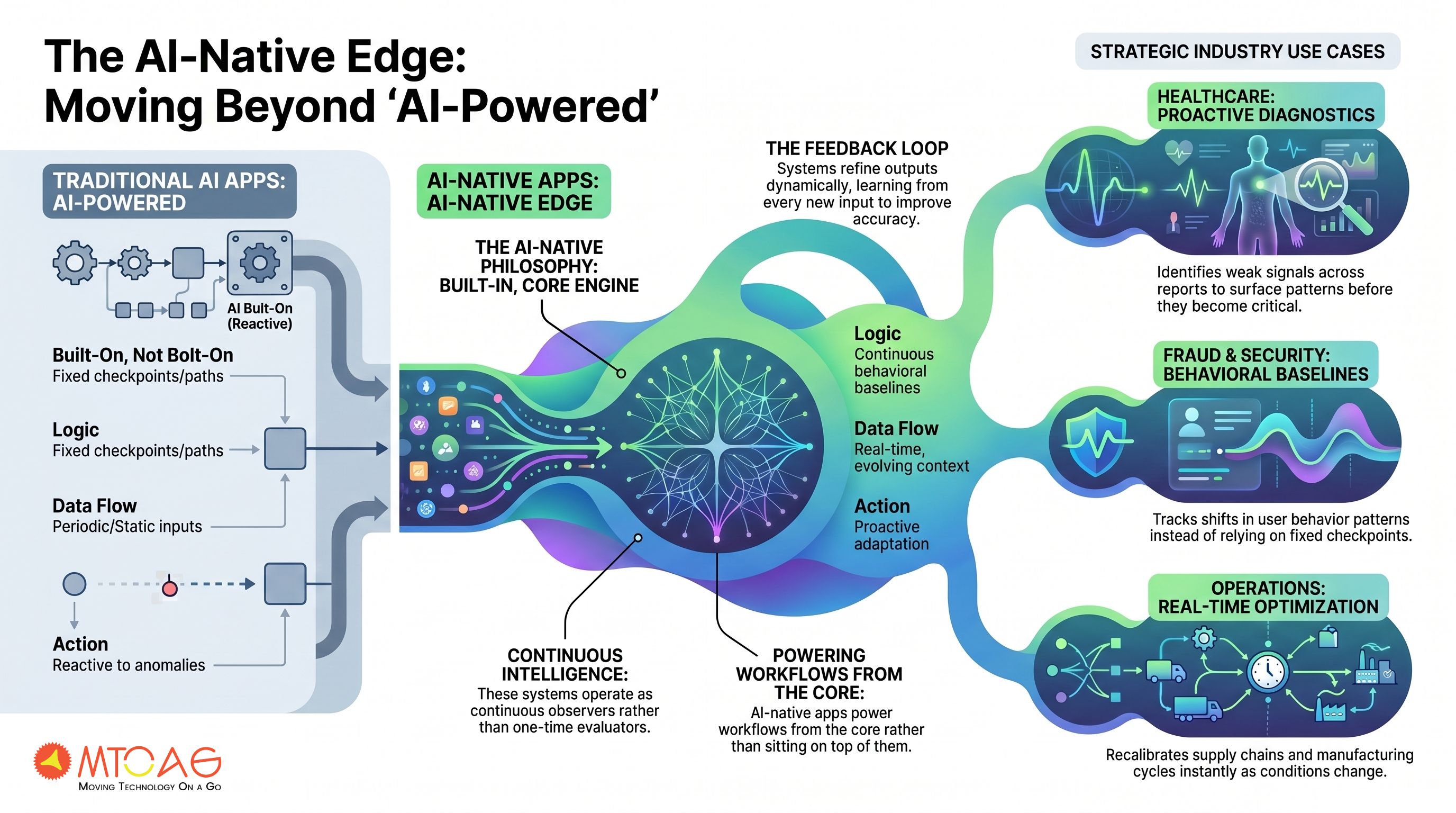
There’s a visible difference between systems that “use AI” and systems that are built around it. The difference shows up in loading times, edge cases, input, and data. AI-native applications don’t sit on top of workflows. They power them.
Below are use cases of AI-native applications:
AI-Native Healthcare Diagnostics
In healthcare environments, AI-native diagnostic systems operate as continuous observers rather than one-time evaluators. They process medical images, patient histories, lab reports, and even real-time monitoring data together.
What stands out is how these systems surface patterns early. A slight variation in scan results, a minor shift in vitals, or a combination of weak signals across reports. Doctors don’t just receive outputs; they receive context that evolves as more data flows in.
This reduces gaps between detection and response. Diagnoses become more informed, and follow-ups become more targeted because the system keeps learning from each new input it receives.
Fraud Detection
AI-native fraud detection systems work by continuously analyzing transaction behaviour instead of checking against fixed checkpoints.
They observe user interactions, such as frequency of transactions, device patterns, location shifts, and timing sequences. Over time, a behavioural baseline forms. When something slightly deviates, even if it doesn’t look alarming on its own, the system catches it in context.
This allows organizations to act earlier. Instead of waiting for large anomalies, smaller irregularities are identified and addressed. The result is smoother transaction monitoring and stronger protection without disrupting genuine activity.
Manufacturing
AI-native systems are embedded into production environments, constantly tracking machine behaviour and process flow. Sensors feed data continuously. The system connects these signals and identifies patterns that indicate how machines are performing over time.
This leads to better maintenance planning and smoother production cycles. Instead of reacting to issues, adjustments happen as soon as subtle changes appear. Equipment runs more consistently, downtime reduces, and overall output becomes more stable.
Customer Support Services
AI-native customer support systems focus on understanding conversations as they unfold, rather than relying on predefined response paths. They interpret intent from ongoing interactions and refine responses dynamically. If a query evolves, the system adapts with it instead of restarting the flow.
This creates smoother support experiences. Conversations feel more natural, issues get resolved with fewer interruptions, and users don’t need to repeat information. Over time, the system improves by learning from previous interactions, making each response more aligned with real user needs.
Cybersecurity Monitoring
AI-native cybersecurity systems continuously observe network activity, user behaviour, and system access patterns. They build a detailed understanding of what normal operations look like. When something shifts, even slightly, it gets noticed within that context.
This approach helps in identifying unusual activity early. Instead of relying only on known threat signatures, the system tracks behaviour changes as they happen. Security teams receive clearer signals, allowing faster and more informed responses.
Dynamic Pricing Systems
AI-native pricing systems adjust in real time by analyzing ongoing demand signals, user engagement, and market activity. They observe how customers interact and combine that with external demand patterns.
This allows businesses to stay aligned with actual market conditions. Prices reflect current demand more accurately, leading to better inventory movement and improved revenue consistency without waiting for periodic updates.
Content Creation (Generative AI Applications)
Generative AI applications treat content creation as a continuous process rather than a one-time output. They generate text, visuals, or media while adapting to tone, audience behaviour, and engagement signals. As content gets used, feedback loops form.
This leads to more relevant and consistent content over time. Messaging aligns better with audience expectations, and production becomes faster without losing direction. Teams can focus on refining ideas while the system handles ongoing generation and adjustment.
Personalized Learning Systems
AI-native learning platforms adapt to how individuals actually learn. They observe progress patterns. Based on this, the system adjusts content delivery, pacing, and difficulty levels.
This creates a learning path that evolves naturally. Instead of fixed modules, learners experience content that responds to their understanding. Engagement improves because the system meets learners where they are, not where the curriculum expects them to be.
Human Resource Systems
AI-native HR systems analyze workforce data continuously to support hiring, engagement, and performance management. They evaluate patterns across employee interactions, project involvement, and performance trends. This helps identify potential fits for roles, growth opportunities, and engagement levels.
Organizations benefit from clearer visibility into their teams. Hiring decisions become more aligned with actual requirements, and internal movements become more informed. Over time, workforce planning becomes more responsive to both individual and organizational needs.
Supply Chain Optimization
AI-native supply chain systems track the movement of goods, inventory levels, and demand fluctuations in real time. They connect signals across the chain and adjust operations as conditions change. If demand shifts or delays start forming, the system responds by recalibrating distribution and inventory flow.
This keeps supply chains more aligned with real-world conditions. Deliveries become more predictable, stock levels stay balanced, and operations remain steady even as external factors change.
What are the Benefits of AI-Native Applications for Businesses?
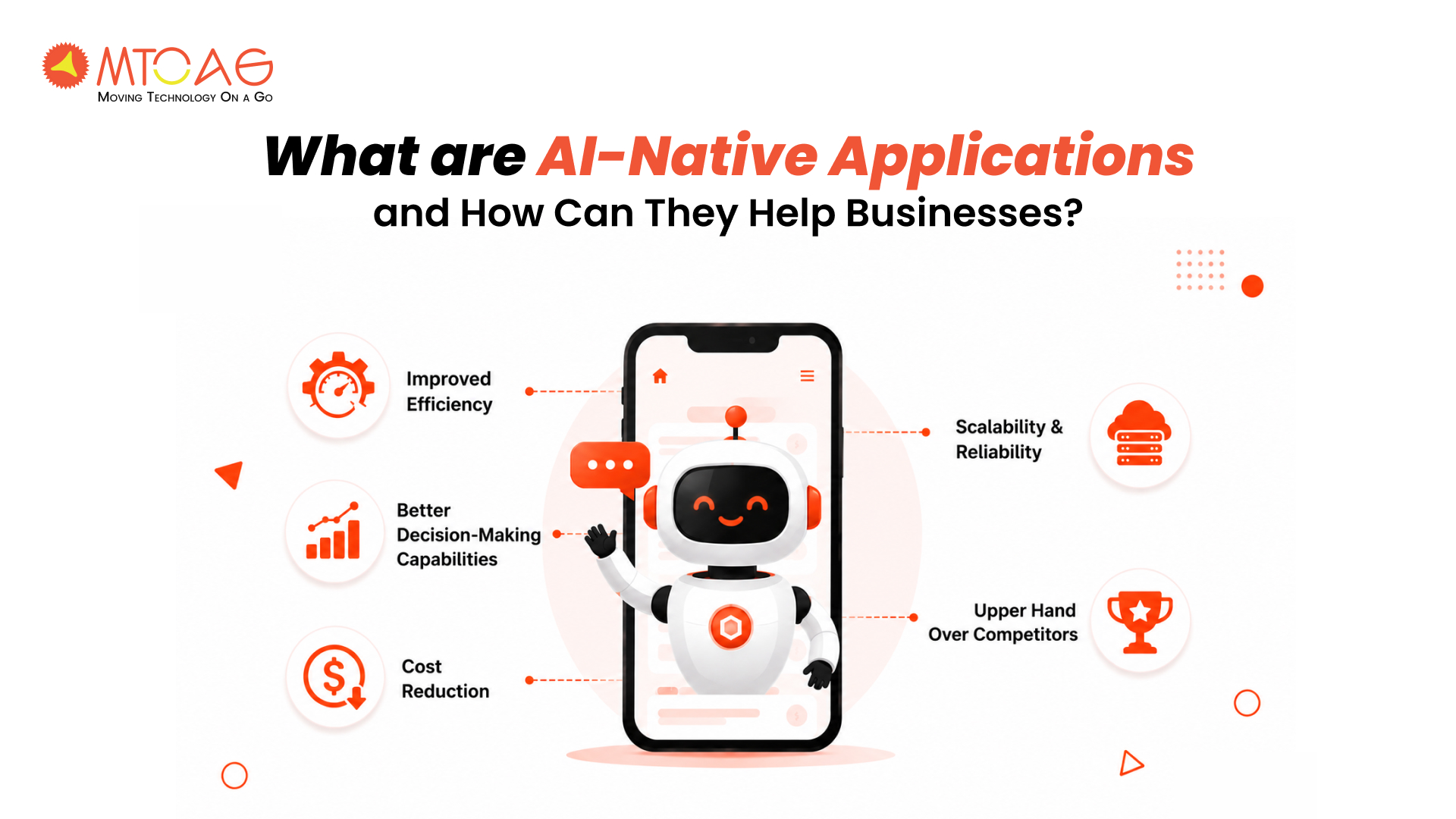
The impact of AI-native applications doesn’t show up as a sudden transformation in businesses. It shows up in how work stops getting stuck. How decisions stop waiting. How systems stop depending on someone noticing something late. Here are some of the benefits of AI native apps:
Improved Efficiency
Efficiency here isn’t about doing the same work faster. It is about removing the need for certain steps altogether. AI-native systems don’t wait for instructions at every stage. They keep processing in the background. That constant movement changes how workflows behave. Things that used to queue up, like approvals, checks, validations, start clearing themselves without manual push.
Over time, this reduces friction across teams. Work doesn’t pile up in pockets. It flows. And when flow improves, the need for constant follow-ups, escalations, and status checks starts fading out naturally.
Better Decision-Making Capabilities
Decisions inside most systems are delayed, not because information is missing, but because it isn’t connected. AI-native applications keep linking signals as they arrive. Sales patterns, user behaviour shifts, and operational changes are continuously evolving.
This leads to decisions that are based on what is happening right now, not what was visible hours or days ago. There’s less dependency on static reports. Instead, insights surface when they become relevant. That timing matters. It allows responses to happen while situations are still forming, not after they have settled.
Cost Reduction
Cost reduction doesn’t come from cutting resources aggressively. It comes from avoiding unnecessary effort. AI-native systems reduce repetition, such as manual reviews, redundant checks, and duplicated tasks across teams. They also minimize the need for rework. When systems catch inconsistencies early or adjust processes mid-flow, fewer errors reach later stages.
There is another layer that becomes visible over time. Resource allocation improves. Systems start using compute, storage, and human input more selectively, based on actual demand patterns. That balance reduces waste without forcing strict controls or limitations.
Scalability & Reliability
Scaling traditional systems often means adding more infrastructure and hoping behaviour stays predictable. AI-native systems handle scaling differently.
They adjust based on usage patterns. When the load increases, they don’t just expand capacity but redistribute effort. Tasks get prioritized differently, non-critical processes slow down slightly, and critical ones continue without interruption.
Reliability improves because the system is always observing itself. It notices strain, adapts to it, and stabilizes before things break. This doesn’t eliminate pressure during peak conditions, but it keeps systems functional and responsive instead of overwhelmed.
Upper Hand Over Competitors
The advantage doesn’t come from having AI. It comes from how deeply it is embedded in operations. AI-native businesses respond faster, not in a visible, dramatic way, but in small, consistent adjustments. customer responses align better. Internal processes adapt without waiting for direction.
These incremental changes stack up. Over time, they create a gap. Competitors relying on periodic updates and manual oversight struggle to match that pace, because their systems aren’t designed to move continuously.
What It Takes to Build AI-Native Apps from Scratch?
Building AI-native systems doesn’t begin with models. It starts much earlier, in places that don’t look technical at first. The real work sits in how problems are framed, how signals are understood, and how systems are expected to behave once they are live.
.jpg)
Here’s what it takes to develop AI-native applications:
List Down Business Challenges
Everything depends on how clearly the problem holds up under pressure. At the surface level, most problems sound simple. But once systems start taking real input, those statements fall apart. The edges start showing.
So the challenge needs to be broken into observable behaviour. What signals exist? What decisions are being delayed? Where is human judgment being used repeatedly? That clarity matters more than any model choice later. Without it, systems drift into guessing instead of solving.
Get the High-quality Data
Clean datasets are rare. Most real-world data comes with gaps, inconsistencies, and silent errors. AI-native systems are expected to function despite that. But there is still a threshold. If signals don’t carry meaning, models start filling gaps with patterns that don’t exist.
High-quality data doesn’t always mean large volumes. It means relevance. Consistency in how events are recorded. Alignment between what the system observes and what actually happens outside it. When that alignment holds, models behave more predictably.
Select the Right Model Approach
Model selection looks like a technical decision. It rarely stays that way. Some models perform well in controlled environments but struggle once inputs become uneven. Others handle noise better but require more careful tuning. The choice depends on how the system is expected to behave under imperfect conditions.
There is also the question of adaptability. Some use cases need models that evolve frequently. Others require stability over long periods. Choosing the wrong approach here doesn’t break things immediately. It shows up later, when updates become harder, or outputs start drifting without clear reasons.
Design the AI Architecture
Architecture defines how everything connects. AI-native systems need continuous input flow, decision layers, and feedback loops built into the structure itself. It is not just about placing a model between input and output. The system has to support ongoing learning, adjustments, and fallback behaviour.
Latency, data pipelines, and storage decisions all of these start affecting outcomes. If architecture doesn’t support real-time or near-real-time processing where needed, the system begins to lag behind actual conditions. And once that gap forms, outputs lose relevance quickly.
Feedback and Iteration
No AI system stays correct on its own. Feedback loops are what keep it grounded. These loops come from user interactions, system corrections, and observed outcomes. They need to be captured continuously and fed back into the system in a structured way.
Iteration becomes part of the system’s behaviour. Small adjustments happen regularly. Larger corrections happen when patterns shift. Without this layer, even well-performing systems slowly lose alignment with real-world conditions.
Deploy & Monitor
Systems that behave well in controlled setups start facing variability once they go live. Input patterns change. Edge cases appear more often than expected. Monitoring becomes essential, not just for uptime but for behaviour tracking.
What matters here is visibility. How are outputs changing? Where are errors increasing? How quickly can the system adapt to new patterns? Monitoring is not a final step. It becomes an ongoing process that keeps the system aligned with reality as it continues to operate.
Conclusion
AI-native applications don’t change businesses through one visible shift. The change builds gradually, in how systems keep moving without waiting, how signals connect on their own, how responses happen while things are still unfolding. That continuity starts reducing the small delays that usually go unnoticed, but keep stacking across operations.
Over time, the difference becomes clearer. Workflows stop depending on constant manual checks. Decisions don’t rely on static snapshots. Systems begin adjusting as conditions change, not after. That creates a certain steadiness in how things run.
But getting there isn’t about adding AI into existing layers. It comes from structuring the system in a way that can handle real input, real variation, and continuous feedback without losing alignment.
Teams that have worked through these layers tend to approach it differently. The focus stays on how the system behaves after deployment. That difference is where AI development companies, such as Mtoag Technologies, tend to bring more clarity into the process, especially when the goal is to build something that keeps working as conditions change.
FAQs
What are AI Native Platforms?
AI-native platforms are systems built with AI at their core, where every input passes through model-driven logic. They continuously process, learn, and adapt, rather than relying on fixed workflows or predefined rules.
What Does AI Native Actually Mean?
AI-native means the system is designed around AI behavior from the start. Decisions, responses, and workflows depend on model inference, allowing the application to adjust based on patterns, context, and evolving data.
How Much Do AI Apps Cost?
The cost of developing AI applications varies based on complexity, data readiness, and system scope. Early builds may stay controlled, but scaling, model tuning, and infrastructure needs gradually shape the overall investment as the application matures.