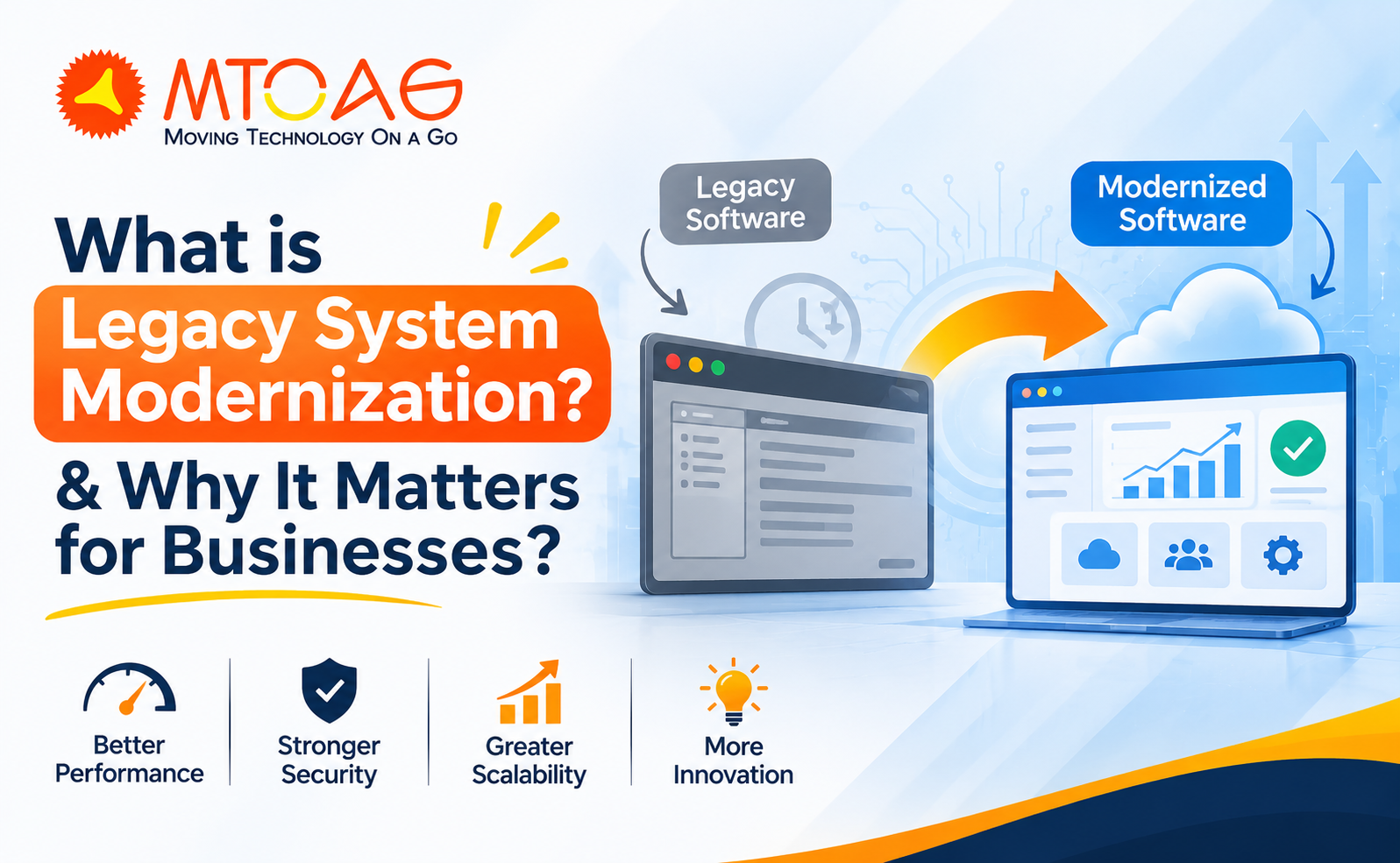
There is an old saying that “Change is the law of nature,” and that fits really well in every industry. Businesses that delay modernization are sure to get left behind by their competitors. Even in this era of technological advancement, many organizations still depend on legacy systems that were built decades ago. While they continue to support daily operations, they often stand as a barrier to progress. And that need amplifies the role of legacy system modernization services.
The old, outdated legacy systems can hinder the organization’s ability to keep up with diverse business needs and are often vulnerable to cyberattacks. However, security isn’t the sole reason for system modernization. There are many, and we will discuss them all here.
In this guide to legacy system modernization, we will look into its basics, why businesses need it, the best implementation strategies, and potential challenges to overcome.
What is Legacy System Modernization?
Legacy system modernization is a process of upgrading or modernizing existing legacy systems to modern platforms using emerging technologies. The process involves various crucial steps that mainly include system architecture, infrastructure, and feature updates.
The primary reason for businesses to go for application modernization remains the need to adapt to dynamic market demands, improve user experiences, and take advantage of the latest technologies, such as AI, cloud computing, and data analytics.
The process starts with a complete assessment of the existing system and identifying the loopholes. After that, businesses can choose from a number of strategies to rebuild the system with cloud-native principles. The overall goal of legacy system modernization remains evolving the critical workflows to help support the business’s long-term goals rather than holding them back.
Why Do Businesses Need Legacy System Modernization?
The very first reason businesses invest in legacy system modernization remains the cost to maintain those outdated systems. They are indeed expensive to maintain. According to data from the U.S. Government Accountability Office (GAO), federal agencies spend roughly 80% of their IT budget on legacy system maintenance, with many critical systems being over 30 years old.
This way, even the 10 such legacy systems in need of modernization can cost around $337 million annually to operate. At the same time, the conditions in the private sector aren’t much more favourable. Many industry estimates report that companies allocate 60% to 80% of their IT budget to maintaining old systems. But financial loss is just the beginning. Here’s what else legacy systems can do to your business:
Security Exposure
Legacy systems are highly vulnerable to cyberattacks, and even cybercriminals find them their prime target. They usually run on outdated or unsupported software that no longer gets new security patches or updates. According to IBM’s report on the Cost of a Data Breach, the average financial loss for data breaches reached $6.08 million in 2024, which is the highest of all industries. Legacy systems are 3X more vulnerable than their modern counterparts.
Talent Drain
The experts who programmed legacy systems are getting old and retiring. For instance, a typical COBOL programmer would be around 70 years old today, with nearly all such programmers expected to retire by 2030. The worst thing is that fewer than 2,000 COBOL programmers graduated globally in 2024. When you don’t have people to maintain your system, you probably have a serious problem to face.
Productivity Loss
According to a Stripe survey, software developers spend an average of 13.5 hours per week addressing technical debt. Even developers admitted that they waste around 17 hours per week on maintaining bad legacy code. That is around 42% of the workweek wasted on maintaining the past instead of building a modern future.
Compliance Risk
Industry regulators such as HIPAA, GDPR, and SOX regularly update new requirements regarding data handling, security, and user privacy. The legacy systems were not designed with these latest standards in mind; retrofitting compliance into these outdated systems is both challenging and unreliable.
Missed Opportunity
The highest cost for a business is the opportunity that is missed, not because of capabilities but lack of resources. The latest technologies, such as AI, ML, and advanced analytics, all require clean and accessible data. Legacy systems are not able to provide this foundation. Every time you delay modernization is a time your competitors get one step ahead of you.
5 Key Legacy System Modernization Strategies
The process of software modernization starts with a clear assessment of the company’s current systems. The evaluation helps assess the current stage, strengths, weaknesses, and areas that need improvement. After that, the next step is to develop working strategies. The choice of strategy greatly depends on the current stage of the system, budget, and business aims.
Here are the most common yet legacy system modernization strategies:
Rehosting
Rehosting, popularly known as the lift-and-shift approach, is a strategy to migrate the current system to a new environment using cloud principles with changes to the existing functionalities and code. The strategy works well for businesses that require quick transitions. But it may not uncover the full potential of modernization.
Refactoring
Refactoring is a crucial process of restructuring the current systems and optimizing the existing code to improve its maintainability and performance without changing its core functionalities. This strategy is ideal for enhancing the application’s efficiency.
Replatforming
Replatforming means moving the legacy systems to a different IT infrastructure or platform. This leads to better performance and scalability. However, the strategy includes some level of code adaptation.
Re-architecting
Re-architecting means completely redesigning the system’s architecture to align with modern standards. It is done in a phased approach, which manages the process and addresses each architectural issue that may arise.
Rebuilding or Full Replacement
In scenarios where legacy systems are too outdated and require an immediate rebuild or replacement, this strategy works really well. Although this strategy offers a fresh start, it brings challenges of possible disruption during the transition.
Understanding the Role of Cloud in Legacy Modernization
Cloud migration isn’t counted as a modernization strategy but something that is the need of the hour. By migrating to cloud technologies, no matter whether public, private, or hybrid, businesses can access managed services, scalable infrastructure, advanced security capabilities, and a pay-as-you-go cost model that eliminates the cost of heavy upfront expenses.
In terms of legacy modernization, cloud adoption has seen exponential growth. According to Mordor Intelligence, cloud-based modernization contributes around 67.78% of the total legacy modernization market in 2024. Public cloud deployments are expanding at a whopping CAGR of 18.26%, driven by the growing multi-cloud partnerships and hyperscale data center regions.
However, cloud migration doesn’t work like lifting and shifting a poorly architected system to a modern cloud platform. It will not solve the fundamental problems in any way. The most successful cloud migrations are a result of architectural improvements, microservices adoption, and cloud-native services implementation to replace custom-built components.
How is AI Accelerating Legacy Application Modernization?
Artificial Intelligence is not just a reason to upgrade or modernize old, outdated systems but something that is making the process faster and less risky.
For instance, AI-powered code analyzers can easily scan legacy codebases to identify dependencies, flag security loopholes, and even suggest refactoring strategies. Even in 2025, Red Hat launched AI-powered tools integrated with its MTA to accelerate legacy codebase modernization.
AI-powered modernization tools can convert legacy languages like COBOL into modern programming languages like Python and Java with faster speed and accuracy without manual rewriting. They can even generate automated test suites, map data flows, and identify the optimal order to modernize interdependent components.
For companies, this means that the cost, time, and risk of legacy modernization all come down. The project that would take years can now be completed in a few months.
Conclusion
Legacy systems have supported businesses for years, but relying on outdated technology can limit growth, increase operational costs, and create security risks. Modernization is not about replacing everything at once but choosing the right strategy that aligns with business goals, budget, and future needs.
Working with an experienced technology partner can simplify this transition and reduce implementation risks. Mtoag Technologies helps businesses modernize legacy applications with practical, scalable, and secure solutions that improve performance while ensuring minimal disruption to ongoing operations and future business growth.
FAQs
What are the 7 Options to Modernize Legacy Systems?
The seven common legacy system modernization options are rehosting, replatforming, refactoring, rearchitecting, rebuilding, replacing, and retaining. The right approach depends on the system's condition, business goals, budget, compliance needs, and long-term scalability requirements.
What is a Legacy System Upgrade?
A legacy system upgrade improves an existing application by updating its software, hardware, security, or features while preserving its core functionality. It extends system life, improves performance, and helps meet current business and technology requirements.
What are Legacy Systems?
Legacy systems are older software applications, hardware, or IT platforms that organizations still use because they support essential business operations. Although functional, they often rely on outdated technology, making maintenance, integration, security, and scalability more challenging.
What are the Latest Trends in Modernizing Legacy Systems?
Current legacy modernization trends include cloud migration, AI-assisted code modernization, microservices architecture, API integration, containerization, DevOps automation, and low-code development. These approaches improve scalability, agility, security, and long-term system maintainability.