We are living in an era where technology has not only influenced our lives but has embedded itself so naturally into them that now you can't imagine the world without it. Meanwhile, the evolution of technologies, especially AI, has introduced us to multimodal AI. But what exactly is it, where we use it, and how can it help? There are tons of questions people have when they get to know about the new technology. But through this write-up, we will answer them by breaking down the basics of multimodal AI, analyzing its benefits and use cases.
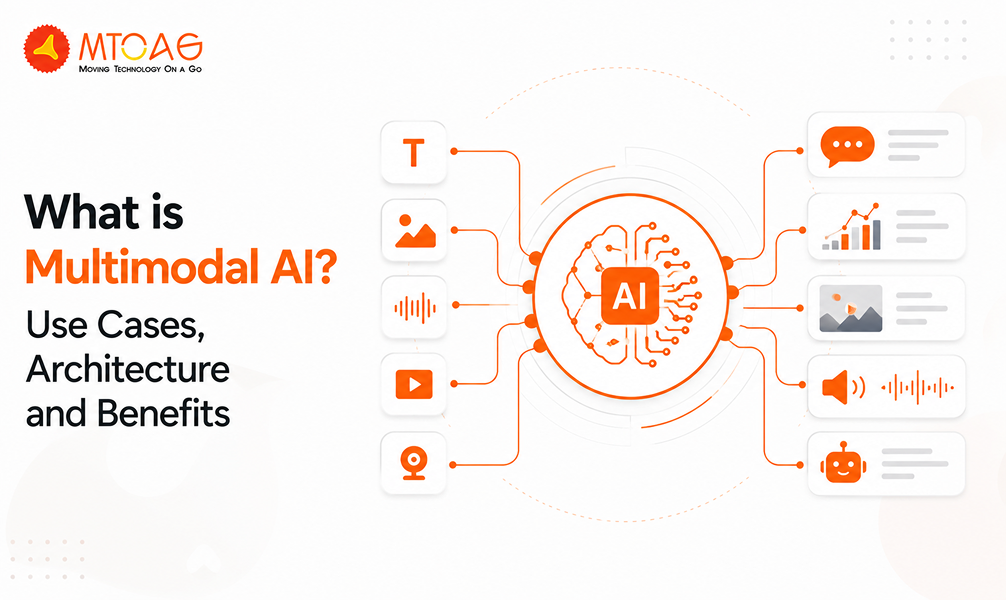
Unlike unimodal models, multimodal AI integrates different data types, including images, text, audio and even video, to understand the context and generate a more effective output. The combination of different data sources helps these systems deliver accurate insights and support context-aware responses.
The multimodal AI concept was started with the launch of GPT-4, the first AI model to handle both images and text effectively. The last year was incredible for multimodal AI, making it one of the most talked-about Generative AI trends of all time. So, let’s understand how you can advantage your business with multimodal AI.
Key Insights on Multimodal AI
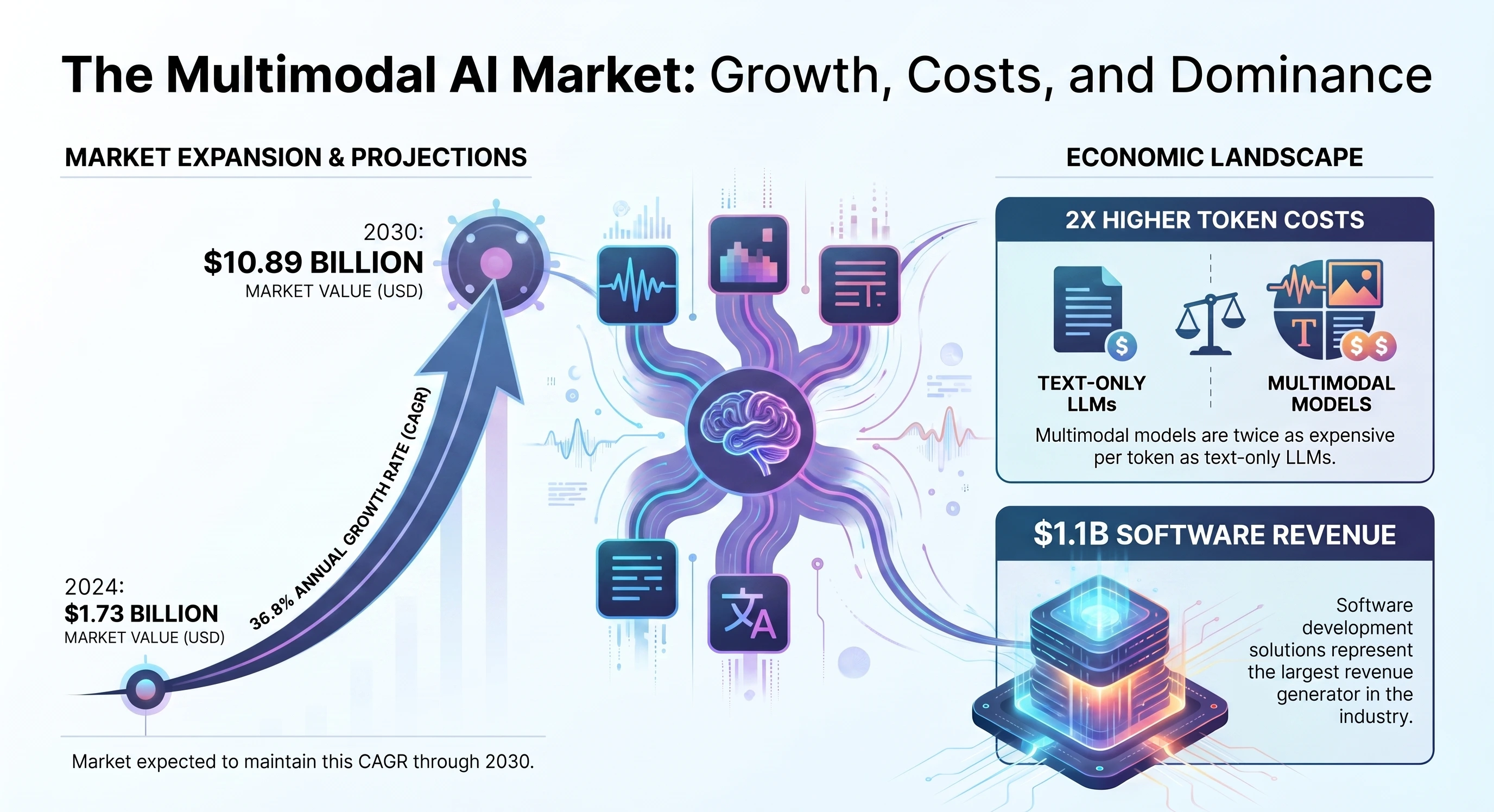
- The global multimodal AI market was valued at $1.73 billion in 2024 and is expected to grow at a CAGR of 36.8% to reach $10.89 billion by 2030. (Source: Grand View Research)
- Multimodal AI models are 2x as expensive per token as compared to traditional text-only LLMs. (Source: McKinsey & Company)
- Software development solutions dominate the revenue generation of multimodal AI, accounting for over $1.1 billion recently.
What is Multimodal AI?
In the technological glossary, modality refers to different data types, including text, images, audio and video. In this reference, multimodal AI can be understood as a unified AI system that can integrate and process multiple data types and modalities.
The combination of various data modalities in these AI systems enables them to give a more diverse and rich output. With regular processing of data inputs, they can make accurate human-like predictions. These AI models can produce complex context-aware outputs. These outputs are relatively different from unimodal AI systems that rely on a single data type.
Examples of Multimodal AIs in the Real World
To help you understand more precisely, we have gathered a list of a few multimodal AI examples that are already dominating the market:
- GPT-4V(ision), upgraded to GPT-4, is an advanced AI model that can process images and text to generate visual content.
- Runway Gen-2 uses text prompts to generate real-life-like videos.
- Inworld AI can create interactive visual characters in the game world.
- ImageBind by Meta AI uses 6 data modalities to generate outputs. It uses text, image, video, thermal, depth, and audio.
- Google Multimodal Transformer (MTN) uses text, audio and images to generate descriptive video summaries.
- DALL-E 3, an OpenAI model, can generate high-quality images using text prompts.
How Does Multimodal AI Work? A Look Into Its Architecture
The multimodal AI architecture has three stages under the hood and works entirely based on these stages. These include:
- Ingestion and Encoding: First, the model converts text, images, videos and audio into model-friendly representations. They include modality-specific encoders with language components to understand.
- Alignment and Fusion: The model finds the similarity across modalities. For instance, what the image shows and what the text claims. The multimodal machine learning models can learn the relationship, which is not possible in any single-dataset model.
- Reasoning and Output: The model answers the response, ranks hypotheses, flags risk, generates summaries and triggers actions. The part of its output generation that is often described as multimodal Generative AI. The real business value comes from decision-making and interpretation support.
The data discipline, latency budgets, linkage, and evaluation capabilities decide the success or failure of multimodal deployments. The alignment becomes problematic when your audio transcript is not readily tied to the case ID or your images are missing metadata. According to the new research, about 40% of all generative AI systems will be multimodal by the end of 2027. If you want to take advantage of multimodal AI, your operating model for system integration and data provenance should match its capabilities.
Real World Use Cases of Multimodal AI Across Sectors
Multimodal AI is not a futuristic concept but something that has already started disrupting several sectors and industries. These systems are helping industries uncover new possibilities and improve existing processes.
Healthcare
Multimodal AI is transforming the healthcare sector through advanced diagnostics and treatment plans. The integration of patient history, medical imagery and other relevant data offers accurate insights and personalized treatment options.
For example, a multimodal system can analyze the patient’s history, medical records, MRI scans and other lab results to recommend a personalized treatment plan. This helps improve the accuracy of diagnosis and assists healthcare professionals in making more informed decisions.
Autonomous vehicles
This is the second most impacted sector by multimodal AI. Autonomous vehicles rely on various sensors, such as LiDAR, cameras and radar to navigate the environment effectively and safely. Multimodal AI integrates the data from these sensors to allow vehicles to make real-time decisions and respond to their surroundings.
Companies like Sensible 4 have been using multimodal AI for their autonomous vehicles through sensor fusion technologies. They have developed DAWN autonomous software that integrates data from multiple sensors like cameras, LiDAR and radar to improve obstacle detection, real-time navigation and decision-making.
This multimodal AI approach helps autonomous vehicles cooperate in literally every weather condition and complex driving situation, making it a reliable and safer urban mobility option.
Customer Experience and Virtual Assistants
Customer experience is the central point for literally every business. Multimodal AI is enhancing virtual assistants and chatbot experiences. These systems can efficiently process voice commands, analyze text data and recognize speech patterns to make customer service better and more responsive to user needs. This advancement leads to better user experience and more natural interactions.
For example, Bank of America uses Erica, a virtual assistant that supports over 25 million mobile banking customers through text, voice and image recognition capabilities. This allows users to perform banking activities, receive financial advice and check account balances instantly in a seamless manner. Natural language processing (NLP) and AI allow for intuitive and personalized customer service experiences.
Robotics and Computer Vision
Robotics is another potential field for multimodal AI to prove its worth. Robots can leverage multimodal AI to make better decisions and perform tasks more precisely. For example, a robot with multimodal AI and computer vision integrations can interpret facial expressions and human gestures precisely and naturally with people.
For example, Google DeepMind’s Robotic Transformer 2 (RT-2) is a perfect example of combining multimodal AI, computer visiona nd robotics. It combines visual data from language models and cameras trained on large datasets and action models to perform object manipulation and navigation tasks.
The robot seamlessly adapts to the environment and uses web data knowledge to execute compex taste in the field of autonomous robotics.
Business Benefits of Multimodal AI
Here are some of the advantages of multimodal AI for businesses and enterprises:
Better Understanding of Complex Data
Businesses deal with large amounts of information every day. This information is often stored and shared in different formats such as emails, documents, images, videos, voice recordings, and customer chats. Traditional AI systems usually process one type of data at a time, which limits their ability to understand the bigger picture.
Multimodal AI changes this by combining multiple forms of information together. It can analyze text, visuals, audio, and other inputs at the same time to generate more meaningful insights. This helps businesses make smarter decisions based on a more complete understanding of situations rather than isolated data points.
For example, an eCommerce business can study customer reviews, product images, return reasons, and support calls together to identify common customer concerns and improve the shopping experience.
Improved Customer Experience
Customer expectations are constantly increasing. People want quick responses, personalized communication, and smooth interactions across websites, apps, and support channels.
Multimodal AI helps businesses deliver better customer experiences by understanding different types of customer inputs naturally. A customer may upload an image of a damaged product, send a written complaint, or explain an issue through voice support. Multimodal AI can process all these inputs together and provide faster, more accurate assistance.
This creates more natural interactions and reduces frustration for customers. It also helps businesses improve response times without compromising service quality.
Smarter Automation Across Operations
Many business processes involve repetitive work that requires handling multiple types of information together. In industries like healthcare, logistics, banking, insurance, and manufacturing, employees regularly manage forms, reports, images, and communication records.
Multimodal AI can automate many of these processes more efficiently than traditional systems. It can organize documents, extract information, verify visual data, and interpret written or spoken instructions in one workflow.
This reduces manual effort, minimizes errors, and improves operational efficiency. Employees can then focus more on important business activities instead of spending time on repetitive administrative tasks.
Better Accuracy and Context Awareness
One major limitation of traditional AI systems is the lack of context. When AI only analyzes one type of input, there is a higher chance of misunderstanding or incomplete results.
Multimodal AI improves accuracy by combining different data sources before generating conclusions. This gives businesses a more balanced and context-aware understanding of situations.
For instance, in manufacturing, AI can inspect product images while also analyzing sensor readings and maintenance logs to detect faults more accurately. In healthcare, doctors can use AI systems that study medical images alongside patient records and test reports for better support during diagnosis.
Stronger Marketing and Personalization
Marketing today is heavily driven by customer behaviour and engagement data. Multimodal AI allows businesses to understand customer preferences more deeply by analyzing videos, social media posts, images, reviews, and conversations together.
This helps companies create more personalized marketing campaigns and relevant product recommendations. Businesses can better understand what customers respond to and improve communication strategies accordingly.
Supporting Long-Term Business Growth
Multimodal AI is not just about automation. It is helping businesses build smarter systems that adapt to changing customer needs and market demands.
As the technology continues to evolve, businesses adopting multimodal AI early can improve productivity, customer engagement, and decision-making capabilities. More importantly, they can create more flexible and future-ready operations in an increasingly digital business environment.
Conclusion
The future belongs to multimodal AI, and we can only see the advancement in this field. The technology has already started to dominate industries and businesses, and is among the top Generative AI trends of all time. However, adoption is the key to taking advantage of such emerging technologies that are there to redefine what’s possible.
Businesses that start exploring multimodal AI early are more likely to gain a competitive advantage through better automation, faster insights, improved personalization, and smarter operational workflows.
If you are interested in multimodal AI and looking to leverage its capabilities, you need a skilled AI development partner who can guide, plan, design, and develop solutions tailored to your business needs. With over 17 years of engineering excellence, Mtoag Technologies has been helping businesses to take advantage of such technologies through its offerings of advanced AI development services.
FAQs
Is ChatGPT Multimodal?
Yes, newer versions of ChatGPT support multimodal capabilities. This means they can understand and process different types of inputs such as text, images, voice, and files together, allowing more natural interactions and broader real-world use across customer support, research, education, and business tasks.
What is an Example of a Multimodal AI?
An example of multimodal AI is Google Gemini, which can process text, images, audio, video, and documents together. For instance, it can analyze a photo, understand related written instructions, and generate meaningful responses based on both inputs simultaneously.
What is the Difference Between Generative AI and Multimodal AI?
Generative AI focuses on creating new content such as text, images, videos, or code. Multimodal AI focuses on understanding and combining multiple types of data together. Some advanced AI systems combine both capabilities by understanding different inputs and generating useful outputs accordingly.
What are the 5 Multimodal?
The five common modalities used in multimodal AI are text, images, audio, video, and sensor or data signals. These different input types help AI systems understand information more completely and respond with better accuracy, context awareness, and decision-making capabilities across real-world applications.