Table of Contents
E-commerce counts among the most lucrative and profitable industries of modern times. Its unpredictable growth from $572 billion in sales revenue in 2010 to $4.2 trillion in 2020 and $6.3 trillion in 2024 speaks a lot about its popularity and widespread adoption. In fact, the market is expected to contribute 24% to global sales by 2026. With customers’ focus shifting from traditional shopping to e-commerce, the demand for a more dynamic and adaptive platform has increased significantly. It is probably the biggest reason businesses are increasingly investing in headless commerce platforms.
With ready-made headless commerce solutions, you don’t have to spend heavily on building an e-commerce platform from scratch. Additionally, the architecture of headless commerce platforms is designed to separate the presentation layer from the commerce engine, which makes the platform faster and more responsive.
If you are on the hunt for the best headless commerce platforms for your e-commerce businesses, the options are aplenty, and it is easy to feel overwhelmed. Your unique business requirements need a unique solution. So, to help you out, we have curated a list of the top 10 headless e-commerce platforms that are making a buzz in 2026.
What is a Headless Commerce Platform?
Headless commerce is an advanced e-commerce architecture that separates the platform’s front-end (storefront and user experience) and back-end (admin panel and business logic). The biggest pro of using headless commerce platforms is that whenever you make any changes in the back-end, they won’t reflect on the front-end in real-time.
The architecture makes it easy to build and make changes in the e-commerce platform, making it even faster and more responsive. Headless commerce platforms utilize APIs to add new functionalities and enhance user experiences.
Key Statistics and Market Overview of Headless Commerce
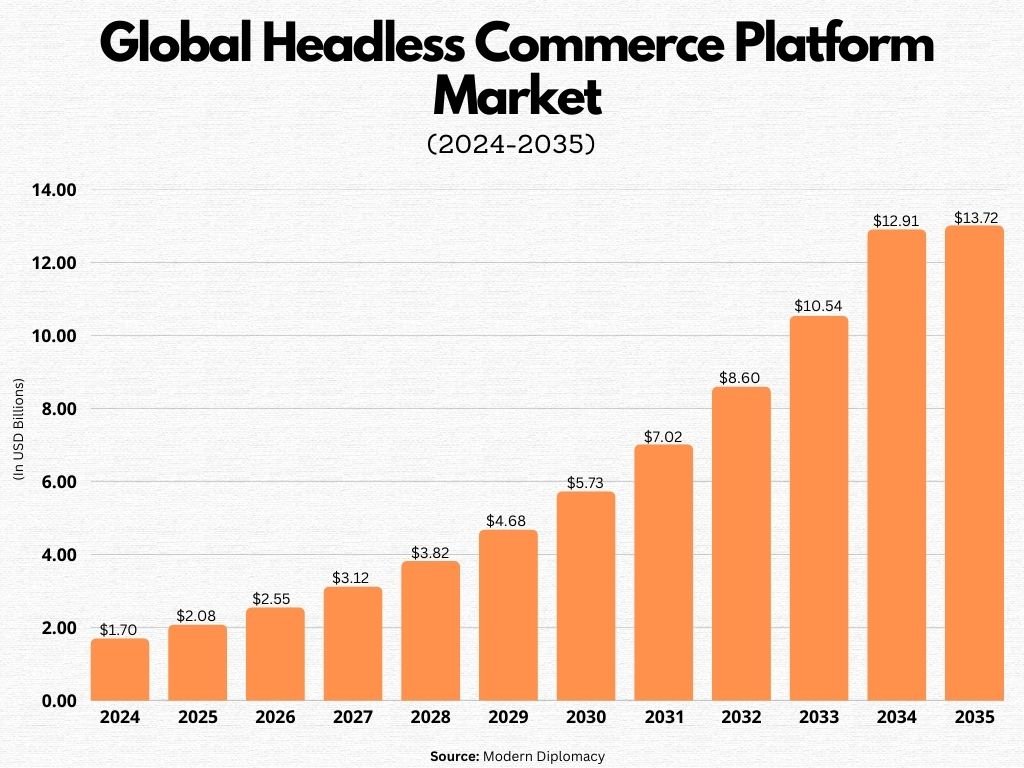
- The market for headless commerce platforms is worth $1.7 billion in 2024 and is expected to grow to $13.2 billion by 2035 at a CAGR of 22.5%. (Source: Modern Diplomacy)
- 73% of businesses are using headless commerce architecture. (Source: Crystallize)
- 98% of businesses are planning to use headless website architecture in the next few years. (Source: Crystallize)
- 6 in 10 retail organizations are planning to migrate to headless platforms by 2026. (Source: Crystallize)
- 79% of organizations have admitted that headless architecture improves their ability to scale. (Source: Crystallize)
List of The Top Headless Commerce Platforms
We have listed the 10 best headless commerce platforms that are modern and advanced enough to align with your business’s diverse needs and requirements.
1. Shopify Plus
Website: https://www.shopify.com/plus
Shopify is an online e-commerce platform that helps small and medium businesses sell their products. It runs on the cloud, meaning no need for fancy hardware, and it’s built especially for big, fast-growing companies. It supports headless commerce.
With Shopify Plus, companies can turn any device into a way to make sales. It also connects easily with lots of other tools and apps. People who build websites can pick whatever tools they like for the design and add extra features from other companies.
The price for Shopify Plus starts at $2,300 a month, which is great for big, settled businesses but might feel steep for ones still trying to grow compared to regular Shopify.
You can change how it looks and works using Shopify’s app store, themes, or special coding options.
- Customization: Tons of customized options with apps, designs, and tech tools.
- Pricing: Starts at $1.8K per month.
- User Base: Powers 6,455,887 websites.
2. BigCommerce
Website: https://www.bigcommerce.co.uk/
BigCommerce is an easy-to-use online store builder that runs on SaaS, which means it’s all handled online for you. It’s perfect for small and large-scale businesses because it has powerful tools and lets you change things to fit your needs.
It’s set up for headless commerce, which gives you the freedom to design a cool, detailed website however you want. BigCommerce also has flexible tech options and lets you run several stores at once, so you can sell in different places or create different brands.
It’s packed with everything you need to sell online, but sometimes connecting it to other outside tools can be a bit tricky.
- Customization: You can tweak your store with lots of apps to make it just right for you.
- Pricing: You get a free month to try it, and after that, plans start at $29.95 a month.
- User Base: Runs 145,027 websites.
3. Adobe Commerce
Website: https://business.adobe.com/products/magento/magento-commerce.html
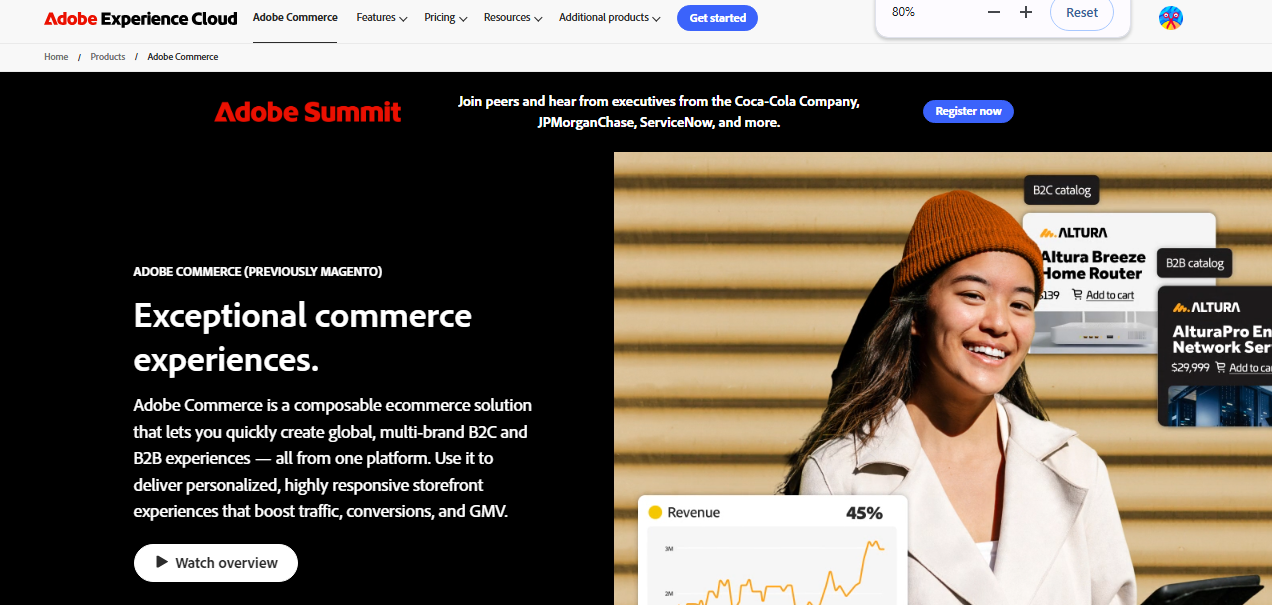
Adobe Commerce, also known as Magento, is a tool from Adobe’s family of products. It helps companies create shopping experiences that work across many channels, like online stores or apps, and fits all kinds of businesses and industries.
It connects smoothly with other Adobe tools, like Analytics, Experience Manager for website building, and Creative Cloud for design, so businesses can make shopping feel special for each customer.
This platform grows with your business and can add new tech whenever you need it, even the latest stuff. The downside? It can get pricey to use because it’s part of a big system that costs a lot to run.
- Customization: You can change it a ton because it’s built on open-source and has a modular design.
- Pricing: The open-source version, Adobe Commerce Open Source, is free. But the paid one, Magento Commerce, starts at $2,000 a month.
- User Base: Runs 713,931 websites in total.
4. Salesforce Commerce Cloud
Website: https://www.salesforce.com/uk/commerce/
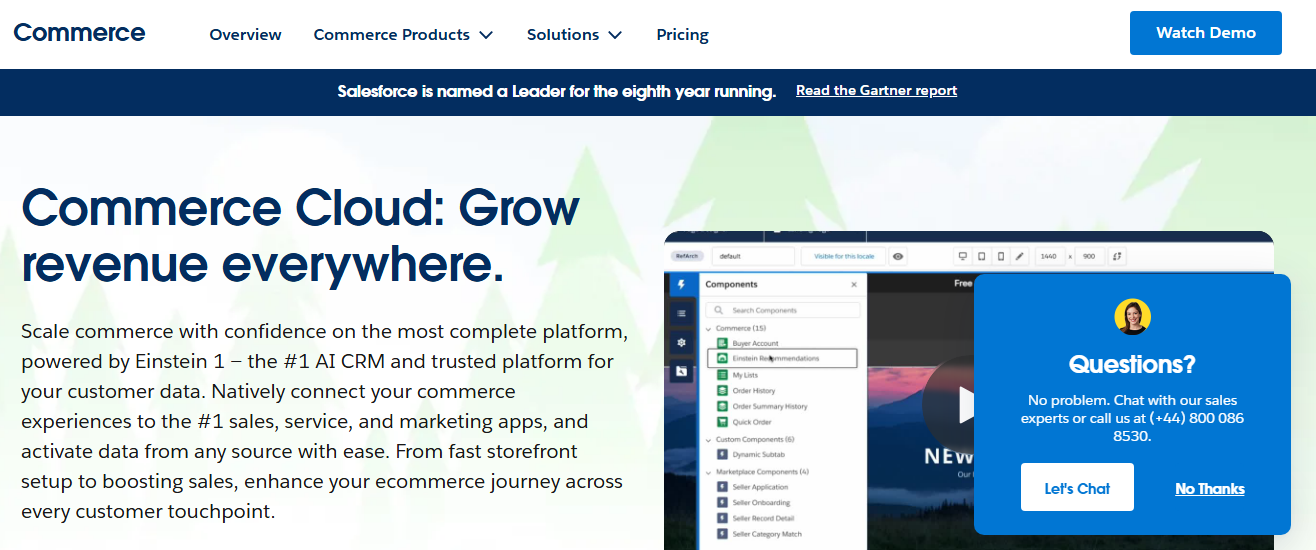
Salesforce Commerce Cloud is part of the Salesforce product family, providing a flexible commerce platform that works with Salesforce CRM. This connection makes it easy to use other Salesforce products, letting businesses tap into the entire Salesforce system effortlessly.
With Salesforce Commerce, online stores can use API-first commerce to improve their customers’ shopping experiences. Stores can also use Salesforce’s ready-made integrations to enhance their websites and create mobile apps.
Although Salesforce Commerce Cloud is great for connecting with the powerful suite, it might present difficulties when integrating tools outside Salesforce and keeping a streamlined tech stack to stay flexible and adaptable.
- Customization: Users can set up, create fields and objects, change picklist values, and set validation rules, among other tasks.
- Pricing: Salesforce Commerce Cloud has an annual license fee of about $150,000/year.
- User Base: More than 8,670 companies use Salesforce Commerce Cloud.
5. Commercetools
Website: https://commercetools.com/
Commercetools is a headless commerce technology combined with an omnichannel platform that offers cloud-based point-of-sale functions for both B2B and B2C businesses.
It allows E-commerce experiences across various touchpoints such as mobile apps, websites, VR applications, and voice assistants. This is made possible through an API-driven approach that separates the front end from the back end, enabling custom solutions.
No SQL or other customizations are required, as the APIs cover everything. The platform includes inventory management features such as tracking, adjustments, multi-store management, and returns.
Commercetools integrates smoothly with CyberSource for payment management, Contentstack for content management, and Frontstatic for front-end development. It can also integrate with front-end CMS systems like Adobe Experience Cloud.
- Customization: Commercetools provides high customization through its API-first approach and modular architecture.
- Pricing: Commercetools starts at $500 per month, scaling with the number of API requests.
- User Base: More than 249 websites use Commercetools.
6. Experro
Website: https://www.experro.com/
Experro is a platform that brings together content, commerce, and advanced search into one easy-to-use system. It allows businesses to innovate with a flexible platform that integrates content, commerce, and data while being scalable and adaptable.
Experro’s features include a Customer Data Platform (CDP), AI-powered merchandising, intent-driven search, a drag-and-drop website builder, and headless architecture, among other tools to enhance your e-store. It integrates seamlessly with major platforms like Shopify, Magento, and BigCommerce, enabling businesses to deliver consistent, high-quality experiences across all channels.
This all-in-one solution connects all parts of the eCommerce journey—from content management to advanced search—creating a smooth ecosystem that boosts engagement and profitability.
- Customization: Experro, an open-source React-based front-end platform, follows MACH architecture, making it API-friendly and allowing full customization on design, feature development, and integration.
- Pricing: Experro offers all necessary components within a single platform, with initial costs starting at a competitive price.
- User Base: Not Known.
7. SAP CX Commerce Cloud
Website: https://www.sap.com/products/crm/commerce-cloud.html
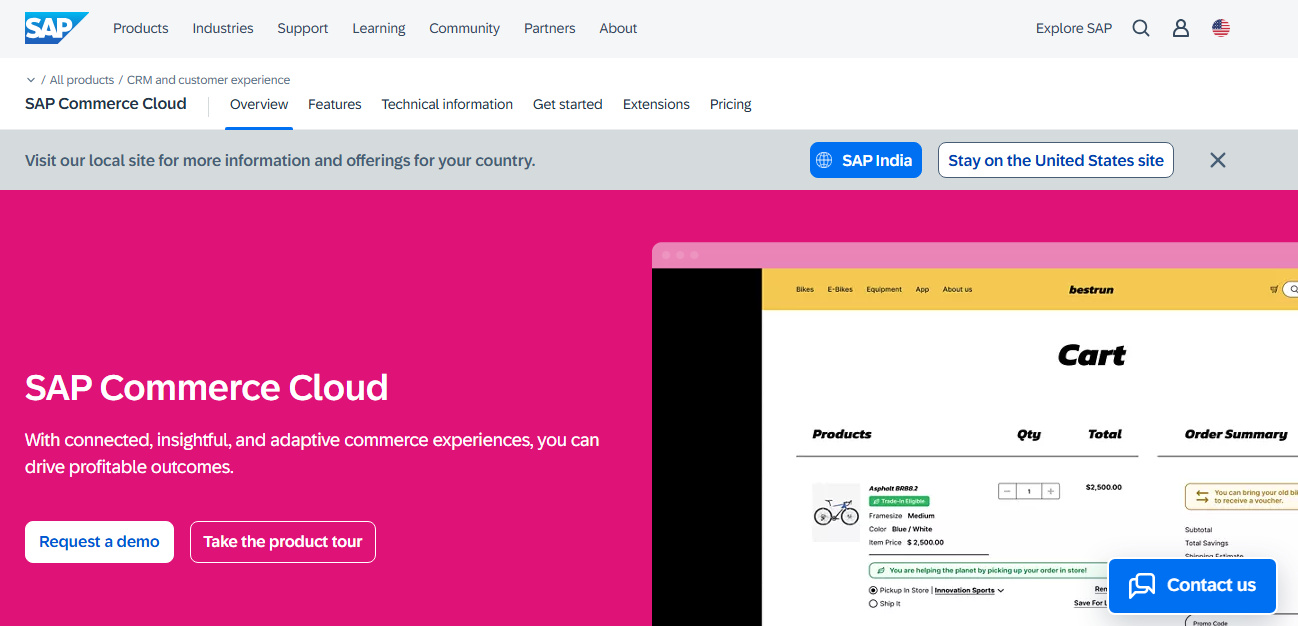
SAP Commerce Cloud is a top solution that helps businesses manage communication, sales, and customer support across all platforms. It centralizes product data in a format that is neutral to media for efficient control and preparation.
Businesses can create and manage online stores across multiple channels, providing personalized experiences based on customer browsing and purchase history, preferences, and behavior. SAP Commerce Cloud integrates seamlessly with SAP and third-party systems, giving real-time insights and analytics on sales, customer behavior, and engagement.
- Customization: SAP Commerce Cloud allows users to easily extend and customize their websites according to their needs with an API-first approach.
- Pricing: The cost is $100,000 per year per license.
- User Base: 21,190 websites use SAP Commerce Cloud.
8. OroCommerce
Website: https://oroinc.com/
OroCommerce, created by the same team that made Magento, specializes in B2B solutions but can be customized for various B2B, B2B2C, B2B2B, and B2C eCommerce needs. It operates on an open-source philosophy and has a supportive community.
Perfect for wholesalers, OroCommerce offers strong B2B features like advanced pricing, catalog management, flexible workflows, and support for complex order fulfillment processes, making operations efficient and meeting B2B customers’ specific needs.
The platform has inventory management capabilities for managing multiple websites and warehouses, with options for personalized catalogs and pricing adjustments. OroCommerce supports both headless and traditional eCommerce, allowing brands to expand their presence on web and mobile platforms.
- Customization: The platform allows for the creation of fully customized e-commerce websites.
- Pricing: Starts at $45,000 per year.
- User Base: Around 558 websites use OroCommerce.
9. Kontent.ai
Website: https://kontent.ai/
Kontent.ai is a flexible Headless CMS designed for e-commerce businesses. It offers a content management system that integrates easily with various front-end technologies.
The platform focuses on e-commerce, helping businesses manage and deliver product content, promotions, and personalized experiences across different channels.
Kontent.ai has a user-friendly content modeling interface that allows content editors and administrators to define and structure content types and relationships without needing technical knowledge or coding skills.
Its main features include Content Variants and Variations, which help businesses manage and customize content for different target audiences, languages, regions, or other specific attributes.
- Customization: The platform is flexible and scalable, making it a great option for organizations needing a customizable content management solution.
- Pricing: Starts at $1,249 per month.
- User Base: More than 173 active customers.
10. FoxyCart
Website: https://www.foxy.io/
FoxyCart is an e-commerce platform that offers full customization for web designers and developers to create strong and user-friendly online shopping carts. It meets the needs of both experienced developers and beginners with basic HTML knowledge.
FoxyCart is known for its versatility and supports various business models, earning recognition as one of the top headless ecommerce platforms. Unlike all-in-one systems, FoxyCart focuses on providing the quickest checkout process possible for retailers, ensuring a simple and efficient buying experience.
The company changed its name from FoxyCart to Foxy.io a few years ago. While emphasizing its API and integration capabilities, its core functionality remains unchanged.
- Customization: With headless APIs, FoxyCart offers extensive customization options, making it highly adaptable to different needs.
- Pricing: Starts at $21.25 per month.
- User Base: Overall, 8,982 websites currently use FoxyCart.
How Different Are Headless Commerce Platforms from Their Traditional Counterparts?
As mentioned above, headless commerce platforms allow store owners the flexibility to work on the front-end and back-end separately. It helps them create custom user experiences through APIs.
These platforms allow businesses to create omnichannel experiences that align with their brand needs and user expectations. Additionally, they allow AI and ML integration to analyze user behavior and display personalized product recommendations.
Meanwhile, traditional e-commerce platforms, also known as monolithic commerce, don’t separate the back-end and front-end. This means less customization, as the platform’s functionalities and built-in templates predetermine how your store works. It is easy to set up, a bit simple, but less customizable. Overall, Headless platforms are a bit expensive but offer a great level of customization.
What to Look for in a Headless E-commerce Platform?
A perfect headless commerce platform is essential for the success of any e-commerce business. Although the options are many, it is easy to feel overwhelmed. So, how do you find the ideal one that aligns with your needs? Well, here are some tips for choosing a great headless commerce platform:
- API Capabilities: Headless commerce platforms heavily rely on API integration for seamless data transfer between front-end and back-end. Before you make a decision, make sure to assess the platform’s API capabilities.
- Customization Options: Customization is what makes headless commerce different from its counterparts. Consider a platform that offers endless customization options to create unique shopping experiences.
- Integrations with Other Systems: Before you choose a headless system, ensure it integrates with your existing systems like PIM, CRM, and ERP for simplified data management.
- User Interface: Always choose a headless platform that offers a clean and simple interface that is easy to navigate and understandable for your team.
- Scalability: Consider investing in a system that scales with your growing requirements without compromising performance.
- Developer Flexibility: Evaluate the platform’s adaptivity to developers. The platform should allow the team to use preferred technologies to build custom features.
- Performance Optimization: Ensure the platform offers faster loading times and is adaptive enough to work on any device. Additionally, it should offer seamless checkout processes to enhance user experience.
- Customer Support: When you start using a new system, it is obvious to have some queries in mind. Therefore, consider investing in a platform that offers quick and reliable customer service.
Conclusion
To wrap up, these top 10 headless commerce platforms offer businesses a simple yet powerful way to shine online. These tools split the store’s look from its workings, letting you customize easily and grow fast. They suit all—small startups or big names—with easy setups, strong features, and app connections.
Choosing one depends on your budget, skills, and plans. Headless commerce is the future, helping you adapt quickly and keep customers smiling. This list shows the best options to build modern, standout online stores.
In 2026, these solutions prove that going headless is a smart, simple step to success. That’s it—now go grow! For more detailed information on the headless commerce platforms, you can contact one of our e-commerce development experts at Mtoag Technologies.
FAQs
Is Shopify Headless Commerce?
Shopify itself isn’t fully headless, but it supports headless commerce through Shopify Plus. This means you can separate the front end (what customers see) from the back end (the tech running things) for more flexibility. Regular Shopify keeps them together, while Shopify Plus lets developers customize the front end however they want using different tools.
What is Headless Technology?
Headless technology splits a website or store into two parts: the back end, which handles data and operations, and the front end, which is the design customers interact with. They talk through APIs, giving you the freedom to use any design tools you like. It’s like building a car where the engine and body can be swapped separately.
What is the Difference Between Headless and Monolithic E-commerce?
Headless e-commerce separates the front end (looks) from the back end (function), letting you tweak each independently with APIs. Monolithic e-commerce keeps everything glued together in one system—simpler to start but harder to change. Headless is flexible for big customizations; monolithic is easier for basic setups but less adaptable.
What are the Drawbacks of Headless Commerce?
Headless commerce can get pricey since you need skilled developers to build and connect everything. It’s also trickier to manage—two systems mean more upkeep. Changes might take longer, and if you’re not tech-savvy, it can feel overwhelming compared to simpler, all-in-one platforms. Plus, you might rely on extra tools, adding costs.
What is Headed vs Headless Commerce?
Headed commerce (or traditional) is when the front end and back end are one unit—like a pre-built store where everything’s tied together. Headless commerce splits them apart, so you can design the front end however you want while the back end runs separately. Headed is straightforward; headless is customizable but complex.
What is Headless Commerce vs PWA?
Headless commerce is about separating the front and back ends for flexibility in design and tech. A PWA (Progressive Web App) is a fast, app-like website that works offline and loads quickly. Headless can use a PWA as its front end, but a PWA is just one option—headless is the bigger setup idea.
Why is It Called Headless Commerce?
It’s called headless because it “cuts off” the front end (the “head”) from the back end (the “body”). In regular systems, they’re stuck together, but headless lets the back end run independently while you build the front end however you like. The name comes from that split, like a body without a fixed head.