2500+
Successful Projects

Have you ever wondered what makes tech giants like Google, Amazon, and Microsoft stand out in the technology industry while others struggle to keep up? Well, the biggest difference lies in their AI tech stack. These companies have invested heavily in artificial intelligence and machine learning. They are among the early adopters of this technology and are now leveraging its potential to be on the top of the market.
But wait! What exactly is an AI tech stack, and how can it help businesses? In simple terms, it is a collection of AI components, frameworks, platforms, and IDEs required to build an AI application. It is basically the base of the AI application architecture.
Table of Contents
For companies looking to embrace AI technology, it is essential to understand the core of the AI tech stack and its components. This guide will help you gain a deep knowledge of modern AI stacks and how you can develop and optimize your AI stack layers to get the most out of this technology. So, let’s get started!
An AI tech stack, in its basics, is a collection of development tools, components, frameworks, integrated development environments (IDEs), and technologies used to create smart AI applications. It is the base of the app architecture. It includes everything from data acquisition and storage to the development and deployment of AI models that adapt to new technologies and techniques.
Generative AI has continued to be the most talked-about technology since 2022, and its use cases in different industries are a perfect example of the saying, “AI is the future.”
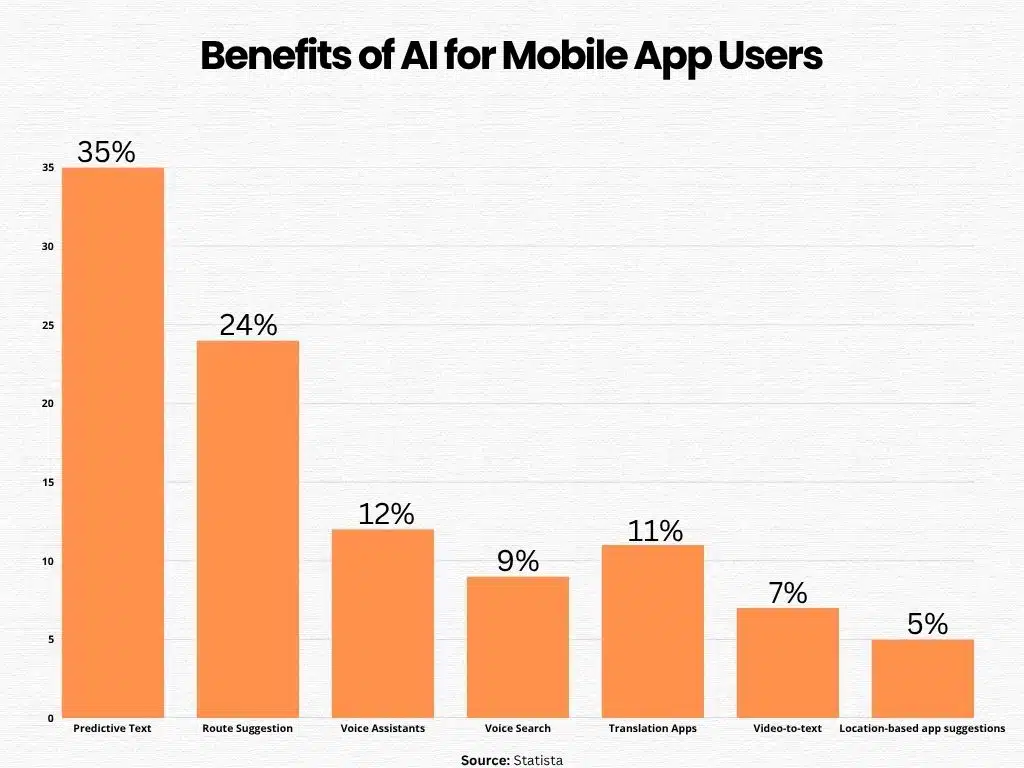
In fact, a report from Goldman Sachs has revealed that AI investment is expected to reach $200 billion by the end of 2025. These staggering figures are enough to prove the worth of AI tech stack in mobile app development in the long run. This increased demand highlights the importance of a well-structured AI tech stack in developing and deploying advanced AI systems.
Building a high-tech AI application requires an equally advanced AI tech stack, which includes different components. These components together make a modern tech stack, each contributes to seamless AI operations. So, let’s understand each of them in this section.
You know what the core of AI development is. It’s data! Therefore, it is essential to store, manage, and organize the data effectively to make sure it is readily available and efficiently processed. Here’s how to store and organize data effectively:
The information you gather is often raw and not easy to use directly. That’s why data preprocessing and feature recognition are essential steps to prepare data for machine learning. These steps improve the quality of the data and make sure that the models get clean and useful information.
Here are some tools that make this process easier:

Machine learning algorithms are the core components of AI models, allowing them to learn patterns and make predictions from data. These algorithms are essential for making AI work, and here are some of the most important ones:
Deep learning is a key part of AI development because it can create complex models and handle huge amounts of data. Like other areas of AI, deep learning relies on various tools, and here are some you might find useful:
Natural Language Processing (NLP) is a widely used area of AI development. It focuses on enabling AI to read, understand, and generate text. This is why technologies like chatbots, sentiment analysis, and language translation rely heavily on NLP. Here are some popular tools used in NLP:
Computer vision helps machines understand information from the world. However, instead of text, it focuses on visual data, making it ideal for tasks like object detection, video analysis, and image recognition. Here are some key tools and techniques used in computer vision:
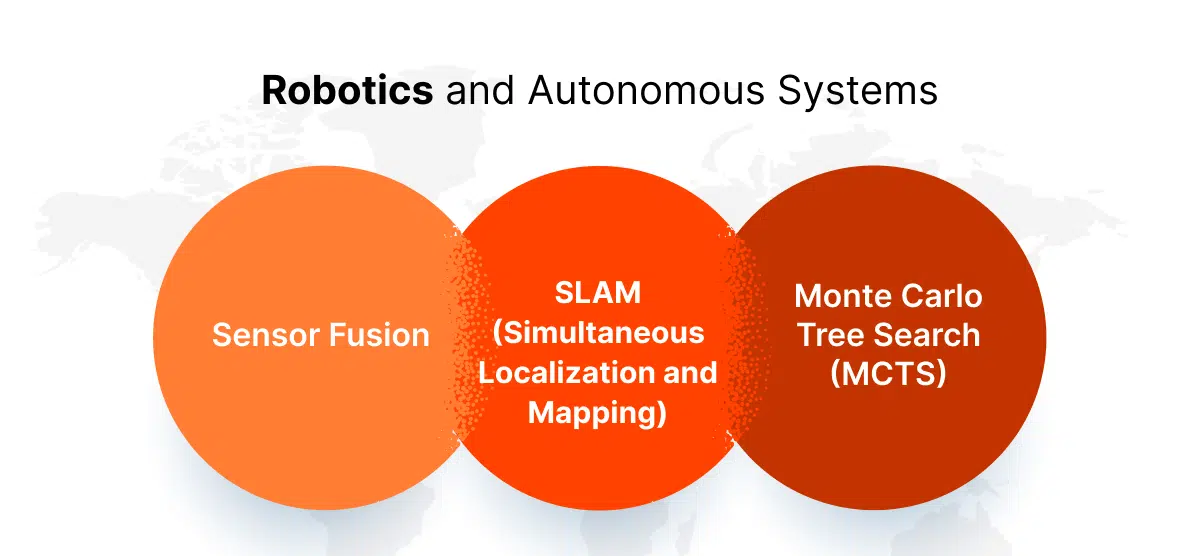
Robotics and autonomous systems combine AI with physical machines, allowing them to perform tasks on their own and interact with their surroundings. Here are some key technologies that make this possible:
Cloud and scalable infrastructure deliver the computing power and storage needed to run large-scale AI applications, ensuring flexibility and efficiency. Here are some of the top platforms that make this possible:
Data manipulation tools are essential for processing and analyzing large datasets, which are critical for training strong AI models. These technologies make it easier to handle, transform, and analyze data, helping to build high-performing AI systems. Here are two key tools used in this area:
AI tech stack consists of multiple layers, each of which helps AI systems work effectively and efficiently. Here are the three main layers of the AI Tech Stack:
The application layer is the top layer of the AI tech stack, where users interact with AI-powered applications. This layer includes tools, frameworks, and interfaces that help developers integrate AI models into user-facing apps smoothly.
Its main goal is to deliver a seamless user experience by leveraging the power of the underlying AI models. Here are the key components of this layer:
What makes this layer so important? First, it ensures user accessibility, making AI features easy to use for everyone. Second, it supports scalability, allowing the application to grow as demand increases. Finally, it’s customizable, giving developers the flexibility to adapt AI functionalities to meet changing needs and business goals.
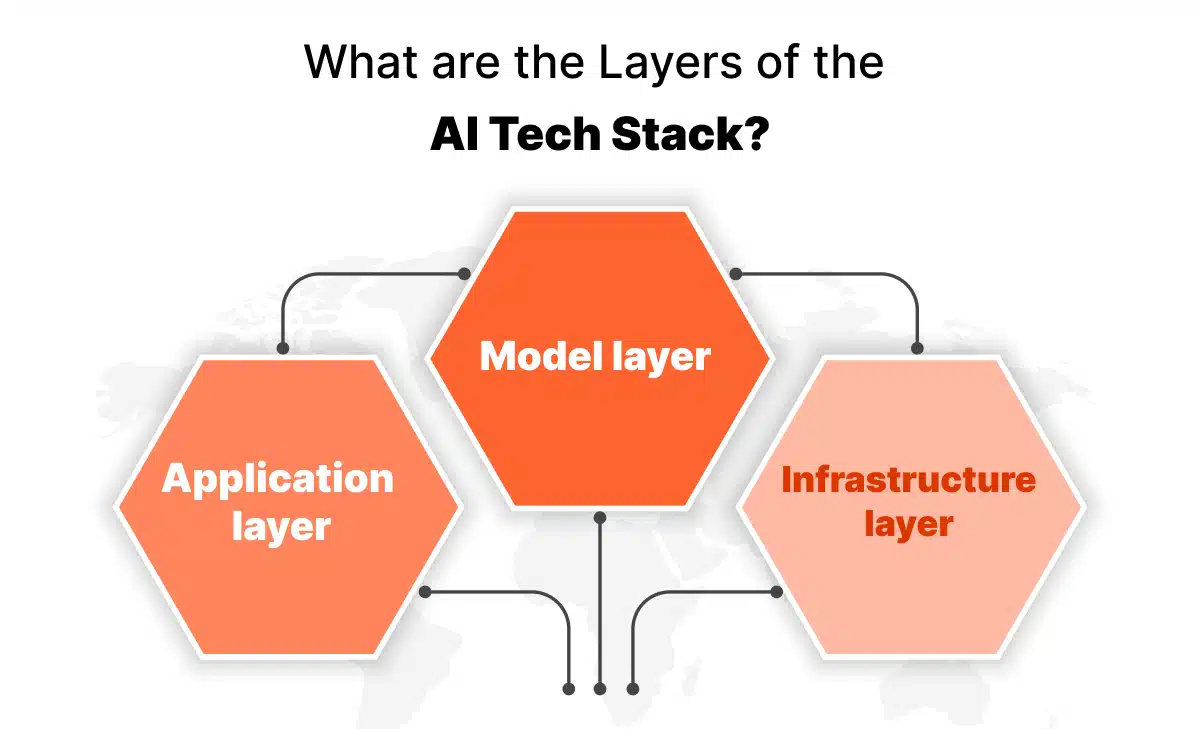
The model layer is the middle layer of the AI tech stack, where AI models are built, trained, and fine-tuned. This layer includes frameworks, libraries, and tools that data scientists and engineers use to create powerful and accurate AI models. Here are its key components:
The model layer is just as important as the other layers in the AI stack. It focuses on creating models that perform well and deliver accurate results for various tasks. It also supports an iterative process, allowing developers to experiment with different algorithms, hyperparameters, and architectures to improve outcomes.
Additionally, the model layer ensures that models can be reproduced and validated by maintaining consistent development and training processes.
The infrastructure layer is the last layer of the AI tech stack, providing the essential resources, storage, and tools needed to support AI operations. This layer ensures that AI models can be trained, deployed, and maintained efficiently and at scale. Here’s what it typically includes:
The infrastructure layer is crucial because it allows AI operations to scale based on demand, making resource use more efficient. It also ensures that AI models and applications are reliable and available to users 24/7, no matter the workload or challenges.
Additionally, this layer focuses on security, protecting data and models from unauthorized access and ensuring compliance with industry standards and regulations.
Different goals and tasks need different kinds of AI setups. Let’s look at the main types of AI systems and what makes each one special.
Generative AI systems are designed to create new content, like text, images, or music. They are key for innovation in creative fields, automation, and content creation.
A major part of these systems is Transformer Models, such as GPT (Generative Pre-trained Transformer) and BERT (Bidirectional Encoder Representations from Transformers). These models are great at understanding and producing content that feels human-like. They’ve pushed forward areas like natural language processing and creative tasks.
Additionally, Generative AI relies on large, high-quality datasets. Well-organized and labeled data helps train advanced models effectively. For instance, OpenAI’s GPT-3 was trained on a huge, diverse dataset, which is why it can handle so many different tasks.
At the same time, development tools like Hugging Face Transformers and OpenAI API offer ready-to-use models and tools, making it easier for developers to customize or add generative features to their projects. These tools make it simpler to get started and speed up the testing of new ideas.
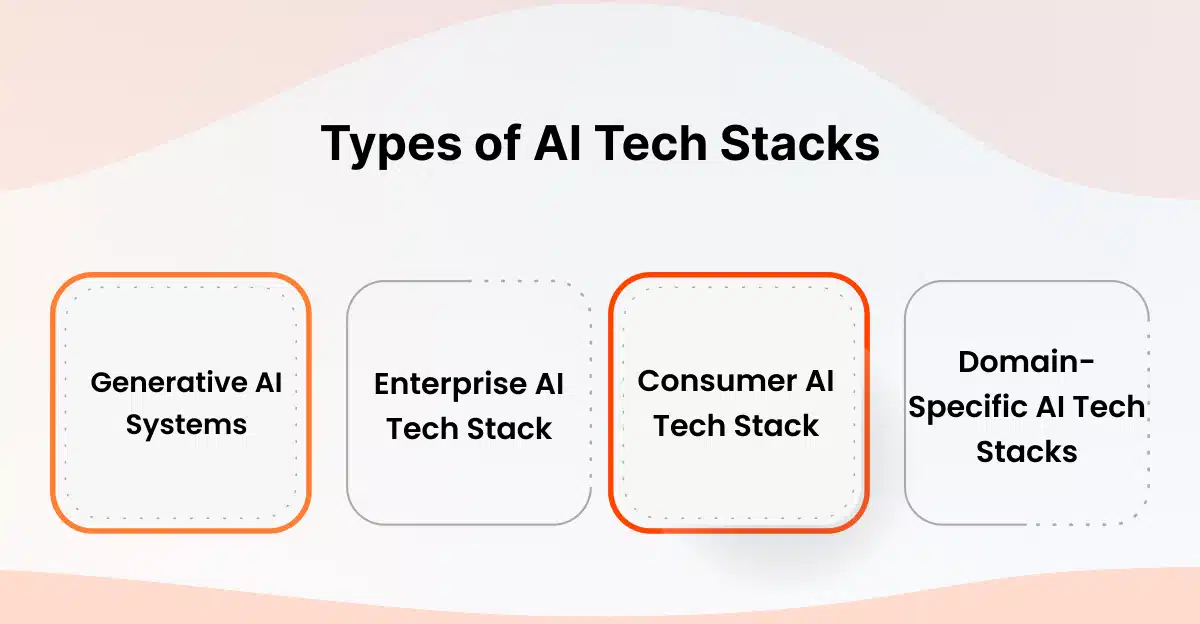
Enterprise AI systems are built to fit the specific needs of big companies. These systems focus on being scalable, customizable, and able to work smoothly with existing tools. Here’s what makes them stand out:
This kind of AI setup is ideal for industries like finance, manufacturing, and telecommunications, where large-scale, tailored solutions are crucial.
Consumer AI systems are all about creating easy-to-use and powerful AI experiences for everyday users. These systems focus on being user-friendly, fast, and reliable, making them perfect for apps that people interact with directly.
A big part of consumer AI is Applications like chatbots, virtual assistants, and recommendation systems. These tools make interactions smoother and more engaging in areas like online shopping or entertainment. For example, virtual assistants like Siri or Alexa and recommendation systems on platforms like Netflix or Amazon show how consumer AI fits naturally into our daily routines.
These models are built to be fast and efficient, unlike heavier systems used in businesses. They need to work in real-time with almost no delay, ensuring a smooth and responsive experience for users. This makes optimizing and compressing models a top priority in consumer AI.
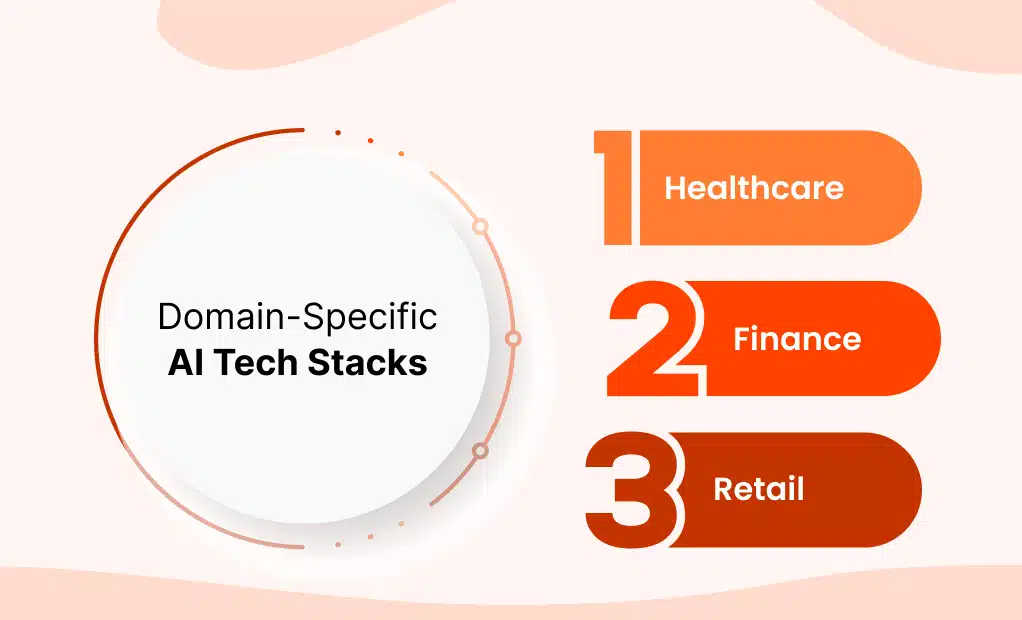
Certain industries need highly customized AI systems to tackle their specific challenges. Here are a few examples:
Artificial Intelligence has started revolutionizing numerous industries and domains, allowing businesses to deliver personalized user experiences, real-time data analytics, and advanced AI app development solutions. As cloud and edge computing advance, the modern AI stack will become the need of the hour.
So, this guide helped you understand the basics of AI tech stack and its importance for developing intelligent applications. Although choosing the best tech stack is essential, so is partnering with the best AI development company to get the most out of this emerging technology.
A tech stack refers to a combination of technologies used to build and run an application. For instance, the MERN stack includes MongoDB (database), Express.js (backend framework), React (frontend library), and Node.js (runtime environment). Each layer of the stack works together to create a functional and scalable application.
AI stacking, or ensemble learning, involves combining multiple AI models to improve performance. By leveraging the strengths of different algorithms, stacking reduces errors and enhances accuracy. For example, combining decision trees, neural networks, and support vector machines can create a more robust predictive model than using any single algorithm alone.
The cost of AI tech varies widely based on complexity, tools, and scale. Basic AI solutions may cost a few thousand dollars, while advanced systems can run into millions. Factors like data processing, cloud services, and development expertise significantly influence the overall expense.


AI
Who doesn’t want an E-commerce store that not only breaks sales records but also boasts an engaged and satisfied client base? Think of having a brand value that’s significantly enhanced and a return on investment that’s higher than ever. Sounds like a dream, doesn’t it? The use of Augmented reality (AR) in e-commerce can help […]
AI
Wix is undoubtedly one of the best website builders out here today. Although this no-code website builder is greatly appreciated for its ease of use and drag-and-drop editor, some flaws in the platform still insist people to search for the best Wix alternatives. So, if you’re using or about to choose Wix for your next […]

AI
With the increasing prevalence of artificial intelligence (AI) across different industries, the technology evolution is at its peak. The popularity of large language models (LLMs) seems to be stabilizing, and new concepts and ideas are set to replace them with state-of-the-art technologies like large action models (LAMs). What actually are Large action models? Are they […]
Successful Projects
Years in Business
Happy Customers
We have been working with Mtoag Technologies for the past 5 years. They have been a very responsible team from the beginning. They are quick at responding, available whenever we need, and are extremely supportive when there’s a high-priority fix. All-inclusive, IAD can be your best bet for app development.