Table of Contents
Who doesn’t want an E-commerce store that not only breaks sales records but also boasts an engaged and satisfied client base? Think of having a brand value that’s significantly enhanced and a return on investment that’s higher than ever. Sounds like a dream, doesn’t it? The use of Augmented reality (AR) in e-commerce can help a lot in turning this dream into a reality.
The e-commerce industry is undergoing a transformative change, offering extraordinary shopping experiences. AR in retail allows customers to interact with products more interactively. This includes the ability to customize products to meet individual needs, enabling customers to make the most informed purchasing decisions.
However, like any new technology, implementing AR in e-commerce might present some challenges. To address these concerns, we have created a guide that explains AR and how your e-commerce business or retail store can effectively use it. This guide also outlines the benefits your business can reap from this technology. So, let’s get started!
The Current State of Augmented Reality for E-Commerce
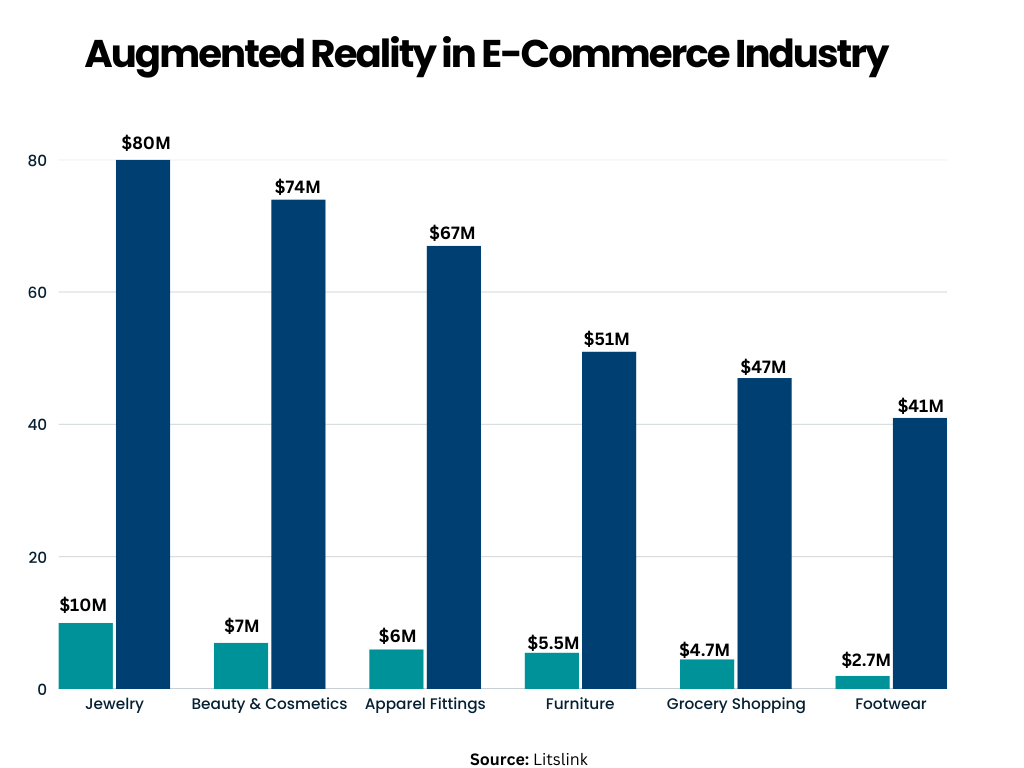
- AR is anticipated to become a regular part of the shopping experience for over 85 million people in the U.S. by 2026. (Source: Payments Association)
- Moreover, AR’s contribution to advertising revenue is projected to hit a remarkable US$8 billion (£6.6 billion) by that year, with 67% of advertising firms incorporating AR to promote goods and services. (Source: Payments Association)
- The AR industry will likely reach a valuation of $50 billion in 2026. (Source: Payments Association)
- Additionally, a significant 61% of consumers express a preference for retailers that provide AR experiences. (Source: Payments Association)
- Shopify reports indicate that stores implementing 3D and AR technologies witness an increase in conversion rates by an impressive 94%. (Source: Payments Association)
What is AR in E-commerce?
Augmented reality (AR) in e-commerce is a new digital concept that is becoming popular these days. It offers a virtual try-on experience, enabling consumers to test and visualize products using devices like smartphones or VR headsets.
AR bridges the gap between digital and physical retail by simulating in-store product interactions or projecting how items would appear in a customer’s home or worn on their person.
This technology is a boon for marketers, as it encourages shoppers to experiment with products, such as trying on apparel or visualizing how new furniture would fit and look alongside their existing decor, before making a purchase.
The Benefits of Using AR in eCommerce
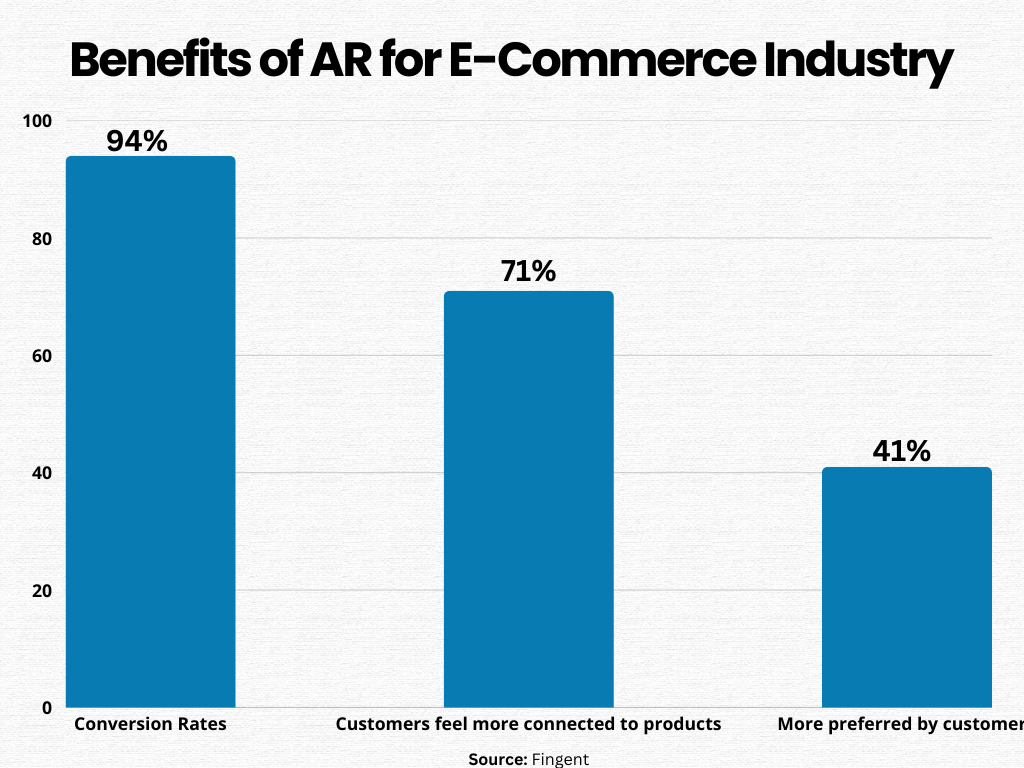
Shopify’s augmented reality (AR) features offer several advantages that can significantly enhance the online shopping experience:
Enhanced Visualization and Personalization
AR technology allows consumers to virtually place products in their own space, giving them a realistic sense of size and design compatibility. It also enriches the experience for wearable items, as customers can virtually try on accessories like shoes, watches, and eyewear or test makeup in real-time, blending the digital with the physical. AR enables product personalization, offering a wider range of options than in-store.
Boosted Conversion Rates
Engaging product interactions through AR has proven to increase conversion rates substantially. Shopify has observed up to a 250% rise in conversions when products are displayed with 3D and AR features.
Decreased Product Returns
With the ability to preview products in their actual environment or on themselves, customers make more informed purchases, leading to greater satisfaction and fewer returns. Data indicates a 40% decrease in returns for merchants who implement 3D and AR visualization techniques.
Enhanced Shopping Experience
Augmented reality (AR) is not just a fleeting trend but a game-changer in e-commerce. Retailers who are quick to adopt AR can set themselves apart, offering customers a unique and immersive shopping experience. AR should be seen as an essential tool for enhancing customer satisfaction and not just a marketing gimmick.
User-generated Content
AR’s role in generating user content is invaluable. As shoppers use AR to visualize products in their own environment, they often share these experiences online. This helps them make purchasing decisions and creates authentic content that can enhance credibility, encourage community interaction, and strengthen consumer trust in the brand.
6 AR Trends eCommerce to Look Out for in 2026
This section highlights six emerging trends in AR shopping for 2026, with a focus on the most prevalent use of AR tech.
1. Social Media Integration
The post-pandemic era has seen a surge in online activity, prompting brands to innovate with AR through social and e-commerce platforms. Deloitte predicts that AR will become commonplace for 75% of the global populace, primarily through social media apps.
Social media giants like Snapchat and Instagram have enabled brands to create AR filters, such as Christian Dior’s campaign, which generated over 1.3 million impressions.
2. Virtual Try-on
AR’s role in product showcasing is expanding, especially for virtual fittings, which have gained traction from 2017 to 2022.
This feature is especially relevant in the fashion and beauty sectors, with a significant portion of consumers across age groups showing interest in AR for trying on products. Sephora’s collaboration with Merve, featuring a lipstick try-on filter, exemplifies this application.
3. Virtual showroom
Augmented reality (AR) is evolving, offering two distinct experiences: virtual try-ons and virtual showrooms. The latter allows customers to visualize products in their own space, like a living room, by simply switching their camera’s perspective.
This similarity in technology is advantageous for businesses, as it means a broader application across various industries. Our research indicates that integrating 3D content can significantly boost conversion rates by 94%.
The mobile AR market is expected to grow from $12.45 billion in 2021 to $36.26 billion in 2026. Beyond phones, tech giants are investing in AR-enabled smart glasses, with several announcements made at this year’s CES, signaling a broadening horizon for AR applications.
4. Advancements in AR Devices
Mobile technology is continuously advancing, with improvements like enhanced depth-sensing hardware, including LiDAR and ToF sensors, showing no signs of abating. Consequently, new smartphone models are increasingly adept at supporting AR functionalities.
Forecasts for the mobile AR market indicate a substantial growth trajectory, with revenues expected to soar from $12.45 billion in 2021 to $36.26 billion by 2026.
The focus on AR extends beyond the smartphone industry. With the advent of more sophisticated technology, major tech corporations like Google, Microsoft, Lenovo, and Vuzix are diving into the development of smart glasses, with several exciting announcements made at this year’s CES highlighting the expanding landscape of AR technology.
5. AR-Enhanced Mirrors for Retail
A trend gaining momentum in retail is the deployment of AR-enhanced mirrors. These mirrors either utilize a digital screen with motion sensors to project augmented images or forego traditional mirrors for large digital displays that function like oversized smartphones.
China is at the forefront of this innovation, but interest is growing in the U.S. as well. Snapchat’s studies indicate that 21% of consumers would make an effort to visit stores equipped with these mirrors, especially for trying on apparel, with a slight decrease in interest in testing makeup or hair color.
6. Gamification of Shopping with AR
Another trend is the gamification of the shopping experience through AR, primarily for entertainment. If brands leverage AR to make shopping more interactive and fun, they could see increased customer engagement.
Snapchat’s data shows that 22% of users would be intrigued by a more playful shopping experience. Brands like Tesco in the UK have successfully used AR to gamify shopping, resulting in stronger brand connections, loyalty, and extended interaction with products.
How to Implement Augmented Reality Into Shopify Store?
If you’re considering integrating Augmented Reality (AR) into your e-commerce business operations, here are some steps to guide you:
Step 1. Define Your Business Goals
Start by identifying what you aim to accomplish and how it benefits your customers. Don’t just stop at the first question; answering the second can elevate your AR application from being merely good to truly exceptional. It’s crucial to comprehend the customer experience you wish to deliver.
Establish your vision and objectives before delving into the technicalities of your AR application. Knowing your destination makes it easier to select the methods and technologies required to reach it.
Step 2. Select the Augmented Reality Tools You Need
Once you have a clear idea of what you want to build, you can begin to pinpoint the tools necessary for the task. Consider the following factors:
- License Type: If budget constraints exist, consider an AR platform that offers a free license. Many AR solutions offer both free and commercial licenses, but remember, the free version may not have all the features of the full software.
- Supported Devices: Ensure the tool you choose is compatible with the hardware (mobile devices, laptops, or AR glasses) you plan to run your AR app on.
- Supported Operating Systems: If your app is intended for multiple operating systems, ensure your chosen platform supports all of them.
- Capabilities: Thoroughly assess each platform to determine if it possesses the specific features you require. For instance, if you’re planning to create a location-based AR app, you’ll need a platform that supports geo-location.
Step 3. Promote Your New Tool
After investing significant effort into developing your tool, it’s time to let the world know about it. Here are some strategies to spread the word:
- Create a Demo Video: Produce promotional and instructional videos for your app that illustrate its usage.
- Display In-App Instructions: Offer clear guidance so users understand how to maximize the benefits of your app.
- Enable Content Sharing: Allow users to share their AR experiences with friends and social media contacts. This can help increase the visibility and reach of your app.
Conclusion
While online shopping is the trendiest thing right now, some products can be challenging to sell online due to the difficulty in visualizing how they would appear in a physical setting as opposed to a digital display. This is where augmented reality (AR) can help users get an idea of how the product looks on them, especially with the increased need for social distancing.
Having understood the various forms of AR, its potential applications, and the advantages it offers, you are now in a position to assess if it’s a suitable solution for your eCommerce business. If it aligns with your needs, you can proceed to invest in the AR for e-Commerce.
FAQs
Does Shopify Support Augmented Reality?
Yes, Shopify supports augmented reality (AR). It offers tools like Shopify AR that integrate with e-commerce sites, allowing users to visualize products in their environment using mobile or desktop devices.
How to Implement Augmented Reality in an eCommerce Website?
To implement AR in e-commerce, start by clarifying business objectives and how AR can enhance customer experience. Identify the right AR tools, considering license types, device support, and capabilities. Finally, market your AR feature with demo videos and in-app instructions.
What is the Difference between AR and VR in e-commerce?
In e-commerce, AR overlays digital information onto the real world, enhancing the shopping experience without removing the user from their environment. VR, however, creates a fully immersive experience in a simulated environment, isolating the user from the real world.
What is the Future of Augmented Reality in e-commerce?
The future of AR in e-commerce is promising, with widespread adoption predicted for immersive product visualization and personalized shopping experiences.