With the increasing prevalence of artificial intelligence (AI) across different industries, the technology evolution is at its peak. The popularity of large language models (LLMs) seems to be stabilizing, and new concepts and ideas are set to replace them with state-of-the-art technologies like large action models (LAMs). What actually are Large action models? Are they LLM successors or a brand new technology looking to overtake the AI market? Let’s find out everything in this guide to understanding LAMs.
Table of Contents
Large action models are creating a buzz in the tech world, with many experts claiming it to be the future of technology. Although it might look like next-level disruption – yet, the information about them is too little, leaving everyone making assumptions and anticipations.
Since AI has advanced so rapidly and has become a mainstream technology, it sets the stage for many more advancements on the way, and LAM seems to be the one in this development. So, to help you understand the nitty and gritty of this technology, we have created this detailed guide to LAMs, leveraging our insights and industry experience.

What are Large Action Models (LAMs)?
Large Action Models are advanced generative AI models that understand complex queries and respond by translating human intentions into action. The technology is more platform-agnostic, action-oriented, and general-purpose. LAMs are trained on large language models (LLMs), one of the foundational aspects of modern GenAI.
Advanced LLMs like OpenAI’s GPT-4o use AI algorithms, natural language processing (NLPs), and machine learning (ML) to power ChatGPT. However, they are limited to generating content only, but LAMs pass this limitation and give models the ability to act.
LAMs are built to execute specific actions based on the user’s prompt. They understand and analyze multiple data sets and human intentions to perform a number of tasks. LAMs are an advancement from language-based models to more interactive action-based systems.
How Do Large Action Models Work?
A large action model (LAM) agent is built using several components that work together. It functions a lot like a large language model (LLM) agent, but often needs the ability to handle different types of data (like text and images) and access to external tools.
To make complex decisions, LAMs learn from huge datasets that include information about user actions. This data helps them plan strategies and take proactive steps in real-time.
Here’s a basic breakdown of how a LAM agent works:
- Foundation Layer: LAMs usually start with an LLM integration as their base. This LLM can be customized with specific data to suit the LAM’s purpose. The foundation layer helps the LAM understand natural language and determine what the user wants.
- Multimodal Input Processing: LAMs can handle different types of inputs, such as text, images, and even user interactions. They leverage advanced natural language processing (NLP) to analyze text, pulling out important details and understanding the user’s intent.
- Goal Inference: The LAM analyzes the user’s request and considers past actions and the current situation. It uses this information to figure out the user’s real goal, which might be deeper than what the user actually said.
- User Interface Interpretation: LAMs use computer vision to understand what’s on the screen. They can recognize things like buttons, menus, and text boxes, and know how these elements work in an app.
- Task Decomposition and Action Planning: Once the LAM understands the goal, it breaks it into smaller steps. It then makes a plan, deciding the best order to do things based on what’s efficient, what the user likes, and what it has learned before.
- Decision-Making and Reasoning: LAMs use advanced algorithms that mix neural networks and logical thinking. They combine pattern recognition with reasoning to choose the best action.
- Action Execution: LAMs work with external systems, using tools like web automation to click, type, or move between pages. They can also make API calls or interact with other software directly.
- Continuous Learning and Human Oversight: LAMs keep improving by using techniques like deep learning and reinforcement learning. They also allow humans to step in and help when things get too complicated.
What are LAMs Used For?
A large action model (LAM) has capabilities to handle a broad range of tasks, including –
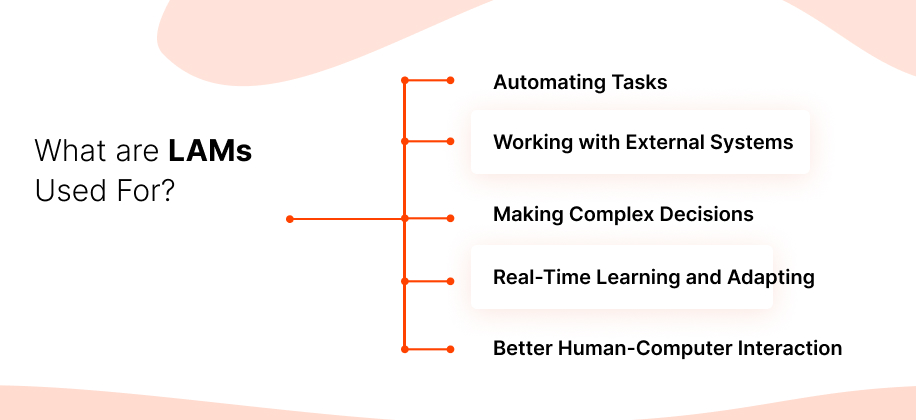
- Automating Tasks: LAMs are smart AI agents that can do complicated tasks on their own. They can use apps, fill out forms, and interact with software just like a person would.
- Working with External Systems: LAMs can connect with other systems and apps. They can browse websites, make API calls, and handle data across different platforms.
- Making Complex Decisions: LAMs are advanced enough that they can think and make choices. They look at different options, weigh the results, and pick the best action to take.
- Real-Time Learning and Adapting: LAMs adjust to their surroundings and learn from how users interact with them. This helps them get better over time.
- Better Human-Computer Interaction: LAMs make it easier for people to work with computers by understanding and doing tasks based on human instructions.
Want to Mobile App Development for your Project ?
LAM Use Cases and Applications Across Different Industries
Despite LAMs being in their early stage, the technology has already found a number of use cases across different industries, which mainly include
AI Assistants
LAMs power advanced AI assistants that go beyond understanding requests. They can also take actions to fulfill tasks, like booking appointments, sending emails, or managing schedules, making them more helpful and efficient for users.
Customer Service
LAMs handle customer inquiries by answering questions, scheduling appointments, and processing returns or refunds. They can manage multiple requests at once, providing quick and accurate support to improve customer satisfaction.
Marketing and Sales
LAMs analyze customer data to create personalized marketing campaigns. They recommend products or services based on user preferences, helping businesses target the right audience and increase sales effectively.
Chatbots
LAMs run advanced chatbots that don’t just chat but also perform actions. For example, they can place orders, update accounts, or provide solutions based on user requests, making interactions more productive.
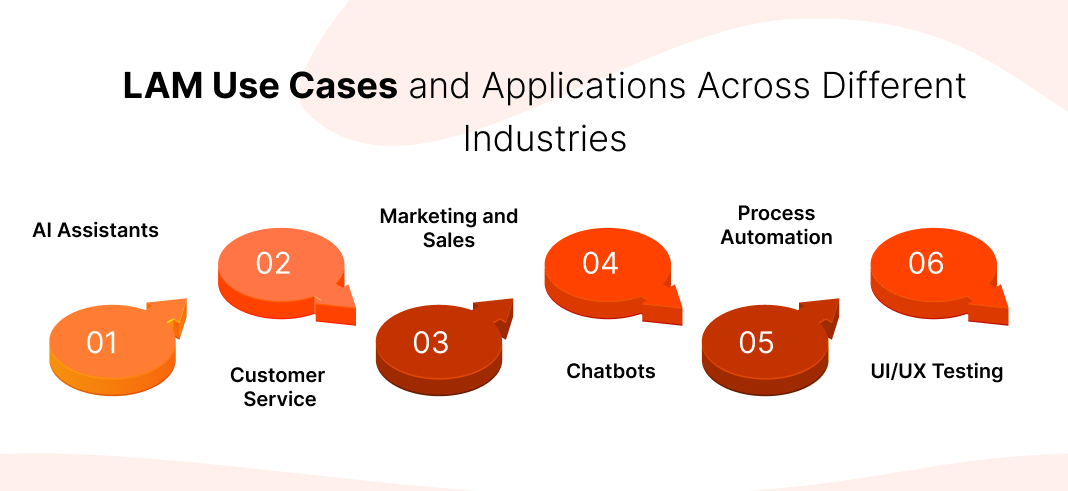
Process Automation
LAMs simplify complex workflows by automating tasks across different apps. They can move data, fill forms, or trigger actions in multiple systems, saving time and reducing errors in repetitive processes.
UI/UX Testing
Because LAMs understand and interact with apps, they can help test user interfaces. They check if designs are easy to use and accessible, ensuring a better experience for all users.
Top 3 Large Action Model Examples
If you still think LAMs are a thing of the future, you probably need to think again. The technology is being adopted rapidly by tech giants, and it is evident through the following real-world examples of large action models:
xLAM by Salesforce
Salesforce’s xLAM family is known for its performance and innovation. It ranks #2 on the Berkeley Leaderboards for Function Calling V1. xLAM shows how good training can unlock the power of API-based tasks.
Its APIGen pipeline uses over 3,673 APIs across 21 categories, all tested for accuracy. The family includes models for different needs: Tiny (xLAM-1B) for small devices, Small (xLAM-7B) for research, Medium (xLAM-8x7B) for industry, and Large (xLAM-8x22B) for advanced tasks. This makes xLAM useful for both simple and complex applications.
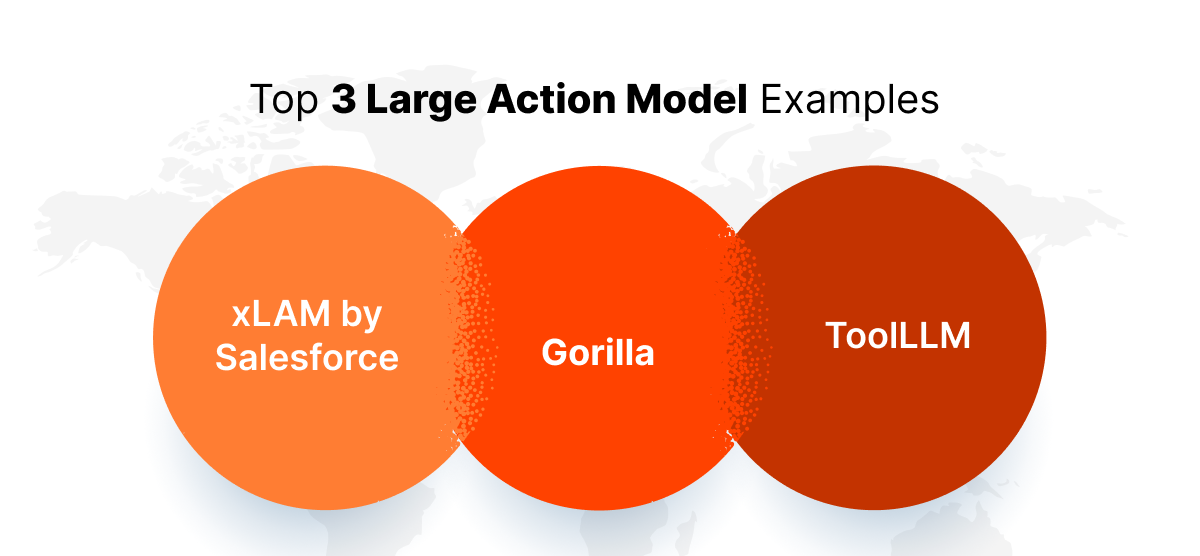
Gorilla
Gorilla stands out by focusing on smooth API integration. It can connect with over 16,000 APIs, letting it handle real-world tasks like accessing databases or running complex workflows. Its open-source framework is available on GitHub and Hugging Face, making it easy for developers to use and test.
Gorilla works well in API-heavy environments because it can understand and use APIs effectively. Its strong performance in tests makes it a top choice for automation and smart systems where APIs are crucial.
ToolLLM
ToolLLM expands what LAMs can do by mastering over 16,000 APIs to solve real-world tasks. Its key strength is deciding when and how to use APIs effectively, thanks to its MetaTool Benchmark. This makes it great for enterprise automation and smartphone tasks, where smart decisions matter.
ToolLLM is built to be strong and scalable, handling complex tasks without slowing down. Like Gorilla, it’s open-source, so developers can customize it for their needs. Its focus on smart task management makes ToolLLM a top choice for API-driven AI systems.
LAM vs LLM: Detailed Comparison
There are similarities between LAMs and LLMs. The comparison table below shows how LAMs are similar to the earlier models.
|
Aspect |
LLMs (Large Language Models) |
LAMs (Large Action Models) |
|
Core Functionality |
Focus on understanding, creating, and working with natural language text. Good at writing, translating, and summarizing. |
Go beyond text to perform actions. They can follow instructions and interact with systems to complete complex tasks. |
|
Data Types |
Work mainly with textual data and learn from large amounts of written content to understand language patterns and semantics. |
Handle text, images, and other data types. They can process and act on a wider range of information. |
|
Action & Interaction |
Produce text-based results but don’t interact with external systems or environments. |
Can take actions like navigating software, making API calls, or controlling robots. |
|
Feedback & Learning |
Don’t use feedback from actions. Instead, they focus only on language tasks without direct environmental interaction. |
Learn from feedback to improve their actions and get better at completing tasks over time. |
|
Applications |
Used in chatbots, virtual assistants, content creation, and language translation. |
They are used in tasks like automation, customer service, managing workflows, and controlling robots. |
Ready to bring your B2B portal or app idea to life?
What are the Challenges of LAMs?
Although LAMs have great potential, developing and using them comes with big challenges related to
Safety and Reliability
LAMs are made to act in the real world, so keeping them safe and reliable is very important. Researchers and developers must put strong protections in place to stop LAMs from doing harmful or unintended things, especially in important areas like healthcare or financial systems.
Explainability and Transparency
LAMs are complex, often using deep neural networks and advanced decision-making. This can make their actions hard to understand or explain. Making these models easier to understand is important, especially when responsibility is the top priority.
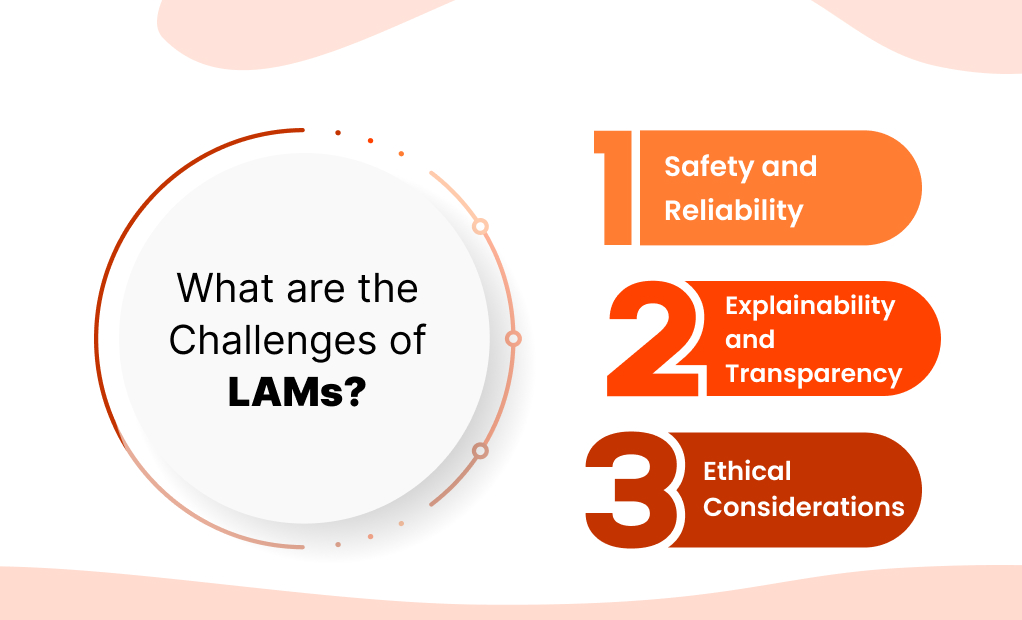
Ethical Considerations
Creating and using LAMs brings up important ethical questions. Issues include possible bias in decisions, job impacts due to automation, and the broader effects on human choice and decision-making. These need careful thought and ongoing discussion.
Is LAM Hype Real?
The first red flag about large action models (LAMs) is that when people talk about them online, they only focus on what these models could do for industries worldwide, not what they have actually done or are doing right now. There’s no clear data to track, no specific market for LAMs to watch, and no well-known examples of their use.
This lack of information might be because LAMs are still new and haven’t made a big impact yet. But even so, decision-makers need to be careful. They should look past the flashy promises and focus on what’s real.
For example, there are some wrong ideas about LAMs that leaders should be aware of:
Enterprise Adoption
The idea of LAMs was first introduced by Rabbit AI, a company that created a product—a device with a custom operating system. This system has a trainable AI assistant that uses LAMs to carry out user requests, like making reservations, giving directions, or ordering services. It also learns and adapts to the user’s specific needs.
The product is in the pre-order stage, so there aren’t many real-world examples or reviews to look at. Even so, this shows that the claim of LAMs being widely used across industries or replacing large language models (LLMs) isn’t entirely true.
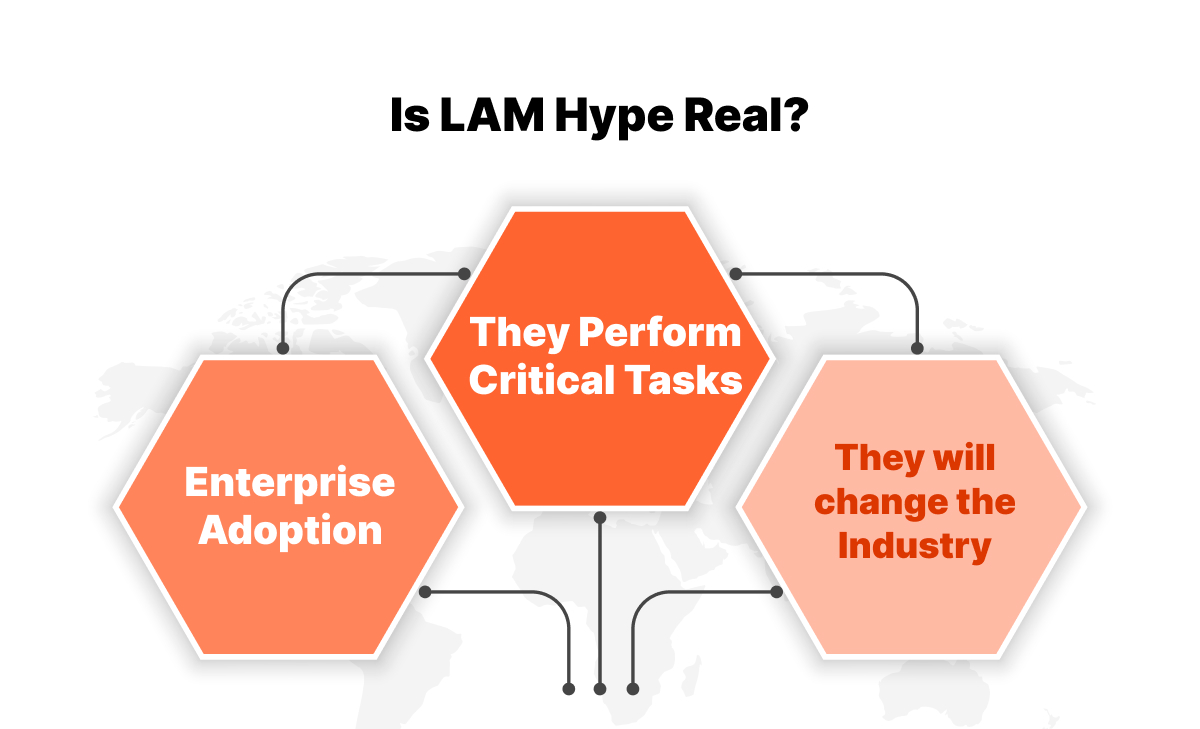
They Perform Critical Tasks
This idea needs a closer look. While LAMs might be able to handle complex and important tasks in theory, theory alone isn’t enough to convince stakeholders—and it shouldn’t be. Even the idea of LAMs doing simple tasks is still being studied. It’s important to focus on what’s real, not just what we hope or assume.
They will change the Industry
Since the first real-world use of a LAM is still waiting to happen—and it’s tied to a user-focused device—it’s too soon to talk about industry-wide benefits. The technology still needs to prove itself and show what it can actually do. We will see its true value and what makes it stand out only through testing and feedback. AI is already a powerful tool that’s changing the world, so it’s better to focus on what it can realistically do instead of unproven claims.
Conclusion
The future of large action models (LAMs) is still unclear, but if we go with the current trends, it looks promising. Right now, LAMs are a new idea, and their full potential hasn’t been tested in real-world situations. They are designed to handle tasks like making reservations, giving directions, or ordering services, but so far, these abilities are mostly theoretical.
In the future, LAMs could become a big part of our technology use. They might make everyday tasks easier by learning from users and adapting to their needs. However, the technology needs to be tested and improved for this to happen. Companies and developers must gather feedback, fix any issues, and show that LAMs can deliver on their promises.
While LAMs could change industries, it’s too early to say how big their impact will be. They might work alongside other AI tools, like large language models (LLMs), instead of replacing them. If LAMs prove their value, they could become a helpful tool for businesses, individuals, and AI development companies. But for now, we will have to wait and see how they develop.
If you need more information on AI models, you can read our interactive blogs on LLMs, SLMs, and similar technologies.
FAQs
What are LLM and LAM?
LLM stands for Large Language Model, which is a type of AI that understands and generates human-like text. It’s used for tasks like answering questions, writing content, or translating languages. LAM, or Large Action Model, is a newer concept. It’s designed to perform actions based on user requests, like booking a ticket or ordering food. While LLMs focus on language, LAMs focus on completing tasks. Both are AI tools, but serve different purposes.
What is a Large Action Model in Finance?
In finance, a Large Action Model (LAM) could be used to automate tasks like processing transactions, managing investments, or analyzing data. For example, it might help users pay bills, track expenses, or suggest budget plans. LAMs could make financial services faster and more efficient by handling repetitive tasks. However, this technology is still new, and its real-world use in finance is yet to be fully explored or proven.
What is LAM in Rabbit R1?
In Rabbit R1, LAM (Large Action Model) is the AI system that powers the device. It’s designed to learn from user commands and perform tasks like making reservations, ordering services, or giving directions. The Rabbit R1 device uses LAM to act as a personal assistant, adapting to user needs. However, the product is still in pre-order, so its real-world performance is not fully known yet.
What is a Small Action Model in AI?
A Small Action Model (SAM) in AI is a simpler version of a Large Action Model (LAM). While LAMs handle complex tasks, SAMs focus on smaller, specific actions. For example, a SAM might turn on lights or send a reminder. SAMs are less advanced than LAMs but are easier to build and use for basic tasks. They are often used in smart home devices or simple automation tools.
What is LAM Integration?
LAM integration means connecting a Large Action Model (LAM) with other systems or tools to make them work together. For example, a LAM could be integrated with a calendar app to schedule meetings or with a shopping app to place orders. This allows the LAM to perform tasks across different platforms, making it more useful. However, integration requires careful planning to ensure smooth and secure operation.
Why are LLMs So Expensive?
LLMs (Large Language Models) are expensive because they require a lot of resources to build and run. Training an LLM needs powerful computers, huge amounts of data, and a lot of time. Running an LLM also uses a lot of energy and computing power. Additionally, maintaining and updating these models adds to the cost. This makes LLMs a big investment for companies, which is why they are often expensive to use.
What is the Difference Between Agentic AI and LAM?
Agentic AI refers to AI systems that can act independently to achieve goals, like a robot navigating a room. LAM (Large Action Model) is a type of AI that performs specific tasks based on user requests, like booking a ticket. While both can take action, Agentic AI is more about independent decision-making, while LAM focuses on following user instructions to complete tasks. They serve different purposes in AI applications.